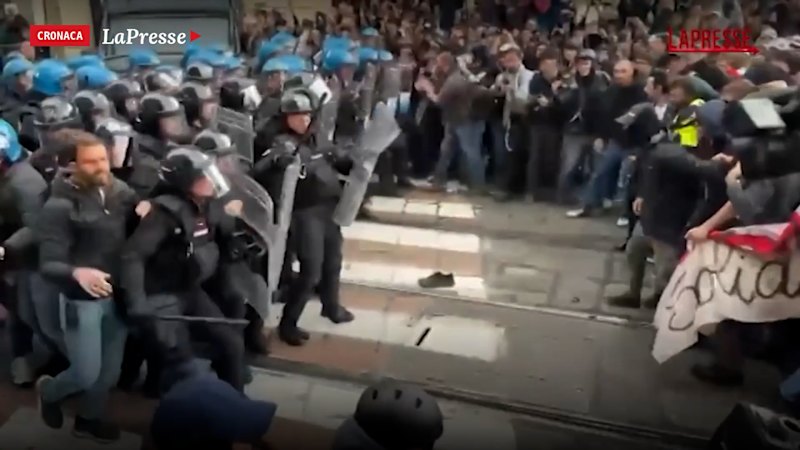
Every time riot shields bang against cobblestones in Turin, the legacy media rolls out the exact same script. You have read it a thousand times. A wire service pushes a headline about Italian police clashing with protesters in Turin, and within an hour, the commentary splits into two predictable, intellectually bankrupt camps.
Camp A screams about authoritarian state overreach and heavy-handed Reparto Mobile tactics. Camp B clutches its pearls over "violent anarchists," black-bloc agitators, and the breakdown of civic order.
Both camps are dead wrong. They are staring at the smoke bombs and missing the machinery.
Having spent the last decade analyzing European public order strategy and advising municipal risk teams on civil unrest, I can tell you what actually happens on the avenues of Piedmont's capital. The recurring street battles in Turin—whether centered around the No TAV high-speed rail line, anti-G7 mobilizations, labor strikes, or student occupations of the Palazzo Nuovo—are not a failure of crowd control. They are a feature of an entrenched political ecosystem where escalation serves the immediate strategic goals of both the state apparatus and the hardline protest organizers.
If you want to understand why Turin burns on a reliable seasonal schedule, stop looking at who threw the first stone. Start looking at who profits from the footage.
The Lazy Consensus of "Escalation"
Mainstream coverage treats a street clash like a weather event. Tensions rise, a spark hits, and suddenly tear gas fills Piazza Castello. This framing relies on a comforting lie: that both the Questura (the provincial police headquarters) and the protest leadership wanted a peaceful march, and things simply "got out of hand."
That is nonsense.
In modern public order policing—specifically under the European Union's GODIAC (Good Practice for Dialogue and Communication as Strategic Principles in Policing Political Manifestations) framework—police commanders are trained extensively in de-escalation, negotiated management, and dynamic risk assessment. Italian law enforcement is not uniquely incompetent. The Polizia di Stato and the Carabinieri possess some of the most experienced crowd-management units in Western Europe.
When a kettling maneuver happens in Turin, or when baton charges clear an intersection near Porta Nuova, it is rarely a panic response by terrified rookies. It is a calculated tactical choice.
Conversely, the Centri Sociali (self-managed social centers like Askatasuna, which has operated in Turin's Vanchiglia district for decades) are not disorganized mobs of angry kids. They are highly disciplined political organizations with institutional memory stretching back to the Anni di Piombo (Years of Lead) of the 1970s and the 2001 G8 summit in Genoa. They know exactly how to provoke a kinetic response from a police line without immediately losing their core formation.
They understand the choreography. And they dance it willingly.
Why Turin Is the Laboratory of Italian Street Conflict
To understand why this dynamic persists here more intensely than in Milan or Rome, you have to understand Turin’s specific socio-economic scar tissue.
Turin was the company town of the Italian industrial miracle. When FIAT—now Stellantis—hollowed out its manufacturing footprint in Mirafiori, it did not just take jobs; it dismantled the traditional union-mediated release valves for working-class anger. Into that vacuum stepped two forces:
- Autonomist and antagonista networks that rejected traditional party politics and parliamentary compromise.
- A post-industrial state apparatus desperate to project stability to foreign investors and European Union technocrats.
I have sat in briefings with European security consultants where Turin is used as a textbook case study for "ritualized confrontation." Unlike spontaneous riots driven by sudden economic shocks or police shootings—such as the 2023 Nahel Merzouk riots in France—Turin’s clashes are frequently scheduled, publicized weeks in advance, and routed through predictable chokepoints.
The Mechanics of the Street Theater
Let us strip away the romance and look at the cold operational reality of how a Turin clash unfolds.
- The Route Negotiation: Under Italian law (Testo Unico delle Leggi di Pubblica Sicurezza - TULPS), organizers must notify the Questore at least three days before a public assembly. In Turin, the "unauthorized" deviations from the agreed route are the entire point. The march approaches a symbolic target—the prefecture, a bank headquarters, or a ministry building—where a static police cordon is waiting.
- The Buffer Zone: The Reparto Mobile deploys in layered formations. Frontline officers wear heavy protective gear, backed by water cannons (idranti) and tear gas launchers. Behind the protest banner, a vanguard wearing helmets, gas masks, and padded jackets steps forward.
- The Kinetic Exchange: Firecrackers (bombe carta), paint bombs, and rocks hit the shields. Police respond with tear gas (CS gas) and targeted baton charges to push the line back fifty meters.
- The Media Harvest: Cameras capture dramatic, high-contrast images of flames reflecting off riot visors.
Notice what does not happen. Nobody takes over the prefecture. Nobody overthrows the government. Nobody makes mass arrests that completely dismantle the organizing networks. Within four hours, municipal street sweepers are washing the tear gas residue off the asphalt, and cafes two blocks away are serving aperitivos.
The Perverse Incentives Driving Both Sides
Why does this loop repeat? Because every major institutional player gets what they need out of the spectacle.
1. What the State and Political Establishment Get
For the Italian government—regardless of whether a center-left or hard-right coalition sits in Palazzo Chigi—images of police holding the line against masked militants are political gold.
- Distraction from structural decay: When youth unemployment stagnates and industrial output drops, a law-and-order crisis shifts the national conversation from economic failure to public safety.
- Legislative justification: Every clash in Turin becomes the primary exhibit used to pass tougher security decrees (Decreti Sicurezza), expanding police powers, increasing penalties for road blockades, and criminalizing passive resistance.
- Deterrence signaling: By allowing a controlled clash to play out against hardened radicals, the state raises the perceived physical cost of protesting for ordinary citizens, keeping moderate unions and middle-class taxpayers off the streets.
2. What the Hardline Antagonista Groups Get
For Turin’s radical left and autonomist movements, a peaceful, unopposed march is a strategic failure.
- Relevance and recruitment: A permitted walk down Via Roma generates zero media coverage. A clash with riot police puts their demands—whether anti-militarism, housing rights, or opposition to the Turin-Lyon high-speed railway—on the front page of La Stampa and Corriere della Sera.
- Internal cohesion: Shared physical risk binds a movement together. Surviving a tear gas volley creates a warrior ethos that keeps young recruits committed to the organization far more effectively than reading political theory.
- Moral leverage: The moment police deploy batons against a crowd that includes students or pensioners alongside the black bloc, organizers pivot instantly to the narrative of state repression, winning sympathy from moderate progressives who otherwise disagree with their methods.
3. What the Legacy Media Gets
Newsrooms are starving for engagement. Nuanced reporting on European infrastructure policy or municipal housing budgets does not drive clicks. High-definition video of shields clashing and dumpsters burning triggers immediate outrage on social media, guaranteeing ad impressions for twenty-four hours before the news cycle moves on.
Dismantling the Wrong Questions
When readers search for news about clashes in Turin, they are usually fed shallow answers to flawed questions. Let us tear those apart.
"Why don't Italian police just arrest the violent agitators beforehand?"
This question reveals a fundamental misunderstanding of democratic policing and intelligence operations. Italian anti-terrorism and public order intelligence—specifically DIGOS (Divisione Investigazioni Generali e Operazioni Speciali)—tracks key organizers closely. They usually know exactly who is in the vanguard.
However, preventive detention on a mass scale without an overt criminal act violates constitutional protections under Article 13 and Article 17 of the Italian Constitution, which guarantee personal liberty and the right of peaceful assembly. Furthermore, executing targeted snatch-squad arrests inside a dense, hostile crowd of three thousand people is tactically suicidal. Pulling a snatch squad out of a tight formation exposes officers' flanks, leads to severe injuries on both sides, and turns a localized skirmish into an uncontrollable brawl. Police hold the line because holding the line is safer than diving into the crowd.
"Are the protesters just mindless thugs who want to destroy property?"
Calling Turin’s street militants "mindless" is the fastest way to lose an argument against them. Look at the No TAV movement in the Susa Valley just outside Turin. For over thirty years, that movement has combined direct action and clashes at construction sites with deeply researched environmental engineering critiques, legal challenges, and broad local municipal support.
When militants smash a bank window or attack a police van in Turin, the target selection is rarely random. They target symbols of finance capital, state infrastructure, or security firms tied to defense contracts. You can condemn the violence completely—and from a strategic standpoint, it is often counterproductive—without pretending it lacks ideological discipline. Underestimating your adversary's coherence is amateur hour.
"Would softer policing stop the violence in Turin?"
This is the progressive fantasy, and it fails the stress test of real-world deployment.
Imagine a scenario where the Turin Questura orders the Reparto Mobile to stand down entirely during a major antagonista mobilization, removing all physical barriers around government buildings and strategic transit hubs. What happens?
In a political culture where symbolic occupation is the ultimate trophy, removing the barrier does not pacify the vanguard; it invites them to escalate until they find the next red line. If they walk unopposed into the prefecture, the state collapses its own authority. If they smash high-end retail districts unopposed, the municipal government faces immediate political annihilation from business owners and voters. Soft policing works brilliantly when dealing with single-issue, reform-minded crowds (like climate marches or labor rallies). It fails catastrophically when dealing with ideological factions whose explicit goal is to delegitimize the state monopoly on violence.
The Uncomfortable Downside of My Own Argument
Intellectual honesty requires admitting where a contrarian framework breaks down. Viewing Turin’s clashes purely as a cynical, mutually beneficial theater between the state and radical networks carries a dangerous blind spot: friction and human error.
Even the most tightly choreographed confrontation operates on a razor's edge. Clausewitz called it the "fog of war," and it applies to a piazza just as much as a battlefield.
- Individual trauma is real: A nineteen-year-old student taking a truncheon to the collarbone or a twenty-four-year-old officer from Calabria taking a cobblestone to the visor is not experiencing a "metaphor." They are experiencing permanent physical and psychological damage.
- The Genoa 2001 shadow: Every commander in Italy knows that a single breakdown in command-and-control—like the catastrophic failure at the Diaz School in Genoa—can permanently stain an institution and ruin lives.
- Escalation spirals: A strategy built on controlled friction assumes both sides remain rational actors. When an external shock hits—a severe economic recession, a geopolitical crisis, or an accidental fatality during a clash—the ritualized boundaries vanish instantly, and the city burns for real.
Systemic incentives explain why the match is struck, not how far the fire spreads once the wind shifts.
How to Actually Break the Cycle (And Why Nobody Will)
If Turin’s municipal leaders and the Ministry of the Interior genuinely wanted to end the recurring street clashes—not just manage them for the evening news—they would have to abandon the current playbook entirely.
1. Kill the Symbolic Chokepoints
Stop defending empty buildings with human walls. When police form a cordon in front of a symbolic target, they create the exact stage the vanguard needs for a confrontation. Advanced public order strategies in Northern Europe increasingly rely on mobile, low-visibility perimeter defense combined with rapid post-event prosecution using high-resolution forensic video, rather than static frontline clashes. Deny the vanguard their shield wall, and their aggressive posture looks absurd to bystanders.
2. Separate the Grievances from the Vanguard
The reason hardline autonomists survive in Turin is that they successfully latch onto legitimate, widespread public anxieties: precarious gig-economy work, the housing crisis for university students, and the gutting of public healthcare. When municipal authorities ignore peaceful petitions from student unions and tenant associations until bricks start flying, they prove the militants right. Engage and concede real policy ground to peaceful civic groups before they march alongside the black bloc.
3. Strip the Political Theater from Security Reporting
Media outlets and local politicians need to stop treating every scuffle at a police cordon as an existential threat to the Republic. Over-dramatizing minor clashes inflates the political capital of small militant factions, giving a group of two hundred people the perceived influence of twenty thousand.
The Verdict on Turin
The next time you see footage of Italian police clashing with protesters in Turin, ignore the breathless commentary about a city on the brink of chaos. Look closer at the formation of the police lines and the disciplined retreat of the vanguard once the tear gas clears.
You are not watching a broken system. You are watching a well-oiled machine where the batons, the smoke bombs, and the outrage headlines all serve their intended purpose—and the only people truly losing are the ordinary residents of Turin left cleaning up the glass.