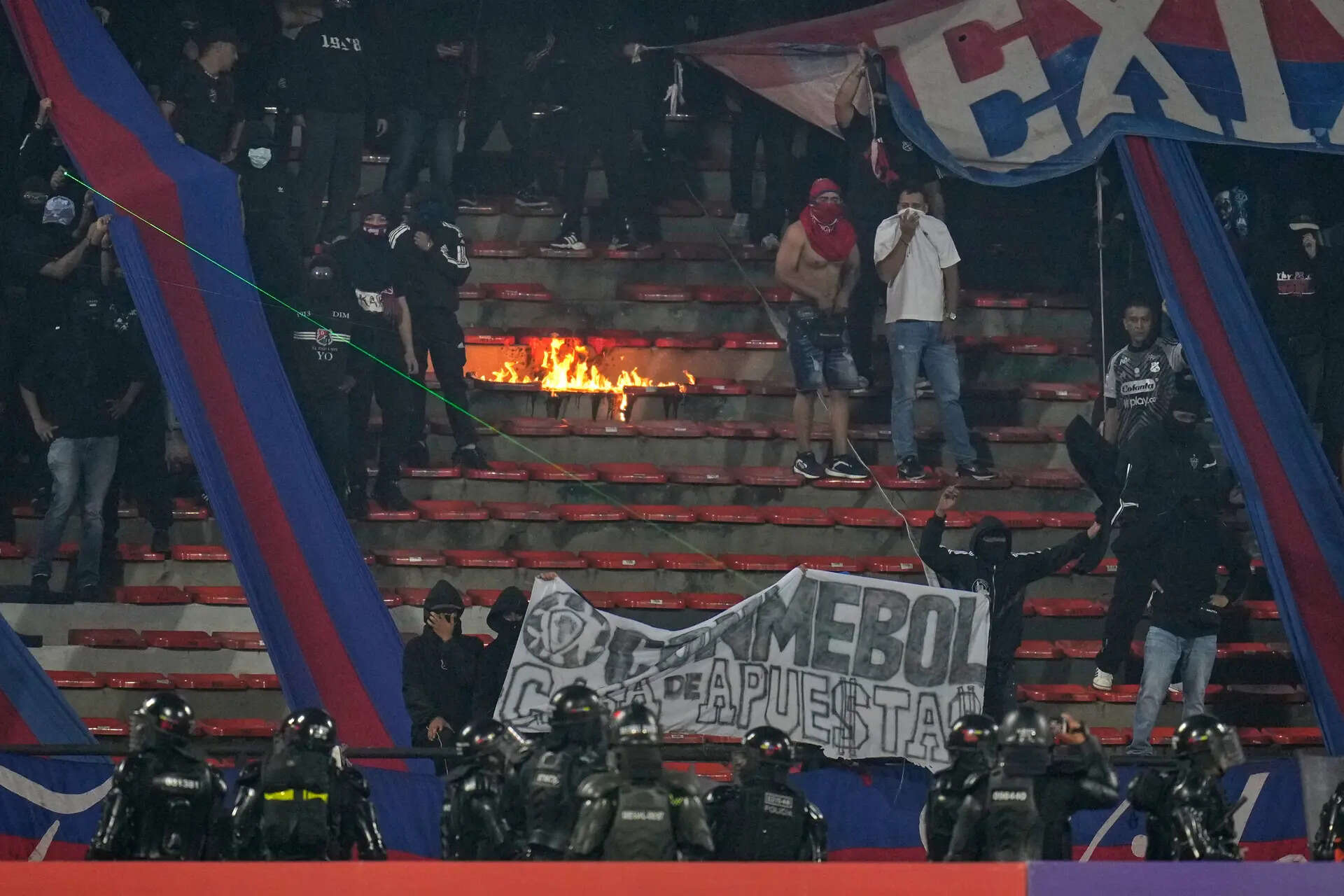
The headlines are predictable. They are lazy. They are written by people who watch South American football through the sanitized lens of a European broadcast. When a match stops two minutes after kickoff because a stadium section is literally on fire, the global media performs a choreographed gasp. They call it "chaos." They call it "tragedy." They demand "stricter bans."
They are missing the point entirely.
The fire isn't the problem. The fire is the inevitable thermal reaction of a broken system. If you think a few hundred guys with flares and matches can shut down a multi-million dollar continental fixture without the implicit or explicit permission of the structures above them, you’ve never spent a day inside a South American sporting institution.
The Myth of the Uncontrollable Fan
The "lazy consensus" suggests that South American football is held hostage by a small group of violent lunatics known as barras bravas. The narrative paints them as external pathogens infecting a beautiful game.
This is a lie.
The barras are not an external force; they are a department of the club. In many cases, they are the most efficient department the club has. They manage the parking. They manage the food stalls. They manage the political muscle required during board elections. When a section of the stadium starts burning, it isn't because security "failed." It’s because security was told to look at their shoes.
I’ve stood in tunnels where police officers shake hands with the very people they are supposedly tasked with frisking. You want to know why those flares make it past the gates? Because they didn't go through the gates. They were moved in three days ago, stored in the locker rooms or the maintenance sheds.
If you want to stop the fires, stop looking at the guys holding the matches. Start looking at the guys holding the keys to the stadium.
The Revenue of Chaos
Broadcasters love to act outraged, but "chaos" is a massive driver of engagement. A 0-0 draw that finishes on time is a footnote. A match that is abandoned because the stadium is melting becomes a global viral event.
There is a perverse incentive structure at play here. In the attention economy, notoriety is a currency. CONMEBOL and the domestic leagues benefit from the "dangerous" and "unpredictable" branding of South American football. It’s what differentiates the product from the sterile, library-like atmosphere of the modern Premier League. They sell the passion, then act shocked when that passion produces heat.
The "broken windows" theory of stadium management suggests that letting small infractions slide leads to larger ones. In South American football, we don't just let them slide; we subsidize them. The clubs provide the tickets. The local politicians provide the legal cover. The media provides the platform.
Why "Modern Security" is a Performance
People love to ask: "Why can't they just use facial recognition and biometric scanning like they do in London?"
The answer is simple: Because the people in charge don't want it to work.
In my time consulting on stadium logistics, I’ve seen millions of dollars poured into "state-of-the-art" surveillance systems that are mysteriously "undergoing maintenance" the moment a riot breaks out. It’s a theater of security. We install the cameras to satisfy the insurance companies and the international press, but we leave the back door open to keep the barras happy.
If you actually identified and banned every person involved in these incidents, you would be banning the very people who ensure the club president stays in power. It is a symbiotic relationship of survival. The fire is just the cost of doing business.
The Nuance of the Flare
Let’s talk about the smoke. The "civilized" world views a flare as a weapon. In the southern cone, it is an essential piece of cultural expression. When you try to regulate it out of existence without addressing the underlying social frustrations, you don't get rid of the fire—you just force it to become more destructive.
The competitor article you read probably argued for "life-long bans" and "stadium closures."
That is amateur-hour logic.
Closing a stadium doesn't solve the issue; it just moves the violence to the streets, where there are fewer cameras. A life-long ban is a joke in a system where ticket checks are performed by $2-an-hour contractors who are easily intimidated or bribed.
If you want to fix this, you don't target the fans. You target the club's bank account. Not a $50,000 fine—that’s coffee money. You trigger automatic relegation. You seize the broadcasting rights for a year. You hit the executives where they actually feel pain: their personal liability.
Until the board of directors is personally responsible for the structural integrity of the stadium, they will continue to hand out matches to the front row.
The Economic Reality of the Match Day
We have to be honest about the economics. Many of these clubs are functionally bankrupt. They rely on the barras to maintain order within the stadium because they cannot afford a professional security force of 2,000 people.
The barras are the security.
They keep the "unorganized" crime out. They ensure that rival fans don't infiltrate the home sections. In exchange for this service, they get autonomy. They get to run their rackets. And occasionally, they get to burn a section of the bleachers to show the world—and the board—who really owns the concrete.
The Fraud of "Fan Culture"
Stop calling it "passion."
It’s power.
Passion is singing until your throat is raw. Burning a stadium is a display of dominance. It is a signal to the authorities that the rules of the state do not apply inside the stadium walls. When a match stops after 120 seconds, it isn't a failure of sport; it is a successful coup by the stadium’s real owners.
The media’s obsession with the "tragedy" of the abandoned match ignores the fact that for the people who started the fire, the mission was accomplished. They didn't want to watch a game. They wanted to demonstrate that they have the power to stop the world from spinning.
The Only Path Forward
The status quo is a loop of fire, outrage, small fines, and more fire. To break it, you have to dismantle the protection rackets that exist between the locker room and the front office.
- End the Ticket Subsidies: Every ticket must be tracked to a digital ID with a verified bank account. No paper, no cash, no bulk hand-offs to "fan coordinators."
- Personal Liability: If a stadium is set on fire, the Club President should face criminal negligence charges. Watch how fast those "uncontrollable" fans are reigned in when the boss’s freedom is on the line.
- De-romanticize the Violence: Stop using slow-motion shots of flares in your promotional videos. If it’s a crime, treat it like one. If it’s "atmosphere," then stop complaining when things get hot.
The truth is uncomfortable. The fans didn't "ruin" the match. The match was ruined years ago when the clubs decided that organized mobs were a more useful tool than a professionalized staff.
The smoke isn't an accident. It's a signature.
Stop acting surprised. Stop writing the same "tragedy" headline. Either burn the whole system down and start over, or admit that you like the spectacle too much to actually change it.
Quit lying to yourselves. The fire is exactly what everyone paid for.