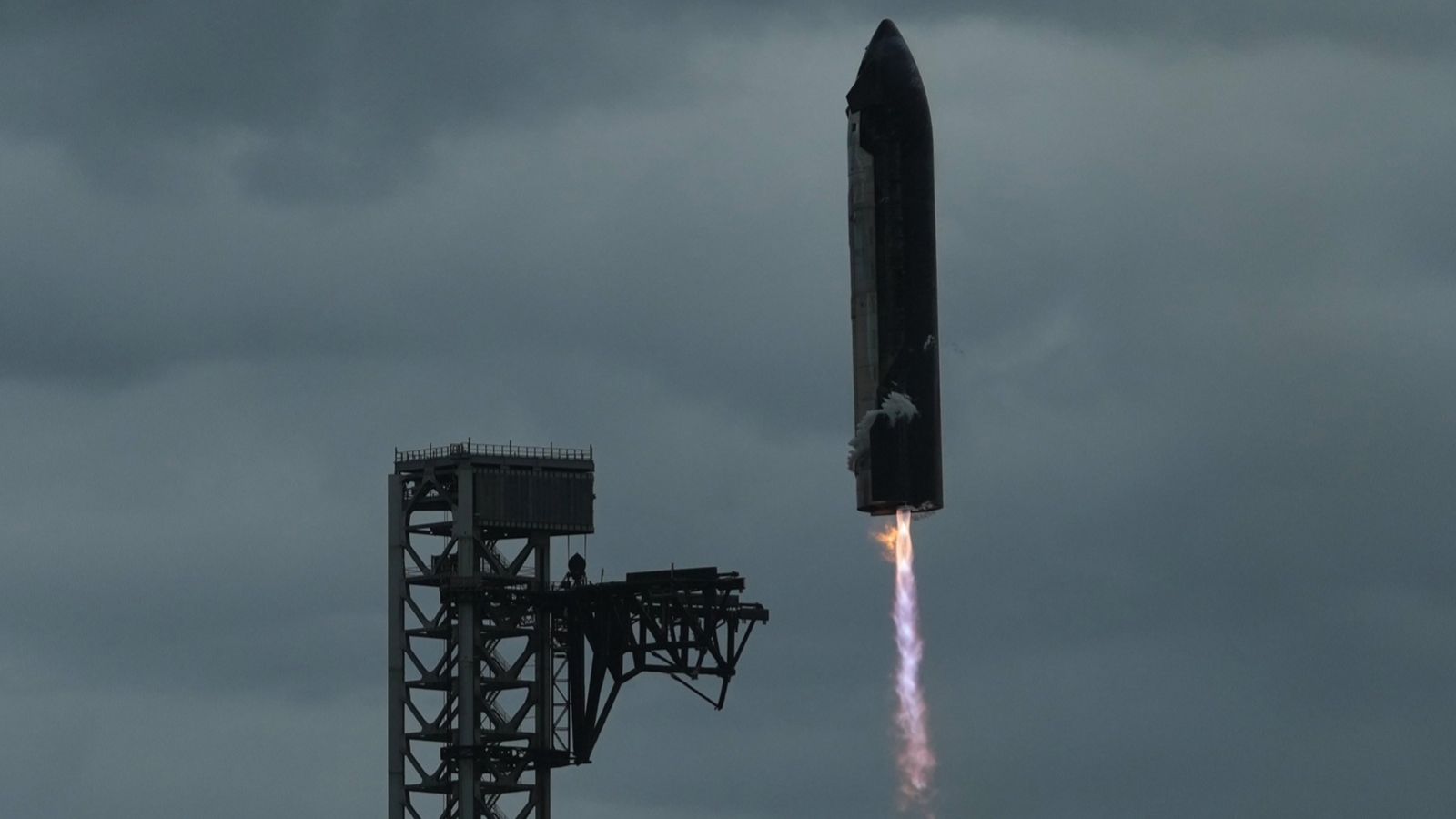
Everybody is cheering for the giant metal chopsticks. Look at the footage from Starbase. A 23-story stainless steel skyscraper drops out of the upper atmosphere, lights three Raptor engines, hovers over a concrete blast pit, and settles onto two mechanical arms with millimeter precision.
It looks like science fiction. It makes for incredible television. And if you look at the engineering reality underneath the viral video, it is an admission of a massive structural compromise. Also making news in this space: The Hidden Cost of Chasing the Shiny New Thing.
The mainstream aerospace press is treating the Starship booster catch like the final boss of orbital economics. They claim the problem of cheap spaceflight is solved. They are wrong. By moving the landing gear off the rocket and onto the launch tower, SpaceX did not eliminate complexity or cost. They just bolted it to the ground in South Texas, creating a single point of failure that violates the most basic rules of high-cadence logistics.
The Tyranny of the Rocket Equation Forced Their Hand
To understand why the Mechazilla catch exists, you have to stop listening to marketing hype and look at Tsiolkovsky's rocket equation. More details into this topic are covered by MIT Technology Review.
Every kilogram of dry mass you carry to stage separation steals directly from your payload capacity to Low Earth Orbit. When SpaceX scaled up from the Falcon 9 to the Super Heavy booster, the structural math turned brutal.
On a Falcon 9, the four carbon-fiber and aluminum landing legs weigh roughly 2,000 kilograms. They sit dead-weight on the outside of the airframe during ascent, generating aerodynamic drag and eating into propellant margins. Scale those legs up to support a 200-ton empty Super Heavy booster—plus the crushing dynamic loads of a rough touchdown—and your landing gear suddenly weighs ten to fifteen metric tons.
Fifteen tons of dead steel. Gone from your payload bay.
SpaceX engineers realized they could not afford the mass penalty. So they ripped the legs off the rocket and built the "chopsticks" on the orbital launch integration tower. On paper, it is brilliant. You trade flight mass for ground infrastructure mass, which costs zero delta-v.
In practice, you just married your reusable vehicle to a single, immovable, ultra-expensive piece of real estate.
The Launch Pad Is Now a Single Point of Failure
Ask anyone who has actually managed high-tempo fleet operations—whether in commercial aviation, naval logistics, or orbital launch—what kills turnaround speed. It is not the vehicle. It is infrastructure bottlenecks.
When a Boeing 737 lands at O'Hare with a hydraulic leak or a blown tire, it does not shut down the airport. Ground crews tow the airframe to a maintenance hangar, sweep the tarmac, and land the next jet ninety seconds later. The runway is dumb concrete. The intelligence and shock absorption live on the aircraft.
SpaceX inverted that model. They put the shock absorption, the alignment sensors, and the structural load-bearing mechanics on the runway itself.
Consider what happens when a Super Heavy booster comes in slightly hot, or experiences a sensor glitch in the final three seconds of its landing burn. A Falcon 9 landing on an autonomous spaceport drone ship off the coast of Florida misses the mark, tips over, and explodes in the ocean. It is an expensive loss of hardware, sure, but Cape Canaveral remains untouched. SpaceX launches another rocket forty-eight hours later.
If a Super Heavy booster fails during a tower catch, it does not just destroy a booster. It obliterates the launch mount, melts the orbital tank farm, shears off the quick-disconnect umbilical arms, and knocks the entire launch site offline for six to twelve months.
You cannot achieve airline-like launch cadence when every single landing doubles as a potential demolition event for your only departure gate.
Thermal Protection Is Still the Real Bottleneck
The public fixation on the mechanical catch completely misses the actual villain of rapid reusability. Catching the booster is the easy part. Keeping the orbital upper stage from melting is what actually grounds the fleet.
Let us look at the physics of reentry. The Super Heavy booster separates at roughly Mach 5 to Mach 6 at an altitude of around 70 kilometers. It experiences brief, manageable aerodynamic heating. The Ship—the orbital second stage—reenters the atmosphere at Mach 25.
At hypersonic velocities, air molecules rip apart into superheated plasma. To survive this, the Starship upper stage relies on roughly 18,000 hexagonal ceramic thermal protection tiles.
Anyone who worked on the Space Shuttle program remembers how this movie ends.
During the Shuttle era, NASA promised weekly flights. Instead, technicians spent tens of thousands of man-hours inspecting, waterproofing, and replacing individual silica tiles after every single mission. A single missing tile on Columbia's left wing led to catastrophic structural failure in 2003.
SpaceX improved the manufacturing process with standardized hex tiles pinned mechanically to the stainless steel hull, backed by an ablative blanket. Yet flight test after flight test has shown tiles cracking, vibrating loose during ascent, and burning through around the forward flaps during peak heating.
You can catch a booster with giant chopsticks in ten minutes, stack a fresh Ship on top in an hour, and fuel the stack in forty-five minutes. None of that matters if your orbital vehicle has to sit in a high bay for three weeks while technicians manually replace four hundred cracked ceramic tiles and weld warped steel flap hinges.
The Myth of the One-Hour Turnaround
Let us examine the famous claim that Starship will launch, land, restack, and refuel in under an hour.
Imagine a scenario where a commercial aviation executive pitches a new airliner that requires a complete, multi-point structural inspection of its titanium thrust structure, a full purge of cryogenic propellant lines, and a battery of non-destructive ultrasonic weld tests between every single flight. Investors would laugh them out of the room.
Cryogenic propulsion is violently hostile to materials. During a Starship launch, the stainless steel tanks experience temperatures of minus 183 degrees Celsius from liquid oxygen and minus 161 degrees Celsius from liquid methane. Minutes later, the engine bay endures combustion temperatures exceeding 3,300 degrees Celsius, accompanied by deafening acoustic vibrations that rattle every weld seam and avionics box on the vehicle.
This thermal cycling causes metal fatigue. Micro-fractures form in turbopump blades, injector plates, and propellant manifolds.
Even on the Falcon 9—the most reliable reusable rocket ever flown—SpaceX rarely turns a booster around in less than three weeks. The current record sits around twenty-one days, and that is after more than a decade of iterative hardware refinement on an engine architecture that runs at less than half the chamber pressure of the Raptor.
The Raptor 2 and Raptor 3 engines operate at over 300 to 350 bar of chamber pressure. That is the absolute bleeding edge of metallurgy. Pushing oxygen-rich staged combustion to those limits turns the engine into a controlled explosion running millimeters away from melting its own walls. Expecting a fleet of thirty-three of those engines to fire, throttle down, relight for a boostback burn, relight for a landing catch, and immediately repeat the cycle sixty minutes later defies material science.
Did SpaceX Actually Solve Orbit or Just Build a Bigger Suborbital Hopper?
We need to separate the booster achievement from the orbital mission profile.
When people ask if Starship is now fully operational, the honest answer is that SpaceX has perfected a massive, reusable first stage—while the orbital architecture remains heavily compromised by payload penalties.
To make the entire system reusable, SpaceX had to sacrifice the payload efficiency that makes expendable rockets so attractive to commercial satellite operators. Look at the numbers:
- Expendable Heavy Lift: A traditional expendable rocket puts roughly 4% to 5% of its gross liftoff weight into Low Earth Orbit.
- Reusable Starship: Because the upper stage must carry heat shield tiles, header tanks for landing propellant, aerodynamic flaps, and heavy stainless steel reinforcement to survive reentry, its dry mass balloons. Current estimates put Starship's payload to LEO at around 100 to 150 metric tons—roughly 2% to 3% of its 5,000-ton liftoff mass.
That math works brilliantly for SpaceX's internal customer: Starlink. When you own the satellite factory and you are launching thousands of flat-packed, mass-produced routers into low orbit, you do not care about launching to geostationary transfer orbit or deep space in a single shot. You just want raw tonnage to LEO at the lowest marginal cost per kilogram.
For everyone else—NASA's Artemis lunar program, deep-space planetary probes, national security payloads in high-energy orbits—Starship's low mass fraction creates a massive operational headache.
To send a single Starship lander to the Moon, SpaceX cannot just launch once. They have to launch a tanker variant into orbit, and then launch ten to fifteen additional tanker flights over several weeks to transfer hundreds of tons of cryogenic methane and oxygen in microgravity.
Cryogenic propellant transfer in orbit has never been demonstrated at scale. Liquid methane and liquid oxygen constantly boil off when exposed to solar radiation in space. Keeping those propellants cold while docking fifteen massive tankers in sequence—without a single tower catch mishap grounding the launch pad—is an engineering mountain that makes catching a booster look like a high school robotics project.
What Competitors Should Actually Learn From This
If you are running an aerospace startup or managing capital allocation in the space sector, do not copy the Mechazilla architecture. Trying to out-SpaceX SpaceX on heavy lift is financial suicide.
Instead, look at the strategic vulnerability their architecture just exposed:
- Decouple recovery from launch infrastructure. Rocket Lab's approach with Neutron—using integrated, lightweight landing legs that deploy from the fuselage and land on a downrange barge or a simple concrete pad—protects the primary launch complex. A bad landing costs you an airframe, not your spaceport.
- Optimize for high-energy orbits, not just LEO bulk. Starship is a bulk freighter built for low orbit. It is terrible at delivering single, high-value payloads directly to geostationary or trans-lunar trajectories without complex orbital refueling. Medium-lift vehicles with high-efficiency upper stages still own that market.
- Prioritize factory throughput over complex recovery. Sometimes, building a dirt-cheap expendable upper stage using automated friction-stir welding and off-the-shelf industrial components beats engineering a delicate, heat-shielded spacecraft that requires a standing army of technicians to refurbish.
The Honest Reality of the Chopsticks
Let us give credit where it is due. Watching a 70-meter rocket reverse thrust, steer itself through turbulent coastal winds using grid fins, and slot its lifting pins onto two steel rails with zero margin for error is an engineering triumph. Gwynne Shotwell, Elon Musk, and the propulsion and guidance teams at SpaceX pulled off a control-theory miracle that legacy defense contractors claimed was physically impossible five years ago.
It proves that modern flight software, real-time thrust vectoring, and differential GPS can tame massive, unstable aerodynamic structures in ways the Apollo generation could only dream about.
Just do not confuse a breathtaking control-systems demonstration with a finished transportation network.
SpaceX did not eliminate the brutal compromises of rocketry when those mechanical arms closed around the Super Heavy booster. They simply moved the risk off the rocket and bolted it to the launch pad. Until they prove they can fly a heat-shielded upper stage through Mach 25 plasma, land it intact, and launch it again without rebuilding the belly of the ship, the revolution is still sitting on the ground.