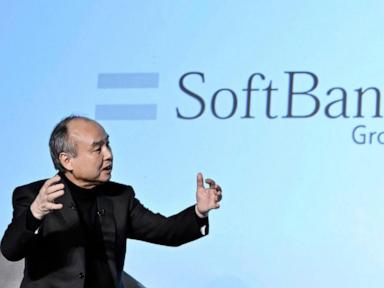
The financial press is currently tripping over itself to applaud Masayoshi Son for a "comeback." They point to the latest quarterly earnings, the soaring valuation of Arm, and the billions of dollars in paper gains as evidence that the Vision Fund has finally cracked the code.
They are wrong. In similar developments, take a look at: The Dragon and the Dealmaker at the Edge of the World.
What we are witnessing isn't the triumph of a superior investment strategy. It is the accidental benefit of a massive, unhedged bet on a single hardware monopoly. If you peel back the layers of SoftBank’s recent "profit gains," you don't find a diversified AI powerhouse. You find a leveraged bet on a cycle that SoftBank didn't create and cannot control.
The Arm Delusion
The narrative suggests that SoftBank is the primary architect of the AI era because it owns 90% of Arm. Let’s get real. Arm is an incredible company, but its current valuation reflects a speculative fever, not a fundamental shift in SoftBank’s picking ability. The Wall Street Journal has also covered this fascinating subject in great detail.
For years, the Vision Fund was a graveyard of "tech-enabled" real estate and dog-walking apps. Remember WeWork? Remember Katerra? Those weren't anomalies; they were the result of a philosophy that prioritizes capital "blitzscaling" over unit economics. Now, because the market has decided to price Arm like a software company rather than a chip architect, the books look green.
SoftBank didn't "invest" in the AI revolution. It survived long enough for a 2016 acquisition to become the only life raft in a sea of failed venture bets. To call this an "AI investment win" is like calling a lottery winner a financial genius because they bought the ticket with a borrowed dollar.
The Problem With Paper Gains
Financial analysts love to talk about "Net Asset Value." It’s a convenient metric because it allows SoftBank to claim victory based on marks-to-market that may never be realized.
In the venture world, a gain isn't a gain until the cash hits the bank. SoftBank's portfolio is heavily weighted toward private companies where valuations are set by the last person willing to write a check, not by actual cash flow. When the public markets get jittery, these private valuations evaporate.
I have seen dozens of funds claim "huge profit gains" during a bull run, only to watch those gains vanish during the "liquidation preference" stage of a downturn. SoftBank is particularly vulnerable here because of its debt structure. The company isn't just an investor; it’s a massive borrower. When your collateral is as volatile as a tech index, you aren't a visionary. You're a high-stakes gambler playing with a margin account.
Why The "AI Pivot" Is Mostly Marketing
SoftBank is now rebranding every move as "AI-centric." This is the same playbook they used for the "Internet of Things" five years ago and the "Mobile Internet" a decade ago.
The truth? True AI value is currently being captured by three groups:
- The hardware providers (Nvidia).
- The cloud giants with the compute (Microsoft, Google, AWS).
- The companies with proprietary data moats.
SoftBank’s Vision Funds are mostly stuffed with late-stage startups that are consumers of AI, not creators of it. These companies are now facing massive increases in their COGS (Cost of Goods Sold) because they have to pay the Nvidia tax to stay relevant.
Imagine a scenario where a Vision Fund-backed logistics company "integrates AI" to optimize routes. They aren't inventing the model; they are renting it from OpenAI or Meta. The margin doesn't go to SoftBank. It flows directly to the platforms. SoftBank is essentially subsidizing the R&D of Big Tech by funding startups that spend their venture dollars on cloud credits.
The Myth Of The "Founder-First" Advantage
Masa Son is famous for his "10-minute gut feel" investments. While this makes for great storytelling, it’s a disastrous way to manage billions of dollars of institutional capital.
The "founder-friendly" reputation of SoftBank actually creates a moral hazard. When you pump a startup with more cash than it can possibly spend efficiently, you break the company. You encourage hiring binges, vanity marketing, and a total disregard for profitability.
I’ve watched companies blow $100 million on "market share" only to realize they were buying customers who had zero loyalty. SoftBank’s capital doesn't build moats; it builds fires. It burns bright and hot, but when the fuel runs out, there is nothing left but ash.
The Hidden Cost Of Diversification Failure
A real investment firm manages risk. SoftBank manages narrative.
If you look at the concentration of value in SoftBank’s portfolio, it’s terrifyingly lopsided. A massive chunk of the equity value is tied up in a handful of names. If Arm has a bad quarter, or if the US-China trade war escalates further around semiconductor IP, SoftBank’s "record profits" turn into record losses overnight.
They aren't diversified. They are concentrated in the most sensitive, geopolitically volatile sector on the planet. Calling this a "lucrative lift" ignores the fact that the floor could drop out at any moment.
Stop Asking If SoftBank Is Back
The media asks, "Is SoftBank back?" or "Has Masa Son been redeemed?" These are the wrong questions.
The real question is: "Is the SoftBank model sustainable in a high-interest-rate environment?"
During the era of zero-interest rates, you could afford to be wrong 90% of the time if your 10% winner went to the moon. But when capital has a cost, the "spray and pray" method fails. SoftBank’s interest payments are real. Their debt is real. Their "profits" are largely theoretical.
The Brutal Reality Of The AI Trade
Everyone wants to believe there is a shortcut to wealth in the AI boom. SoftBank sells the dream that by buying their stock, you are getting a diversified slice of the future.
In reality, you are getting:
- A massive pile of debt.
- Exposure to late-stage startups with questionable paths to IPO.
- A heavy concentration in a single UK-based chip designer.
- A CEO who pivot faster than a weather vane in a hurricane.
If you want to invest in AI, buy the companies actually building the infrastructure. Don't buy the holding company that is trying to convince you that their 2016 portfolio is suddenly a collection of AI geniuses.
SoftBank didn't predict the AI surge. They got stuck in a room, and the room happened to catch fire in a way that looked like a sunset.
Profit gains on paper are not the same as success. In the world of high-leverage finance, the distance between a genius and a casualty is usually about six months of market volatility. SoftBank hasn't changed its DNA; it just got a favorable gust of wind.
Don't mistake the wind for the engine.