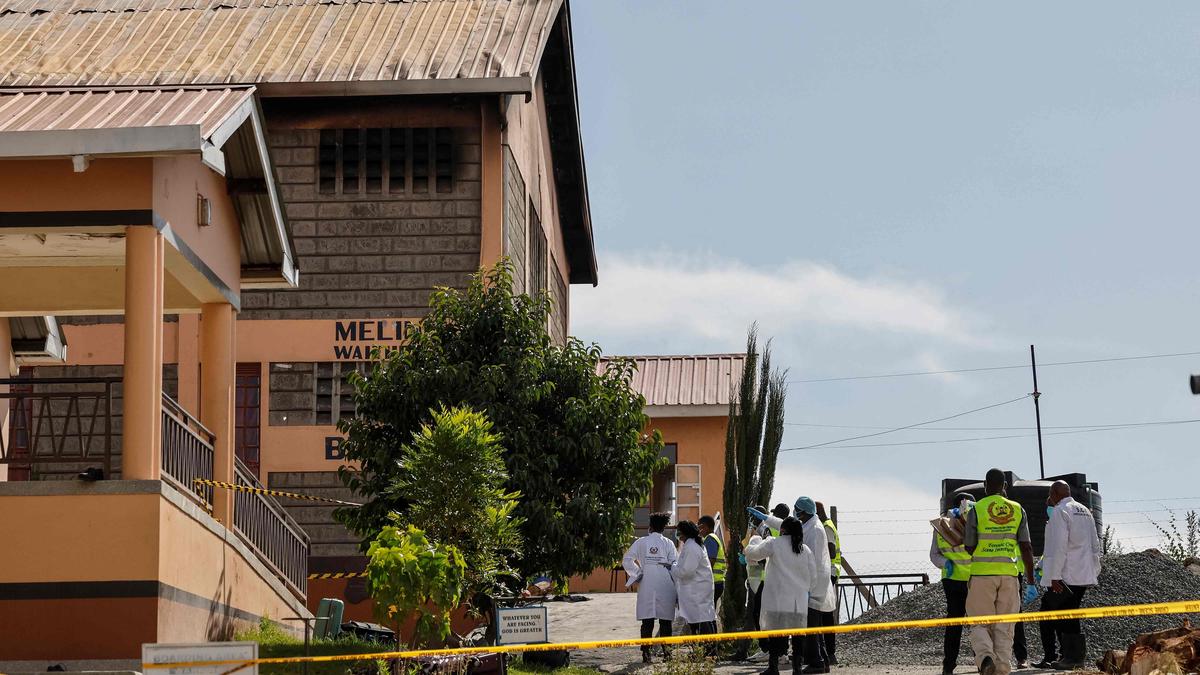
The smell of woodsmoke usually signals comfort in the Kenyan highlands. It means tea is brewing, or evening warmth is settling over a homestead. But in the early hours of a September morning in Nairobi, smoke meant something entirely different to the wakeful neighbors of Moi Girls’ High School. It carried the acrid, terrifying stench of burning foam mattresses, synthetic uniform fabric, and trapped panic.
By sunrise, the country woke to a horror that defies the basic contract of parenthood. You send your daughter to an elite boarding school to secure her future. You do not expect to receive her back in a body bag. Nine schoolgirls died in that dormitory fire. They were young women with names, dreams, and families who had scrimped to pay their tuition.
Then came the arrest.
Police detained eight students. The lead suspect was a fourteen-year-old girl.
This is not just a story about a localized tragedy or a single delinquent act. It is a window into a recurring, dark phenomenon within East African education. To understand how a child becomes an alleged mass murderer, we have to look past the yellow police tape and examine the pressure cooker of the boarding school system.
The Weight of the Iron Gates
Boarding schools in Kenya carry a prestigious legacy. Institutions like Moi Girls are seen as golden tickets, paths out of poverty and into leadership. Admission is fiercely competitive. The pressure begins the moment a child scores her first high marks in primary school.
Imagine the psychological landscape of a teenager thrust into this environment.
Let us look at a composite reality, a student we will call Amina. Amina is fourteen. She scored near-perfect marks on her primary school exams. Her village threw a celebration when she was accepted into a national school. Her uncle sold a piece of land to afford the uniform, the books, and the boarding fees.
Amina arrives at the school gates carrying the economic hopes of an entire lineage on her adolescent shoulders.
Inside, the regime is monastic. Wake-up bells ring at 4:30 AM. Preps last until late at night. The curriculum is a relentless march toward the final examinations, a high-stakes gamble where a single bad day can ruin years of effort. There is little room for vulnerability. Mental health resources are virtually non-existent, often replaced by strict religious counseling or corporal punishment.
When a child suffocates under this weight, she cannot simply walk home. The gates are locked. The walls are topped with broken glass or barbed wire.
Solitude becomes impossible. Coping mechanisms break down.
When Arson Becomes an Alphabet
To an outsider, burning down a dormitory seems like an act of unfathomable malice. But to historians and sociologists studying Kenyan education, it is a recognizable, tragic pattern. Arson is a dark language.
Over the past few decades, hundreds of Kenyan schools have experienced student-led fires. In 2016 alone, over one hundred schools reported incidents of arson. The targets are almost always the same: dormitories and administration blocks.
Why?
Because the dormitory is the symbol of confinement. The administration block is the seat of authority.
When dialogue fails—or when dialogue was never permitted in the first place—destruction becomes the only megaphone available to a desperate student. It is a distorted, catastrophic cry for control. A student who feels utterly powerless realizes that with a single match and a five-shilling bottle of kerosene, they can bring a massive, revered institution to its knees.
They rarely consider the physics of fire. They do not think about how quickly polyurethane foam mattresses ignite, creating a toxic, blinding smoke that fills a room in less than sixty seconds. They intend to cause a disruption, a forced holiday, a pause in the relentless pressure. Instead, they create a graveyard.
The Anatomy of the Investigation
The aftermath of the Moi Girls’ fire was a study in collective trauma and swift retribution.
Police investigators moved through the charred skeleton of the Kabarnet dormitory. They found what they were looking for: traces of accelerants. The narrative quickly shifted from a tragic accident to a criminal conspiracy.
The fourteen-year-old girl accused of mastermind status was alleged to have planned the fire for days. Witnesses claimed she had expressed hatred for the school and a desire to transfer. She had allegedly tried to light a fire earlier in the week, a warning sign that went unheeded by an overworked staff.
Consider the moment of her arrest. A child, surrounded by detectives, facing charges of arson and multiple counts of murder.
The public demand for justice was deafening. Parents of the victims stood outside the school, weeping, demanding to know how their daughters could be burned alive in a facility they paid to protect them. The government promised a swift trial and harsh penalties.
But locking up eight teenagers does not extinguish the embers that still glow in other schools across the nation.
The Silent Complicity
We are quick to demonize the children who hold the matches. It is easy to label them as monsters, sociopaths, or anomalies. That way, society absolves itself of blame.
The hard truth is that the educational system is complicit.
When we prioritize test scores over human sanity, we create the conditions for disaster. When we build schools that resemble minimum-security prisons, we should not be surprised when the inmates riot. The strict hierarchy of these institutions often silences student grievances, viewing any form of dissent as rebellion to be crushed.
If a student is being bullied, if she is struggling with her identity, if she is collapsing under the academic workload, she often has nowhere to turn. The traditional family structure is hundreds of miles away. The school administration is an adversarial force.
The match becomes an exit strategy.
The Cost of the Crimson Sky
The trial of the lead suspect eventually moved behind closed doors, protecting her identity as a minor but shielding the public from the uncomfortable details of the case. She was eventually convicted of manslaughter, a legal acknowledgment that while her actions caused the tragedy, the intent to mass-murder her peers was not fully established.
A legal verdict, however, offers little solace.
The families of the nine girls who died are left with empty bedrooms and unanswered questions. The survivors carry scars that are invisible but deep—the sound of crackling wood, the taste of ash, the guilt of having made it out of the window while a friend did not.
And across Kenya, millions of children still wake up at 4:30 AM to the sound of a bell, staring at the concrete walls of their dormitories, wondering how much longer they can hold the weight.
The smoke has cleared from the Nairobi sky, but the air remains thick with warning.
A school uniform hanging on a clothesline in the afternoon sun looks innocent enough. But if you look closely at the girls walking back to their dormitories as the sun dips below the horizon, you can see the terrible fragility of it all. They walk in straight lines, their eyes fixed on the dirt, carrying the impossible dreams of their elders, waiting for the night to fall.