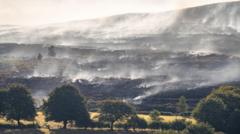
The ash tasted like copper and old newspapers.
I remember standing on the hill behind my neighbor's sheep pasture, watching the horizon turn the color of a bruised plum. It was not the gentle mist people associate with the Welsh valleys, that soft, grey blanket that rolls off the Irish Sea and settles into the wool of your sweater. This was an amber menace. It swallowed the sky, chewed through decades of dry gorse, and left behind a silence so absolute you could hear the pine needles popping two ridges over.
We are used to rain in Wales. We measure our lives in downpours. But lately, we measure them in smoke.
When a Welsh county—quiet, forgotten, green-ribboned by history—suddenly erupts into a global carbon hotspot, the headlines sound like abstract accounting. Millions of metric tons. Emissions spikes. Satellite anomalies flashing red over terrain that usually registers as a quiet carbon sink. It reads like a spreadsheet error.
It is not an error. It is a transformation.
Consider what happens when a landscape designed to hold moisture dries out until it becomes tinder. For generations, the peatlands and upland heaths of the UK acted as subterranean sponges. They locked away carbon for thousands of years, layer upon layer of decomposed moss and organic matter acting as a dark, wet vault. We thought that vault was permanent. We treated the earth beneath our boots as a floor that would never give way.
Then came the dry springs. Then came the heatwaves that parked themselves over the British Isles like unwelcome relatives.
I spoke with Mair, whose family has farmed the same sheep run near the Brecon Beacons for four generations. She is not a scientist, but she reads the land the way a sailor reads the tide.
"The earth isn't holding water the way it used to," she told me last autumn, her hands stained with soil that felt more like dust than loam. "The ditches run dry by June now. Used to be, you’d sink to your shins in the bog after a summer shower. Now, you strike a match by accident, and the ground itself burns."
That is the hidden cruelty of a carbon hotspot born from wildfire. When a standard forest burns, the trees release carbon dioxide back into the atmosphere—a heavy breath, certainly, but part of a natural cycle if the forest regrows. But when peat burns? When the ancient, mucky underworld of the hills catches fire? It is a geological theft. It releases carbon that was sequestered before the Roman conquest. It burns downward, eating away at the floor of history itself, smoldering under the topsoil for weeks long after the visible flames have crawled over the ridge.
The global atmosphere does not care about borders. It does not distinguish between the exhaust pipe of a congested metropolis and the slow, subterranean burn of a Welsh hillside. When thousands of hectares of upland vegetation and peat ignite simultaneously during extreme weather events, local ecosystems are instantly converted from carbon sinks into massive carbon emitters. For a few frantic weeks, a stretch of rural pasture punches far above its weight class in global atmospheric degradation.
We look at climate data and search for villains. We point at factories, cargo ships, concrete sprawl. It is much harder to look at a patch of wild heather and realize that the wilderness itself has turned against us.
The psychology of this is disorienting. We look to the country to escape the industrial age. We walk the ridgelines to breathe clean air, to wash the city noise from our ears. To discover that the very sanctuary we sought refuge in is quietly pumping greenhouse gases into the upper atmosphere feels like a betrayal. It shatters the pastoral myth. Nature is no longer a static backdrop; it is an active, trembling participant in a shifting climate regime.
And yet, blame is a cheap currency.
The people fighting these fires are not corporate executives or remote policymakers. They are local sheep farmers, volunteer fire crews, and forestry wardens hauling water pumps up impossible grades while the wind shifts unpredictably. They are working with equipment designed for urban garages, trying to drown a mountain that has turned into a coal seam.
I watched a young forestry worker named Rhys emerge from the smoke line two summers ago. His face was streaked with black soot, his eyes red-rimmed and exhausted. He sat on the tailgate of a Land Rover, drank lukewarm water from a plastic bottle, and stared out at the charred remains of a gorse brake that had taken three centuries to grow and three hours to vanish.
"People talk about carbon budgets," he said, wiping his brow with a forearm black as a stovepipe. "They talk about targets for twenty-fifty. They should come up here and smell what twenty-fifty smells like right now."
He was right. We treat climate change as a future tense. We speak of it as an approaching horizon, a homework assignment due at the end of the century. But on the hillsides of Wales, the future arrived early, smelling of scorched earth and burnt peat.
The science behind this emergency is stark, yet remarkably simple to visualize. Think of the landscape as a bank account. For millennia, plants drew carbon down from the sky as interest, depositing it into the deep savings account of the soil. Wildfires act as an instantaneous, catastrophic withdrawal. They empty the vault in minutes. And because changing land management practices, restoring degraded bogs, and rewetting dried-out uplands takes decades of patient, unglamorous labor, the deficit lingers long after the smoke clears.
We are forced to ask uncomfortable questions about how we manage the land. For centuries, traditional burning practices were used to manage vegetation for grazing. But as summers grow hotter and droughts stretch longer, traditional methods become ignition keys. The margin for error has shrunk to zero. A stray spark from a discarded glass bottle, a rogue campfire, a single lightning strike—and an entire county flips from a quiet guardian of the atmosphere into a roaring chimney.
There is no easy absolution in this story. No neat policy paper will instantly restore the moisture to the soil or cool the surface of the North Atlantic. Fixing this requires a fundamental reimagining of our relationship with the wild. We cannot simply leave nature to fend for itself in a warming world, assuming the old rhythms will hold. We have broken the metronome.
Now, we have to learn how to keep time in the dark.
The sun went down behind the blackened spine of the mountain, casting a dull, copper glow across the valley floor. Down in the village, chimney smoke began to rise from stone cottages, mixing with the lingering ghost of the wildfire. I pulled my jacket tighter against the evening chill, feeling the strange weight of the air—an atmosphere charged with the memory of what was lost, and the heavy, quiet realization of what is still to come.