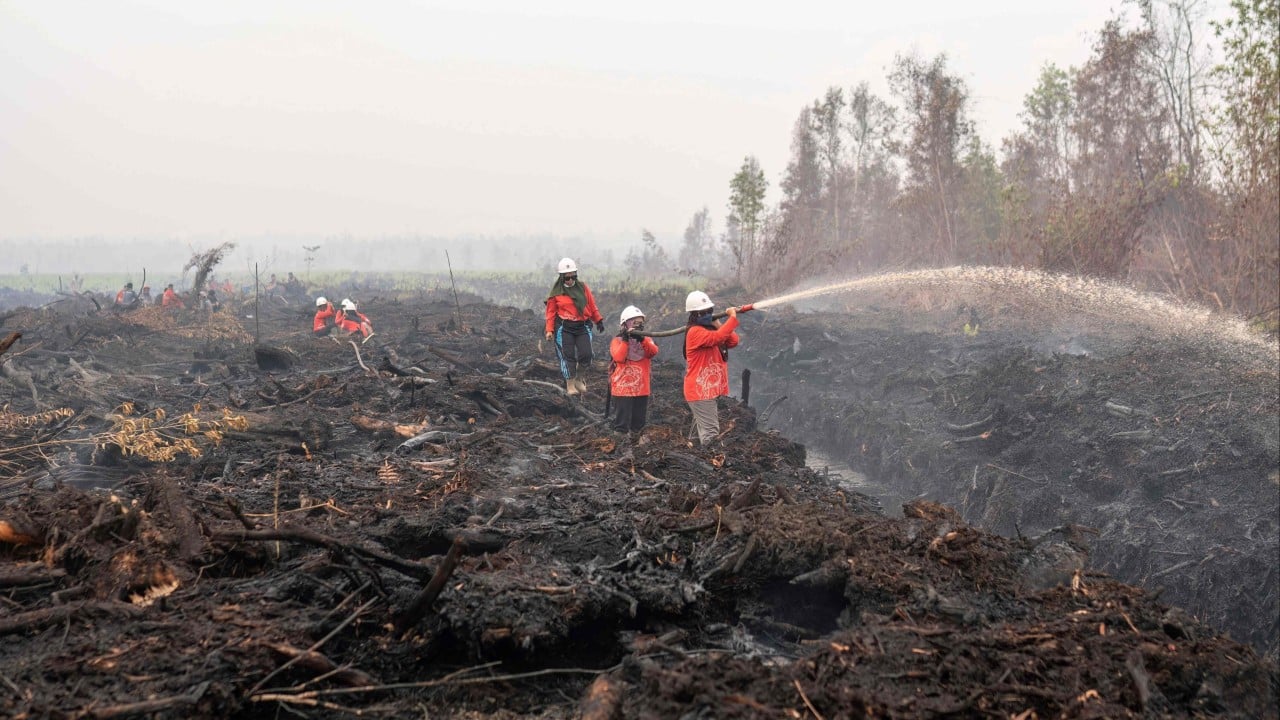
The afternoon sun does not set in Pekanbaru during the worst weeks of dry season; it simply dims, turning from fierce tropical gold into a bruised, copper coin hanging behind a curtain of gray. You taste the air before you see it. It sits on the back of your tongue like wet cardboard and burnt rubber, sharp enough to catch in the throat of a healthy adult and heavy enough to bend a child's breathing into a shallow, whistling rasp.
I have stood in skies like that, watching streetlamps flicker on at two in the afternoon while neighbors pressed damp cloths over their noses and counted the hours until a shift in monsoon winds might push the smoke somewhere else. Smoke does not respect passports. Neither does soot. Across Sumatra and Kalimantan, seasonal land-clearing fires—many lit to prepare drained peatlands for palm oil and pulp plantations—send plumes spiraling upward until prevailing winds carry the acrid fog across the Strait of Malacca toward Malaysia and Singapore. What begins as a local agricultural shortcut quickly becomes a regional public health emergency and a recurring diplomatic headache between neighboring capitals.
Traditional diplomacy moves slowly, measured in joint task forces, memorandum drafts, and careful phrasing that avoids offending a sovereign neighbor while soothing an anxious electorate. Press releases cite air quality indices and hotspot counts. Ministries trade assurances. Yet when visibility drops to fifty meters and schools shut down for weeks at a time, numbers on a spreadsheet feel thin—almost insulting—to a mother rocking a coughing toddler at three in the morning.
Out of that frustration, a different kind of response has gathered force across Indonesia: eco-art. Painters, sculptors, textile weavers, street muralists, and community collectives are turning smoke, ash, charred timber, and discarded waste into works that refuse to let the crisis be filed away as a seasonal inevitability. Instead of arguing purely in policy jargon, they are forcing people to look closely at what the haze actually costs—and who pays for it.
Why Smoke Becomes a Border Dispute
To understand why a brush stroke or a charcoal installation carries weight in a regional row, it helps to look at how peat works beneath the forest floor. Peat is not ordinary dirt. It is thousands of years of half-decomposed plant matter—roots, leaves, fallen trunks—waterlogged and packed dense with carbon. Left wet and intact, a peat swamp is a natural sponge and one of the planet's most potent carbon vaults.
Drain that sponge to plant profitable cash crops, and the chemistry changes completely. Exposed to tropical heat and oxygen, dry peat turns tinder-dry. Once lit, a peat fire rarely stays on the surface; it smolders underground for weeks or months, feeding on ancient organic matter and pumping out dense, particulate-heavy smoke rich in fine aerosols (PM2.5) that lodge deep in human lungs.
Consider what happens next: those microscopic particles ride seasonal winds right past customs posts. In Kuala Lumpur or Singapore, a sudden spike in unhealthy air triggers school closures, flight delays, hospital visits, and sharp public criticism aimed at Jakarta. Indonesian officials, meanwhile, push back against blame that feels one-sided, pointing to cross-border investment flows, global demand for cheap commodities, and years of domestic enforcement efforts alongside economic pressures in rural districts where alternative livelihoods can be scarce.
Diplomacy stalls when both sides feel cornered. One capital sees negligence drifting across its borders; the other sees unfair scapegoating over a complex structural problem rooted in land tenure, seasonal drought, and global supply chains. Anger builds on both sides of the water.
To see how this tension plays out on the ground, picture a hypothetical character—let's call her Tari, a primary school teacher in Riau province who has spent twelve years watching the dry season arrive with a familiar dread. Every autumn, her classroom thins out. Chalk dust mixes with outside smoke seeping through louvered windows, and half her students arrive wearing surgical masks that slip off small ears by mid-morning.
Tari is not an environmental economist. She does not draft transboundary haze treaties. Yet she knows the exact rhythm of a bad haze season: the sudden surge in asthma inhalers at the local clinic, the quiet exhaustion of parents missing work to stay home with sick children, and the strange bitterness of hearing distant diplomats debate blame while her own lungs ache after a ten-minute walk from the bus stop. When local artists set up a mural near her school showing children holding lanterns inside a thick cloud of gray, Tari stops not because the painting solves the policy dispute, but because it names the heaviness in her chest.
Art as Evidence, Not Decoration
Many people still picture environmental art as pretty scenery—a watercolor river or a carved wooden bird meant to look nice in a hotel lobby. That kind of art soothes. Eco-art in haze-hit communities is built to unsettle.
Artists working around Sumatra, Java, and Kalimantan have experimented with materials pulled straight from the crisis itself. Some mix collected soot and ash from burned brush into pigments and inks, painting directly onto salvaged wood or discarded canvas so the medium itself carries the residue of combustion. Others stage public installations—sculptures built from charred branches, plastic packaging, and respiratory masks—placed in busy squares where commuters cannot step around them without noticing.
Why does this matter when scientists already measure air quality with precision instruments? Because data informs the mind, while image and story pierce the armor of habit. Most of us are remarkably skilled at tuning out statistics. Hearing that fine particulate levels reached hazardous thresholds or that thousands of hotspots were detected in a given week can blur into background noise after the third or fourth headline.
A canvas darkened with real smoke is harder to scroll past. A street mural painted on a wall facing a smoky highway turns an abstract environmental metric into a shared human face—a child squinting, a farmer standing beside a blackened stump, a family trying to breathe clean air. In communities where people sometimes feel powerless against distant corporate decisions and slow government machinery, public art creates a commons. It gives neighbors a place to gather, point, argue, and say: This is happening to us right now.
Let me be honest about my own doubts here. Watching art confront a massive ecological and diplomatic crisis can sometimes feel like bringing a wooden shield to a wildfire. Can a sculpture stop an illegal land fire? Can a community theater piece rewrite forestry enforcement or calm tense trade talks between neighboring capitals?
No. If we pretend art alone fixes land-use economics or transboundary politics, we are fooling ourselves—and doing a disservice to the people breathing bad air. Eco-art does not replace law enforcement, peatland restoration, or patient diplomacy. What it does is shift the emotional climate in which those decisions are made. It strips away euphemisms. It reminds leaders that behind every diplomatic note is a real household, and behind every economic statistic is a body that needs clean air to survive.
The Invisible Stakes Beneath the Surface
The deepest danger of seasonal haze is not only what you can see in the sky at noon; it is what accumulates quietly over years. Repeated exposure to heavy smoke strains cardiovascular and respiratory health, disrupts schooling when classrooms close repeatedly, and drags down local productivity when workers fall ill or stay home to care for relatives.
There is also a quieter cost: normalcy creep. When bad air returns almost every dry season, people adapt in ways that can be dangerous. They seal windows, buy air purifiers if they can afford them, ration outdoor play, and treat coughing fits as just another part of the calendar. Adaptation is human ingenuity at work, yet normalizing toxic air lowers the bar for what counts as acceptable life.
Eco-art pushes back against that quiet resignation. By treating smoke and ecological degradation as urgent moral stories rather than routine weather, artists challenge the idea that people should simply endure whatever drifts their way. Across Indonesia's vibrant contemporary and grassroots art scenes, creators have increasingly woven ecological themes into murals, performance, craft, and visual storytelling—linking local environmental harm to broader questions of justice, stewardship, and civic voice.
And notice how that changes the conversation across borders, too. When citizens in neighboring countries see Indonesian artists and communities openly confronting the same smoke that clouds their own skylines, the narrative shifts from simple national blame toward shared vulnerability. Wind carries ash across straits, and it can also carry a common recognition: no neighbor truly breathes alone in a shared airshed.
Building Pressure That Lasts After the Rain
Rain always comes eventually. Monsoon shifts wash the sky clean, visibility returns, school bells ring on schedule again, and the urgent headlines fade until the next dry spell.
That cycle is the trap. Once the air clears, public attention often drifts back to everyday routines, leaving root causes half-addressed. Peatlands that were dried out remain vulnerable unless re-wetted and protected for the long haul. Enforcement that surges during peak smoke seasons can lose momentum once the cameras move on.
Artists who stay engaged after the rains arrive are trying to break that forgetting reflex. A permanent mural in a neighborhood alley, a series of prints exhibited in a community center, or a collaborative project between young artists and local farmers keeps the memory alive when the sky looks blue again. It asks a sharp, uncomfortable question during calm weather: What are we doing right now so this doesn't burn again next year?
That is where real leverage lives—not in one dramatic protest or one viral image, but in sustained cultural pressure that makes inaction look costly. Politicians respond to sustained public care. Businesses pay attention when brand reputation and social license are tied to how land is managed. Communities organize more boldly when they see their own lived experience reflected with dignity and clarity.
So when you hear that artists in Indonesia are turning toward eco-art amid haze, anger, and diplomatic friction, do not dismiss it as a side note to "serious" news. Look closer at what is actually happening. People are refusing to let smoke erase their stories. They are taking the very ash falling from a troubled sky and using it to draw a line in the dirt—and in the air.
A single brushstroke cannot clear a horizon.
Yet in a season choked with gray, a painted lantern on a concrete wall can still make the dark feel less final.