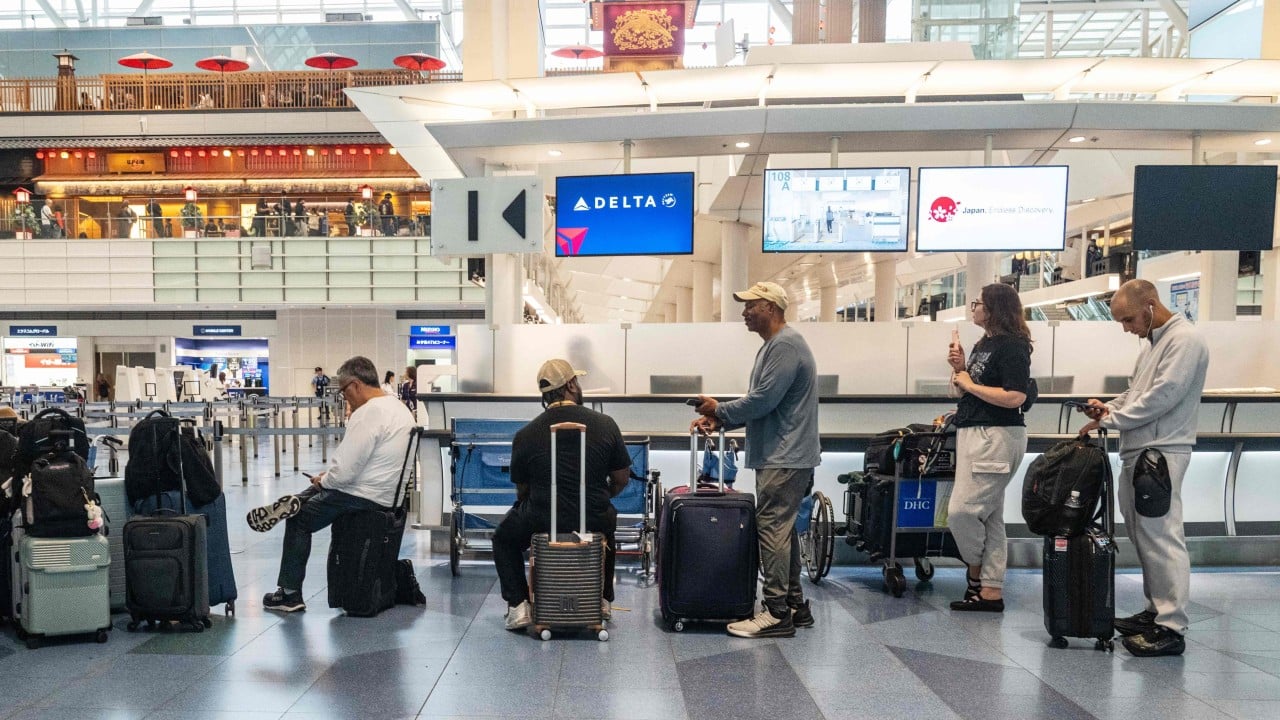
The departures board at Tokyo’s Haneda Airport did not blink. It just changed color. A solid wall of amber text replaced the standard green and white flashes, turning hundreds of carefully planned itineraries into immediate, quiet chaos.
Flight cancellations are usually discussed in the abstract language of logistics. We hear about percentages, fleet re-routing, and the economic ripple effects on commercial carriers. But a cancelled flight is rarely just a logistical hiccup. It is a sudden, sharp severance of human intent. It is the wedding missed in Sapporo, the final business deal left unsigned in Osaka, or the exhausted family stuck on a linoleum floor, staring at a duffel bag that has suddenly become their entire world.
When two massive storm systems began barreling toward the Japanese archipelago simultaneously, the headlines broke the news with standard clinical precision: over one hundred flights grounded. The data tells you the scale. It does not tell you about the quiet, frantic phone calls made from airport lobbies as the wind begins to pick up outside.
The Convergence of Two Fronts
To understand how a transportation network grinds to a halt, you have to look at the atmosphere not as a weather map, but as a shifting pressure cooker. Japan is no stranger to typhoons. Its infrastructure is built to bend, endure, and reset. But the rare synchronization of two distinct storm systems creates a unique kind of paralysis.
Think of it as a pincer movement. One storm approaches from the south, dragging heavy tropical moisture and erratic wind shears across the main islands. Meanwhile, a secondary system locks in from the Pacific, compressing the atmospheric channels. For commercial aviation, this is not just a matter of avoiding a heavy downpour. Modern jets can fly through rain with ease. The real enemy is predictability.
When twin systems interact, they create microbursts and unpredictable crosswinds around coastal runways. An airport like Haneda or Narita relies on a rhythm as precise as a Swiss watch. Planes land and take off in tightly metered intervals. The moment wind speeds exceed safe operational thresholds for landing gear or ground crews, that rhythm shatters.
Grounding a hundred flights is a preventative strike. Airlines do not wait for the storm to hit the tarmac; they calculate the risk hours in advance to prevent aircraft from being trapped in the wrong hubs. If a plane cannot land in Tokyo, it cannot depart for Okinawa later that afternoon. The entire network unravels from the inside out.
The Human Cost of the Tarmac Standstill
Consider a hypothetical traveler named Kenji. He is not a statistic on an airline ledger. He is an independent contractor who spent six months securing a meeting with a major distributor in Fukuoka. His suit is pressed. His presentation is saved on two separate drives. He arrived at the terminal three hours early, watching the rain streaks turn horizontal against the massive glass panes of the terminal.
When the notification chimed on his phone, the cancellation was instantaneous. No delay. No rescheduled time. Just a stark notification offering a refund or a rebooking option four days away.
The immediate reaction to these moments is often a wave of collective frustration that ripples through a terminal. You can hear it in the sudden increase in footsteps toward the customer service desks, the sharp tapping on smartphone screens, and the heavy sighs of people realizing their immediate futures are entirely out of their hands.
The true weight of a disrupted travel network is measured in these micro-disappointments. For international tourists, a grounded domestic flight means missing a connection back across the ocean, incurring thousands of dollars in emergency lodging and last-minute ticket changes. For locals, it means missing moments that cannot be rescheduled. The atmosphere does not care about human milestones. It simply moves according to the laws of thermodynamics, indifferent to the schedules we draw beneath it.
The Invisible Engine of Resilience
Behind the scenes, another human drama unfolds. While passengers scramble to secure hotel rooms, air traffic controllers and airline dispatchers enter a high-stakes game of geographic chess.
Every single aircraft must be accounted for. Leaving a multi-million-dollar Boeing 777 exposed on a tarmac during peak wind gusts is a massive liability. Ground crews work in torrential downpours, securing heavy equipment, catering trucks, and baggage carts that could become lethal projectiles in high winds.
The decision to cancel a flight is a heavy financial blow to an airline, costing millions in lost revenue, voucher payouts, and operational friction. It is a decision never made lightly. It is the result of tense, fast-paced debates between meteorologists, flight operations captains, and safety executives who must balance the brutal reality of a balance sheet against the absolute mandate of passenger safety.
The wind outside the terminal windows begins to howl, a low, vibrating hum that shakes the heavy metal framing of the building. On the radar screens inside the operations center, the two storm systems appear as swirling vortexes of green, yellow, and deep crimson, slowly closing the gap between them.
The amber text on the departures board remains unchanged. The terminal slowly empties as people accept their fate, heading toward nearby hotels or catching the last crowded trains back into the city before the rail lines, too, consider shutting down. The grand machinery of global travel rests entirely on the assumption that we have tamed the elements. Days like this remind us that we are merely operating in the brief, quiet spaces the earth allows us.


