The sirens in Kyiv do not sound like a warning anymore. They sound like an exhausting, heavy chore. They are a daily disruption that forces you to turn off the stove, grab a jacket, and walk down into the cold dampness of a concrete cellar. For three years, people have learned to calculate the geometry of survival in seconds. If the launch is from the south, you have ten minutes. If it is a ballistic missile from the north, you have less than two.
On a Tuesday morning, the calculations failed.
The air defense systems fought back, leaving white, jagged scars across the gray sky, but the sheer volume of the barrage tore through the defense grid. Eleven people woke up that morning, made coffee, checked their phones, and never saw the afternoon. They became the newest entries in a ledger of loss that grows longer every day. But as the smoke cleared over the capital and several regional centers, another kind of casualty emerged from the rubble—one made of canvas, ancient stone, and collective memory.
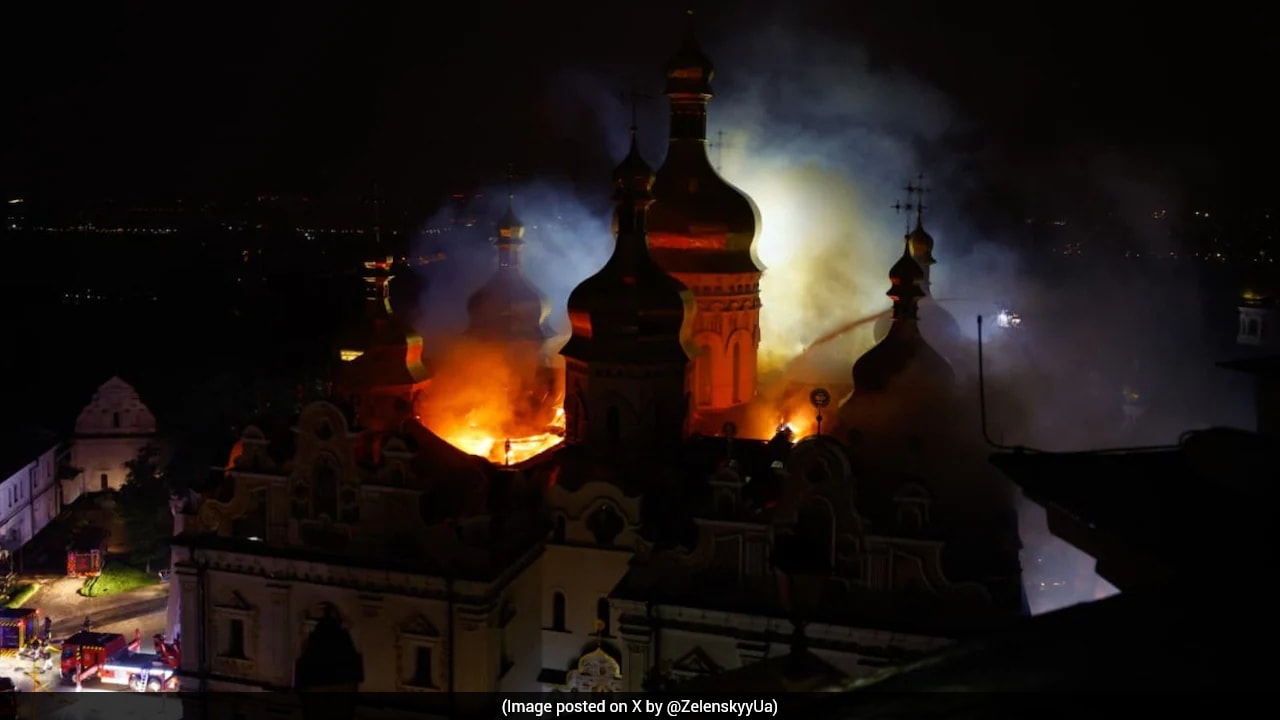
A missile, or the blazing fragment of one shattered in mid-air, struck near one of the city's historic cultural sites. The blast wave shattered windows dating back two centuries. It ripped ancient plaster from the walls and left a layer of gray dust over art that had survived revolutions, fires, and the czars.
This is the hidden mathematics of modern conflict. We measure the immediate horror in body counts, and rightly so. Eleven lives are eleven universes extinguished. But there is a secondary, slower campaign underway—a war against the evidence that a people ever existed at all.
To understand what happened, you have to look past the military briefings. Think about a painting hanging in a gallery. It is just pigment on woven fabric. It has no physical power. It cannot stop a piece of shrapnel traveling at supersonic speed. Yet, millions of dollars are spent to target the cities where these paintings hang, and immense human effort is spent to pack them into wooden crates and hide them in secret basements.
Why? Because a missile does not just want to destroy a bridge or an oil depot. It wants to break the thread that connects the person standing in the rubble today with the ancestors who built the city under their feet. If you destroy the art, the archives, and the architecture, you erase the receipts of a nation's history. You turn a distinct society into a blank slate.
Consider what happens next when a historic site is breached. The immediate response is not academic; it is desperate and visceral. Curators, volunteers, and elderly historians who have spent forty years guarding these halls do not run away from the smoke. They run into it. They sweep up glass with shaking hands. They use pieces of cardboard to cover holes where winter air threatens to ruin centuries-old manuscripts. They are not soldiers, but they are fighting on a frontline that stretches through time.
The tragedy of a long war is the normalization of the absurd. In the first months, a single struck building was global news. Now, a massive attack that claims eleven lives and chips away at Europe's old heritage is compressed into a short headline, a push notification that disappears with a swipe of a thumb. The danger is not just the kinetic force of the weapons; it is the fatigue of the onlookers.
When the dust settles on the broken galleries of Kyiv, the physical damage can eventually be patched with mortar and glass. The eleven families will face a quiet, permanent emptiness that no treaty can fix. And the paintings, wiped clean of soot by careful hands, will go back on the walls, bearing new, invisible scars. They remain there as stubborn witnesses, proving that even when the sky turns to iron, the story of a place cannot be buried under the weight of its own ruins.