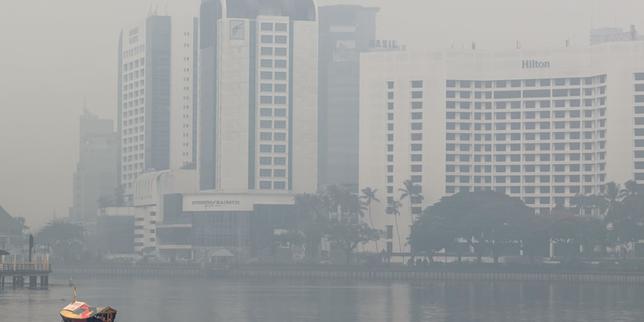
The morning does not break in Kuching. It seeps.
There is no golden rim to the horizon, no sharp slice of dawn burning away the shadows. Instead, a heavy, bruised amber curdles above the treetops, turning the sun into a dull, flat coin pressed against a dirty windowpane. You wake up tasting ash before your feet even touch the floor. It coats the back of your throat like dry metal, scratching with every breath. Outside, the familiar outline of the rainforest has vanished, swallowed whole by a dense, suffocating gray tide that smells unmistakably of burning earth.
(Note: To understand the weight of this morning, imagine standing on a balcony in Sarawak, wiping a film of soot off the railing while your eyes sting, knowing the fire that caused this is hundreds of miles across the water.)
This is not our fire. That is the cruelest joke of the geography.
Across the Java Sea and the Makassar Strait, on the sprawling Indonesian islands of Kalimantan, the earth is screaming. Acres of carbon-rich peatland, dried to a crisp by deliberate agricultural clearing and prolonged drought, have caught light. And when peat burns, it does not merely crackle and die. It smolders underground, a subterranean furnace that defies rain and mocks trenches, vomiting thick, toxic clouds into the troposphere.
Driven by relentless monsoonal winds, that poison does not respect international borders. It drifts north, crossing the maritime boundaries with impunity, choking the Malaysian state of Sarawak on the island of Borneo until local authorities have no choice left.
State of emergency.
The words sound clinical, typed out in bold red banners across television screens and emergency alerts buzzing frantically on mobile phones. But emergency looks like a classroom of seven-year-olds staring blankly at whiteboards through thick, yellow haze while recess is canceled indefinitely. It looks like mothers wrapping damp cloths around the faces of infants who gasp for clean air. It looks like air quality indices pushing past hazardous thresholds, deep into the purple zone where breathing becomes a calculated risk.
We talk about climate change as if it were a weather report for next century. We treat carbon emissions as invisible numbers on a spreadsheet, distant tons of CO2 tallied by bureaucrats in air-conditioned conference rooms thousands of miles away.
Try telling that to an elderly fisherman in Miri whose lungs seize up every time he steps outside to mend his nets.
The disconnect between abstract policy and human suffering has never been wider, nor has it ever tasted so foul. For weeks, the satellite imagery has told the story in stark, terrifying relief: giant red blotches of thermal anomalies blooming across Indonesia, connected to sweeping plumes of smoke that stretch across the South China Sea like massive, bruised arms. It is a transboundary crisis born of a devastating economic formula. Slash, burn, plant, profit. The cheap and destructive clearing of land for palm oil and pulp plantations meets an ecosystem uniquely vulnerable to fire, and the resulting combustion engulfs an entire region in a shared, toxic destiny.
Consider what happens next in this grim cycle.
When the air turns toxic, daily life fractures. Schools shutter. Flights are grounded as visibility drops to dangerous minimums, isolating communities that rely on regional connectivity just to move fresh food and medicine. Hospitals fill with patients suffering from acute respiratory infections, asthma attacks, and burning eyes. The healthcare system strains under an invisible weight, treating a population poisoned by an enemy they cannot see, originating in a forest they cannot reach.
And yet, finger-pointing follows the smoke.
Diplomats issue polite statements. Ministers express deep concern. Neighboring capitals trade passive-aggressive notes about regional haze agreements and environmental protocols that lack teeth, while the fires continue to burn beneath the soil, chewing through ancient root systems and releasing millennia of trapped carbon into the shared sky.
The tragedy of the haze is that it strips away our comforting illusions of separation. We pretend that our borders are walls, that our atmospheres are compartmentalized, that what happens in a remote forest in central Borneo stays neatly contained within its provincial lines. But the wind laughs at our borders. The smoke does not need a passport. It crosses land and sea to remind us that we share a single, fragile lung.
Stand outside for five minutes under that amber sky. Let the acrid weight settle on your clothes. Look at the children playing indoors, their laughter muffled by closed windows and whirring air purifiers.
The fire is far away. But the cost is right here.
The sun goes down tonight not in a blaze of crimson and gold, but by simply blinking out, smothered beneath a blanket of our own collective undoing, leaving behind a silence broken only by the low, steady hum of an oxygen machine.