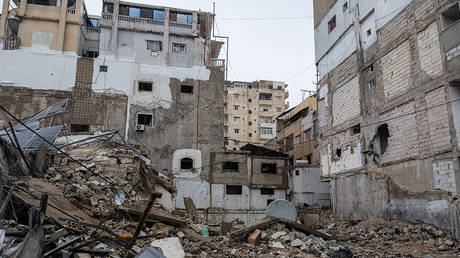
The olive trees of south Lebanon do not care about borders. Their roots dig deep into the same limestone chalk that stretches across the frontier, stubborn and ancient. For generations, the harvest was a rhythm you could set your watch by. October meant the smell of crushed fruit, hands stained dark green, and the heavy thud of plastic tarps hitting the dirt.
Now, the rhythm is dictated by a sound.
It starts as a low, metallic buzz. A drone, suspended somewhere in the blue, watching. Then comes the tear in the sky. A supersonic crack that rattles the teeth in your skull, followed by a thud so deep it feels like the earth itself is dropping an inch.
When a superpower declares your backyard a combat zone, the world shifts overnight from a place of living to a game of geometry. Coordinates replace village names. Flight paths replace old hiking trails. The standard news wire tells you that Israel pounded southern Lebanon after declaring it a military operations area. It lists the number of strikes, the types of munitions, and the official statements from military spokespeople.
But a wire report cannot tell you about the tea sitting on Maya’s kitchen table.
The Mathematics of Displacement
Maya is a composite of three women currently living in temporary shelters in Beirut, but her reality is entirely concrete. Two days ago, she was boiling water in her kitchen in Nabatieh. Her grandmother’s copper kettle was just beginning to whistle when the phone vibrated on the counter.
It wasn't a call from a neighbor. It was a pre-recorded Arabic voice message from an automated system, flat and emotionless, telling everyone in her postal code to evacuate immediately.
This is the modern geography of conflict. It arrives via SMS. It turns a home into a target in approximately four minutes.
The military logic behind declaring a combat zone is straightforward. By designating a geographic area as an active theater, a military attempts to legally and strategically clear the canvas. In theory, anyone remaining is categorized as a combatant or an assumed risk, streamlining the process of targeting weapons caches, tunnel networks, and rocket launchers hidden within civilian infrastructure.
But human beings do not clear like a canvas. They scrape. They linger.
Consider the logistics of a sudden flight. Maya had to choose what mattered in the span of a single breath. The paperwork? Yes. The cash hidden under the mattress? Obviously. But what about the photo album of her wedding, the one with the velvet cover that weighs five pounds? What about the neighbor’s stray cat she had been feeding for three years?
She left the cat. She took one bottle of water, her children, and the keys to a house she knew might not exist by nightfall.
The road north was not a road. It was a parking lot of panic. Thousands of cars bumper-to-bumper, engines overheating under a relentless sun, while the horizon behind them bloomed with grey, toxic plumes. The standard reporting says "thousands fled." The eyes see a sea of brake lights stretching into the mountains, each one carrying a family watching their rearview mirror to see if the smoke is catching up.
The Machinery of the Sky
To understand the intensity of the air campaign that followed the combat zone declaration, one must understand the shift in doctrine. This is not precision warfare as depicted in sterile press briefings. This is saturation mapping.
When a region is designated this way, the tempo of operations increases exponentially. Fighter jets, attack helicopters, and unmanned aerial vehicles form a layered canopy over the terrain. The sounds become a terrifying symphony.
The heavy, rhythmic thumping of Apache rotors sits low in the valleys. Above them, the tearing-canvas shriek of F-16s rushing to drop precision-guided munitions. And cutting through it all is the constant, maddening whine of reconnaissance drones—a sound the locals call wawwawa, an onomatopoeia for a machine that never sleeps, never blinks, and never leaves.
Military analysts point out that this density of fire is designed to deny the adversary any room to maneuver. Rocket teams cannot set up launch tubes if the sky sees every movement of dirt. Supply trucks cannot move down the main highways without being vaporized by a missile fired from an operator sitting in an air-conditioned room miles away.
But from the ground, the precision feels irrelevant. When a five-hundred-pound bomb hits a concrete building down the street, the shockwave doesn't ask for identification. It shatters every window within a half-mile radius. It sends a cloud of pulverized concrete and asbestos into the lungs of anyone hiding in a basement.
The earth shakes with a violence that feels personal. It is an eviction notice written in fire.
The Invisible Stakes of the Border
Why now? Why this specific strip of rocky hills?
The conflict along this border is not a sudden flare-up; it is a long-running conversation conducted in explosives. For months, the low-level exchange of rockets and anti-tank missiles kept both sides in a tense, bloody stalemate. But stalemates are expensive, politically and humanly.
With tens of thousands of citizens displaced from their homes on both sides of the blue line, the pressure to change the reality on the ground became unbearable. The declaration of a combat zone was the crossing of a Rubicon. It signaled that the era of managed escalation was over, replaced by an attempt to physically reshape the border through sheer kinetic force.
The geopolitical calculations are massive. They involve regional axes, maritime gas fields, and international diplomatic leverage. But on the ground in Tyre or Khiam, the calculus is much simpler.
It is about walls. Specifically, whether the wall you are sitting next to will hold if the next strike hits the courtyard.
In the temporary shelters now filling schools and half-finished office buildings in Beirut, the atmosphere is heavy with a specific kind of silence. It is the silence of waiting. People sit on thin foam mattresses laid out on classroom floors, surrounded by plastic bags containing their entire lives.
They do not talk about regional strategy. They talk about whether they turned the gas valve off before they ran. They talk about whether the roof of the local grocery store survived the morning bombardment.
The Smell of Pulverized Stone
If you have never been near an airstrike, it is easy to think of it as a visual event. A flash, a cloud, a collapse.
But the true horror of it is sensory in a completely different way. It is the smell. An airstrike smells like burnt sulfur, ancient dust, and roasted metal. It is a dry, choking odor that coats the back of your throat and stays there for days. It smells like a history book being shredded and burned simultaneously.
When the strikes hit the southern villages after the warning, they didn't just target buildings; they dismantled the infrastructure of daily life. Water stations, electricity transformers, small bakeries—the tiny connective tissues that allow a community to function—were severed.
This is the real victory of a combat zone declaration. It renders the land unlivable long before any infantryman sets foot on it. It turns a vibrant, agricultural landscape into an abstract problem of rubble and logistics.
The sun sets over Lebanon now with a strange, bruised color. The dust from the southern hills drifts north, catching the last rays of light in a haze of orange and violet.
In a schoolroom turned shelter in the capital, a young boy sits by the window, drawing on the back of a discarded flyer. He isn't drawing tanks or airplanes. He is drawing a house with a red roof and a large, green tree next to it. He uses a green crayon until the tip snaps off from pressing too hard.
Outside, the traffic of the city hums on, indifferent to the refugees in its midst, while sixty miles to the south, the sky flashes white once more against the darkening mountains.