The diesel exhaust in Windsor, Ontario has a specific weight to it. It hangs in the humid air, mixing with the scent of river water and asphalt. For twenty-two years, Marcus Vance has breathed that air from the cabin of a Volvo semi-truck. He knows the rhythm of the border better than most. He knows that when the brake lights ahead of him stretch into a continuous, glowing red snake toward the horizon, a few pennies have just changed value somewhere in New York, or a bureaucrat in Ottawa has cleared his throat.
But lately, the rhythm is broken.
Marcus isn't just idling his engine; he is watching a six-lane lifeline of steel and concrete freeze in mid-air.
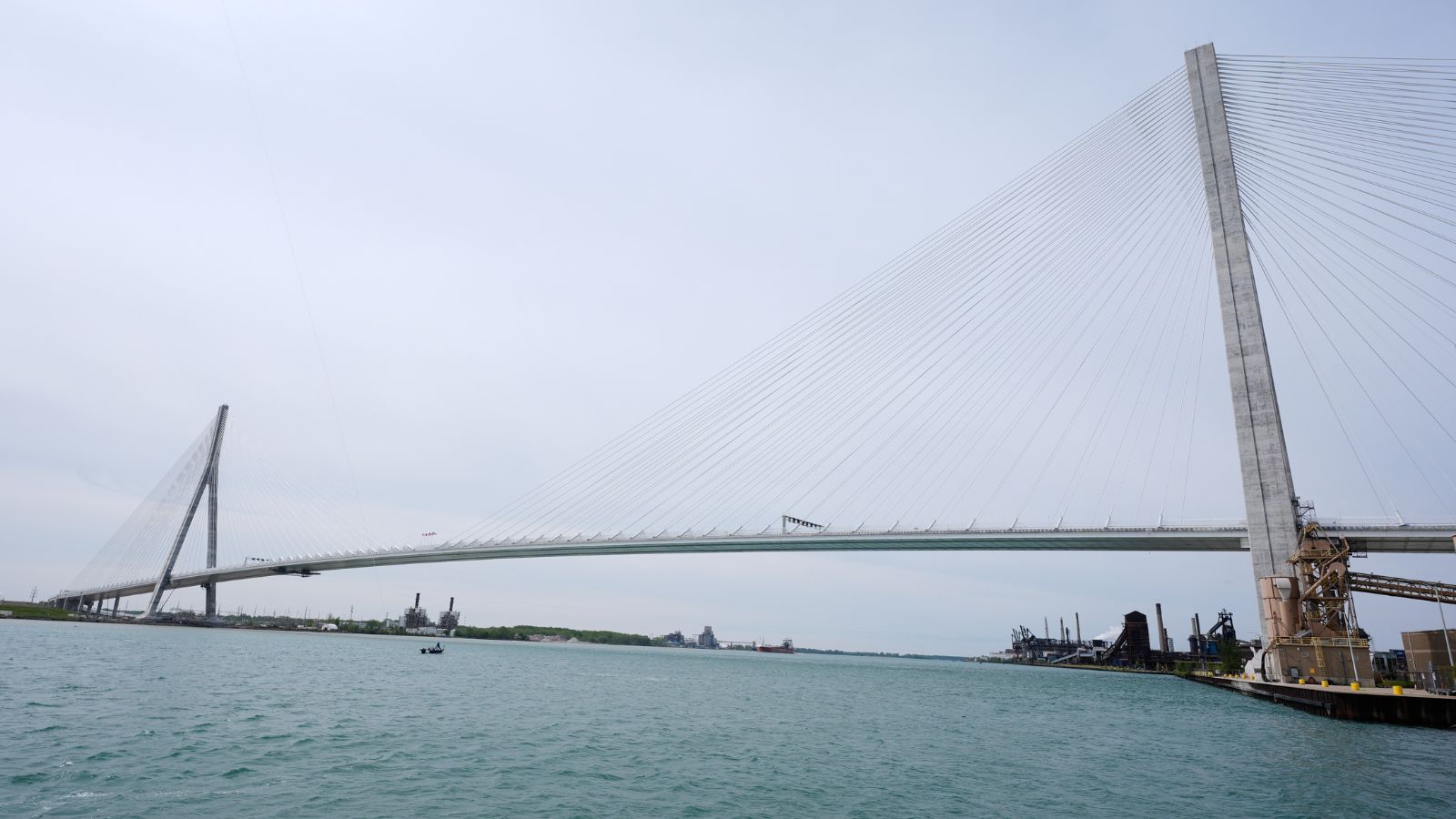
Just a few miles down the Detroit River, the Gordie Howe International Bridge was supposed to be the answer. For a decade, it has been promised as the ultimate bypass—a majestic, cable-stayed monument that would finally relieve the choking bottleneck of the aging Ambassador Bridge. It was supposed to open wide, letting billions of dollars in auto parts, produce, and machinery glide effortlessly between the United States and Canada.
Then came the threat from Washington.
Now, the grandest infrastructure project in North America is caught in a political wind shear. The concrete towers stand tall against the gray sky, but the invisible currents surrounding them have suddenly turned icy.
The Concrete Versus the Word
To understand why a single bridge matters, you have to look at the numbers that usually hide in boring economic reports. Nearly $400 billion in trade crosses the US-Canada border every year. A massive chunk of that squeezes through this single corridor. It is a tightly choreographed dance of just-in-time manufacturing. A bumper stamped in Ontario needs to arrive at a Michigan assembly plant within a precise two-hour window, or the entire line grinds to a halt.
The Gordie Howe Bridge was engineered to make sure that dance never stopped. It is an engineering marvel, boasting the longest main span of any cable-stayed bridge in North America.
But steel wires are only as strong as the treaties that allow trucks to cross them.
When Donald Trump announced his intention to impose sweeping 25 percent tariffs on all Canadian imports, he did not just target lumber or oil. He threw a wrench into the gears of the bridge itself. Almost immediately, the atmosphere at the construction site shifted. The physical work continued, but the financial and strategic foundations began to groan under the weight of uncertainty.
Consider what happens next when a border becomes a barrier instead of a gateway.
Private investors and international logistics firms operate on predictability. They build warehouses, buy fleets, and hire workers based on the assumption that a bridge built today will be flooded with traffic tomorrow. When a major political shift threatens to penalize the very goods meant to cross that bridge, the math breaks down. Project managers face a sudden, terrifying question: What if we build a massive highway to a closed door?
The View From the Cab
Marcus rolls down his window, spitting into the gravel by the side of the road. His truck is loaded with steering columns bound for an assembly plant in Ohio. Every hour he sits here, his paycheck shrinks.
"They talk about tariffs like they're just numbers on a spreadsheet," Marcus says, tapping his fingers against the worn leather of his steering wheel. "But if those tariffs hit, the company I drive for might cut its cross-border routes entirely. They won't need this new bridge. They won't need me. We’re building a multi-billion-dollar monument to a partnership that people are trying to tear down."
The delay isn't just about construction timelines, though engineering teams have quietly admitted that coordinating international inspections and customs technology becomes infinitely more complicated when the regulatory ground is shaking. The real delay is psychological. It is a freeze in confidence.
The Gordie Howe Bridge project has already faced its share of natural hurdles, from pandemic disruptions to complex soil conditions along the riverbanks. But those were physical problems with engineering solutions. You can pump out water; you can reinforce shifting dirt. You cannot engineer your way out of a sudden geopolitical storm.
The financial stakes are staggering. The project, managed by the Windsor-Detroit Bridge Authority, is a public-private partnership. This means private companies have put up massive amounts of capital with the expectation of recovering their investment through tolls and increased trade volume. If tariff walls go up, trade volume goes down. If trade volume drops, the financial model of the bridge collapses, leaving taxpayers or private consortia holding a very expensive, very quiet piece of infrastructure.
The Invisible Friction
It is easy to get lost in the grand scale of international politics, to view this as a simple clash of egos between Washington and Ottawa. But the friction is felt most acutely at the ground level, where the abstract becomes concrete.
In local diners along the Windsor waterfront, the conversation isn't about global trade theory. It is about survival. Small business owners who rely on the daily influx of American tourists and cross-border workers are watching the news with a knot in their stomachs.
"We built our whole lives around the idea that the river is just a street we cross," says Elena, who runs a bakery frequented by commuters from both sides of the border. "If they make it harder to cross, if they make it hostile, the new bridge won't save us. It will just be a bigger shadow over an empty neighborhood."
This is the hidden cost of political volatility. It creates a fog that distorts the future. When the rules of engagement between two historic allies can be rewritten in a single evening, long-term planning becomes an act of reckless gambling. The Gordie Howe Bridge was meant to be a symbol of permanence, a declaration that the bond between these two nations was cast in iron. Instead, it has become a barometer for the fragility of modern alliances.
The irony is thick enough to choke on. The bridge is named after a hockey legend who played for the Detroit Red Wings but was born in Saskatchewan—a man who embodied the seamless blend of Canadian grit and American industry. He belonged to both places, moving across the border as easily as a skate cuts through ice.
A Quiet Standoff
The sun begins to set over the Detroit River, painting the unfinished towers of the bridge in shades of bruised purple and orange. The construction cranes are parked for the night, standing like giant birds frozen in time.
Below them, the traffic on the old bridge moves with an agonizing slowness.
Engineers will tell you that a cable-stayed bridge relies entirely on tension. The cables must pull against the deck with immense force to keep the whole structure suspended in the air. It is a delicate balance of opposing pressures.
Right now, the Gordie Howe International Bridge is holding its breath, caught in a different kind of tension. It is suspended between a massive, physical reality that is nearly complete and a political reality that could render it obsolete before the first ribbon is cut.
Marcus shifts his truck into first gear, moving forward exactly three feet before hitting the brakes again. The red lights reflect in his rearview mirror, casting a warm, deceptive glow over a landscape that feels increasingly cold. He looks out toward the new span, its cables catching the last rays of daylight.
The steel is there. The concrete is there. The river is still there. But the bridge, for all its immense weight, has never felt more weightless.