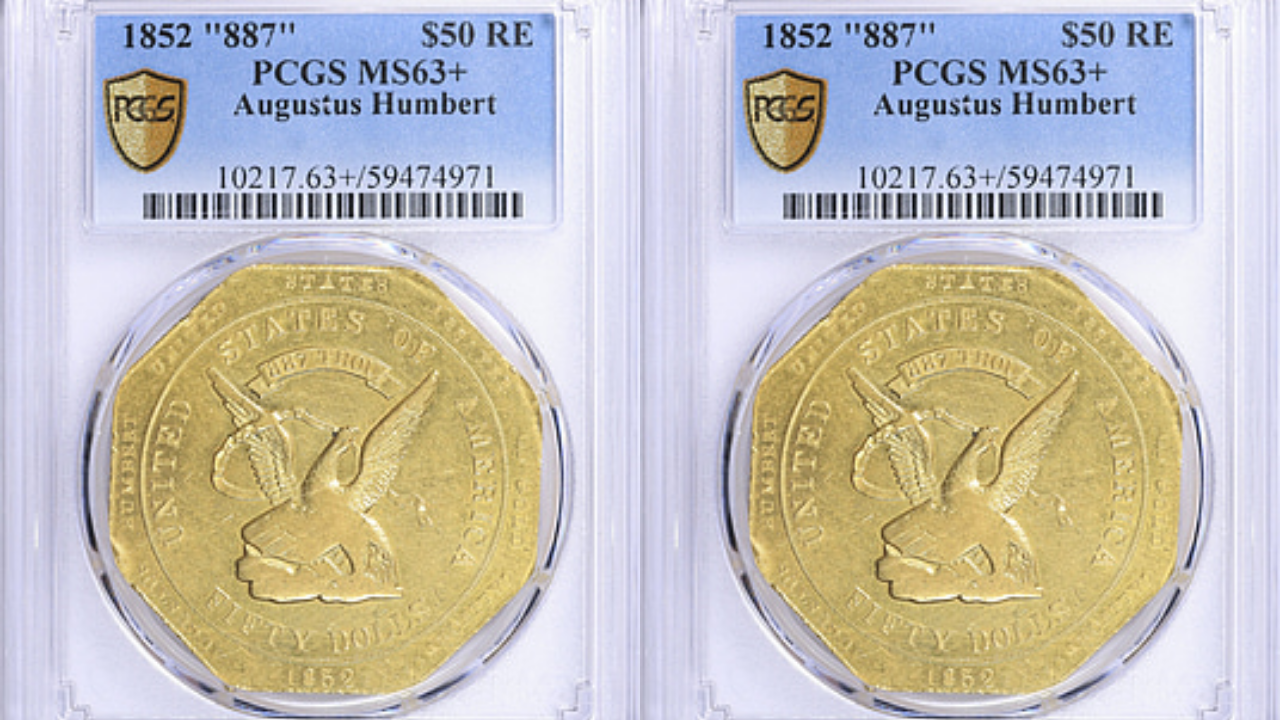
A private collector recently shelled out $367,875 for an 1852 California Gold Rush fifty-dollar slug, proving that physical remnants of America’s wildest economic experiment still command staggering sums. This massive octagonal gold piece, weighing nearly two and a half ounces, was not minted by the federal government. It was an emergency measure forged out of necessity, desperation, and raw ambition when California found itself swimming in raw precious metal but utterly starved of actual circulating currency.
When James Marshall pulled flakes of gold out of the American River at Sutter's Mill in 1848, he triggered a chaotic stampede that upended the global economy. Overnight, thousands of miners flooded the Sierra Nevada foothills. They pulled tons of gold from the earth, but they faced a crushing paradox. They had plenty of wealth in raw metal, yet they could not buy a loaf of bread or a shovel. The nearest United States mint was in Philadelphia, thousands of miles away across treacherous terrain. Shipping raw gold east was expensive, slow, and dangerous.
The local economy needed a medium of exchange immediately. Enter the private assayers. Without official authorization from Washington, private firms stepped into the vacuum, melting down raw dust and nuggets into standardized gold coins. Among the most prolific of these operations was Augustus Humbert, who served as a United States assay office official in San Francisco, alongside private entities like Moffat & Co.
These heavy octagonal pieces, affectionately dubbed "slugs," were cumbersome. They were rough around the edges, irregular in their purity checks during the earliest days, and massive compared to traditional eastern coinage. Yet, they functioned. They allowed merchants to transact business, kept mining camps supplied, and provided a temporary bridge until the San Francisco Mint finally opened its doors in 1854.
The auction price of nearly $370,000 reflects more than just rarity. It represents the concrete weight of a turbulent era when trust was local and liquidity had to be manufactured by entrepreneurs. The 1852 slug remains a tangible artifact of an era where federal bureaucracy lagged years behind reality, forcing ordinary citizens to build their own monetary system from scratch.
Modern numismatists understand that these pieces carry historical scars. Many show test cuts, scratches, and dents where merchants and saloon keepers verified that the metal was solid gold and not a clever base-metal core wrapped in gilt. Those marks tell the true story of the frontier. They are evidence of immediate, hard-nosed skepticism. In a boomtown where fortunes appeared and vanished in a single afternoon, nobody trusted anything at face value.
The premium paid for this specific specimen highlights the enduring appeal of the Gold Rush era. While digital ledgers and fiat currencies dominate modern commerce, the primal allure of heavy, high-purity gold remains entirely intact. When a piece of frontier history commands the price of a suburban home, it serves as a stark reminder that physical assets issued during times of crisis retain a unique, unshakeable hold over the human imagination.