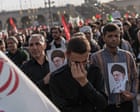
The heat does not care about history. It settles over the asphalt of Tehran like a wet wool blanket, trapping the smell of exhaust, rosewater, and the sweat of hundreds of thousands of human bodies pressed shoulder to shoulder.
A sea of black cloth stretches as far as the eye can see. From above, it looks like a single, massive organism breathing in slow, agonizing sync. But look closer. Look at the edges of the crowd, where the grand political statements splinter into fragile human realities.
An old man leans heavily on his grandson’s shoulder. His feet, clad in worn leather sandals, have been shuffling along the pavement for four hours. His eyes are fixed on the horizon, weeping not just for a fallen leader, but for the youth he spent living under the shadow of a single name. Beside him, a young woman adjusts her black chador with a quick, nervous flick of her wrist. She is not crying. Her eyes dart toward the side streets, measuring the distance to safety, wondering if the world outside this suffocating mass of humanity realizes how fast the ground is shifting beneath their feet.
Six days.
That is how long the state has decreed the mourning will last. Six days of closed shops, shuttered banks, halted traffic, and endless, echoing chants broadcast from loudspeakers bolted to utility poles. For the outside world, analyzing the event through satellite feeds and intelligence briefings, this is a geopolitical pivot point. It is a data point in a security assessment. But for the people walking these streets, it is a surreal suspension of time.
The Anatomy of an Echo
To understand the weight of this moment, one must understand how sound moves through a crowd of this magnitude. It starts as a low rumble at the front of the procession, where the official mourners lead the cadence. It travels backward, bouncing off the concrete facades of apartment buildings, mutating from a structured chant into a raw, collective roar.
By the time it reaches the back rows, the words lose their literal meaning. They become pure rhythm. Thump. Thump. Thump. Hand against chest. A physical percussion that vibrates through the soles of your shoes.
Consider a hypothetical shopkeeper named Reza. For thirty years, Reza has sold saffron and dried barberries from a small stall in the Grand Bazaar. His life is measured in grams, rials, and the daily arrival of the afternoon sun hitting his counter. Today, his metal shutter is locked down. He stands on a street corner, watching the procession pass.
Reza is old enough to remember the last time a supreme leader died. He remembers the chaotic grief, the absolute certainty back then that the world was ending. This time, the feeling is different. The grief is still there, carefully orchestrated and deeply felt by millions, but it is laced with a profound, unspoken anxiety.
The question isn't just who will take the seat of power. The question is what happens to the price of bread tomorrow. What happens to the internet connection his daughter uses to study? What happens when the six days expire and the music stops playing?
The state demands total devotion to the ritual, but human survival demands calculation. Even in the middle of a historic funeral, people are whispering about bank withdrawals and the black-market rate of the dollar. The sacred and the terrifyingly mundane walk hand in hand down the avenue.
The Invisible Fault Lines
The foreign cameras capture the grand scale perfectly. They show the sweeping drone shots of the square, the immense banners bearing the face of the deceased leader, the tears streaming down the faces of the faithful. They capture a monolithic entity.
But the monolith is a myth.
Iran is a country composed of overlapping, conflicting realities. There are those who view the departed leader as a holy protector, the only shield standing between their ancient culture and Western decay. To them, this death is a deeply personal tragedy, an orphanhood of the soul. They march because their hearts are genuinely broken.
Then there are those who march because their employment contracts require a stamp of attendance.
There are university students who joined the crowd simply because staying home felt more dangerous than disappearing into the anonymous mass. They wear the required dark clothing, but their minds are miles away, plotting trajectories out of a economic stagnation that has choked their ambitions for a decade.
The tension between these worlds is palpable, even if it never breaks the surface of the ritual. It is present in the way people look at each other. A glance prolonged for a second too long can mean everything or nothing. Trust is a luxury that has been rationed just as strictly as fuel.
The state media broadcasts images of unified sorrow to the world, a display of strength intended for adversaries across the ocean. Look at our numbers, the images say. Look at our devotion. But true power does not need six days of mandated theater to prove its existence. The very length of the ritual betrays a deep-seated fear of what happens when the silence returns.
The Architecture of Grief
Organizing a six-day funeral for millions of people is an staggering feat of logistics. Water trucks line the avenues, their hoses spraying a fine mist over the crowds to prevent heatstroke. Emergency vehicles sit with their lights flashing silently, unable to move through the dense pack of bodies.
Volunteers hand out sweet syrup in plastic cups. The plastic crunches underfoot by the millions, creating a strange, crackling soundtrack beneath the solemn hymns.
This is the machinery of public emotion. It is an industry built over decades, designed to channel raw human feeling into a specific political shape. Every flag, every chant, every route has been calculated by a committee.
But humans are messy. They do not always follow the script.
Midway through the afternoon, a minor scuffle breaks out near a water distribution point. A young man, exhausted and dehydrated, drops his cup. Someone pushes. Someone shouts. For a terrifying ten seconds, the rhythm of the march breaks. The crowd sways violently.
In that brief moment, you can see the absolute fragility of the order. If the crowd panics, thousands could die in a crush. The security personnel, heavily armed and positioned at every intersection, move forward with their hands on their holsters. Their faces are masked, but their eyes show the same thing everyone else is feeling.
Fear.
The incident dissolves as quickly as it began. An older woman steps between the shouting men, offers them a fresh cup of water, and murmurs a prayer. The rhythm resumes. The mass moves forward. But the reminder lingers: underneath the grand display of national unity lies a volatile energy that could shift in an instant.
When the Banners Fade
By the fourth day, the energy begins to change. The initial shock of the announcement has worn off, replaced by a grinding, physical exhaustion. The air in Tehran grows thicker, heavy with the dust kicked up by millions of marching feet.
The banners are starting to look frayed at the edges. The faces printed on them, meant to evoke timeless authority, look slightly weathered under the relentless sun.
This is when the reality of the future begins to press in. The funeral is a buffer zone. It is a calculated pause button hit on the nation’s destiny. While the mourning continues, no major policy decisions can be made. No new conflicts can officially begin. No new crackdowns can be openly implemented.
It is a truce with time.
But the truce is running out. Behind the closed doors of the government buildings lining the funeral route, the real story is happening in total silence. Phones are ringing. Documents are being shredded or signed. Alliances are being forged in whispers while the crowds outside sing themselves hoarse.
The people in the streets know this. They are not blind to the machinery. They have lived through enough transitions, enough promises, and enough disappointments to know that the spectacle on the street is merely a curtain.
The real drama is happening backstage.
The Final Hours
On the sixth day, the procession reaches its climax. The body will finally be laid to rest in the massive, gold-domed mausoleum on the outskirts of the city. The heat has broken slightly, replaced by a gray, overcast sky that matches the mood of the capital.
The crowd is quieter now. The frantic energy of the early days has given way to a somber, heavy resignation.
We watch the coffin pass, elevated on a flatbed truck, encased in glass and covered with floral arrangements. To the true believers, it is a sacred vessel. To the cynics, it is the end of a long, difficult chapter. To the millions caught in the middle, it is simply a marker of an uncertain tomorrow.
The grandson who spent the week supporting his grandfather now stands alone near the edge of the highway. His grandfather grew too weak to attend the final day, left behind in a quiet room with a fan oscillating against the heat.
The young man watches the truck disappear down the road toward the southern horizon. The crowd begins to thin, people melting away into the side streets, shedding their black garments as soon as they are out of sight of the security cameras. The ordinary world is clawing its way back. A motorbike engine roars to life. A street vendor yells the price of tomatoes.
The six days are over. The pause has ended. The nation holds its breath, waiting for the first sound to break the new silence.