Silence in the Persian Gulf rarely means peace. Usually, it just means everyone is holding their breath.
If you live on a small island archipelago tethered to the Arabian Peninsula by a sixteen-mile causeway, you learn to read the sky differently than people who live in the middle of vast continents. You watch the horizon over the water not for weather, because the weather is almost always an unrelenting, humid glare, but for movement. You listen to the hum of the desalination plants and the distant thrum of the refineries, the twin mechanical heartbeats that keep life possible on a strip of desert rock where fresh water does not naturally exist in enough volume to sustain a modern city.
So when the official wires crackled out a single, clinical headline—that Bahrain reported an Iranian attack striking an industrial facility while air defenses intercepted incoming threats—the rest of the world read it as another data point in a long, exhausting ledger of regional friction. A ticker symbol twitched. An oil trader in London leaned forward over a glowing terminal. An analyst in Washington updated a map with a fresh red dot.
Then they went to lunch.
In Bahrain, nobody simply goes to lunch after the sky lights up.
To understand what actually happens when iron meets concrete in the Gulf, you have to step away from the satellite imagery and the sterile language of military communiqués. Words like interception and industrial facility are linguistic sedatives. They sanitize violence. They turn a terrifying breach of the night sky into an accounting entry. They hide the truth that in a place as compact and interconnected as Bahrain—an island nation roughly three and a half times the size of Washington, D.C.—there is no such thing as a remote strike. Every pipe, every turbine, every storage tank sits within earshot of a neighborhood, a school, or a family trying to sleep through the heat.
The Architecture of Vulnerability
Consider a hypothetical night shift supervisor—let us call him Tariq, a composite of the thousands of engineers and technicians who keep the Gulf’s industrial arteries pumping while the rest of the region sleeps. Tariq works in a control room surrounded by banks of monitors that track pressure gauges, flow rates, and thermal sensors across miles of gleaming steel piping.
For Tariq, the abstract geopolitics of the Strait of Hormuz are not theoretical. They are measured in pounds per square inch.
When air defense batteries engage inbound drones or missiles overhead, the physics of the event do not end at the moment of interception. People often imagine a missile shield as an invisible glass dome that vaporizes threats into harmless dust. Reality is far messier, and far heavier. An interception at thirty thousand feet is a violent collision of supersonic metal and high explosives. Even when the shield works—even when the primary warhead is destroyed before reaching its target—gravity still collects its due. Shrapnel, twisted fuselage fragments, and unspent propellant rain downward across whatever lies beneath the flight path.
And when one slips through, or when a strike lands directly on an industrial compound, the danger is not merely the initial blast. It is the secondary chain reaction.
Industrial facilities in the Gulf are marvels of modern engineering, dense ecosystems of pressurized hydrocarbons, volatile chemicals, and high-voltage electrical grids. A single breach in a containment wall or a ruptured pipeline does not just break a machine; it threatens to turn a workplace into a furnace. Inside that control room, the transition from routine monotony to existential crisis takes less than three seconds. One moment, the air conditioning hums and a mug of cardamom tea cools beside a keyboard. The next, the floor vibrates with a sub-audible thud that you feel in your teeth before your ears even register the roar. Alarms shriek. Screens flash crimson.
Wait.
Stop and picture that room for a second.
The manuals tell you to follow protocol, to isolate the valves, to shut down the turbines in sequence so the pressure doesn't blow the entire grid apart. Your hands, however, are human hands. They shake. Your mind races outward from the control panel to an apartment complex ten miles away where your wife and two children are waking up to the rattle of windowpanes. You have to choose between running for the reinforced bunker or staying at the console for sixty agonizing seconds to bleed the pressure off a storage line so the fire doesn't spread to the neighboring tank farm.
That is the invisible stake behind a two-sentence news alert. That is what "industrial facility" actually means.
Why Every Square Mile Counts
To grasp why an attack on Bahrain carries a psychological weight vastly disproportionate to its geographic footprint, you have to look at a map—not a political map with neat colored borders, but an infrastructure map.
Bahrain was the first state on the Arab side of the Persian Gulf to discover oil, back in 1932. Over the following nine decades, the island transformed from a quiet pearling and trading hub into a densely woven tapestry of finance, heavy industry, aluminum smelting, and maritime logistics. Unlike Saudi Arabia or Iran, which possess vast hinterlands where strategic assets can be scattered across hundreds of miles of empty desert, Bahrain has nowhere to hide its vital organs. Everything is layered on top of everything else.
A major refinery sits just down the road from residential suburbs. One of the world's largest aluminum smelters operates within sight of major highways. Desalination plants—the literal lifelines that turn undrinkable seawater into the water flowing from every tap and hospital faucet—sit exposed along the coastline.
In military strategy, analysts talk about "strategic depth"—the distance between a nation's front lines and its core population centers. Bahrain has almost zero strategic depth. When an aerial threat crosses its coastline, the margin for error is measured in seconds, not minutes.
Let us be candid about something that defense briefings rarely admit: modern air defense is an extraordinary technological feat, yet it is also an exhausting, nerve-shredding gamble. Every time batteries launch interceptors into the dark, operators are playing a high-stakes game of probability against trajectories, decoys, and weather patterns. Even a ninety-five percent success rate leaves a five percent gap. In a sprawling country, five percent might land in an empty scrubland or a dry riverbed. On a crowded island, five percent lands on a warehouse, a substation, or a processing plant.
And even when the shield holds completely, the economic and emotional tax is paid in full.
The Ripple Across the Water
You might wonder why a localized strike on a single facility in a small Gulf state should matter to someone checking their phone thousands of miles away in Chicago, Frankfurt, or Tokyo. It is easy to succumb to headline fatigue when Middle Eastern tensions flare and cool in endless cycles.
Yet the global economy is built on an illusion of effortless abundance, and the Persian Gulf is the engine room where that illusion is maintained.
Consider what happens next when an industrial site takes a hit, even if the fire is extinguished by dawn and production resumes within days. First comes the immediate shock to the people on the ground—the workers who have to walk back onto a scorched site the next morning, inspecting warped steel and wondering if the sky will stay quiet through their next shift. Then comes the quiet, methodical repricing of risk.
Maritime insurers in London adjust their war-risk premiums for vessels entering the Gulf. Shipping companies reroute tankers or delay departures by twelve hours while security protocols are reviewed. Commodity markets, which run on sentiment just as much as physical supply, bake a fresh layer of anxiety into the price of energy, aluminum, and petrochemicals. That tiny fraction of a cent added to fuel and raw materials travels silently through supply chains, showing up months later in the cost of airfare, packaging, construction materials, and groceries on shelves half a world away.
More than that, though, these incidents erode something far harder to repair than a damaged turbine: the fragile psychology of deterrence.
For decades, the Gulf states have walked a precarious tightrope. They have poured billions into transforming their cities into glittering global crossroads—places of gleaming glass towers, international sporting events, and frictionless commerce—while sitting right next door to one of the most volatile geopolitical fault lines on earth. The unspoken promise to every resident, expatriate worker, and foreign investor has always been simple: Whatever happens out there in the wider region, the dome will hold here. Life will go on uninterrupted.
Every time an attack breaches that perimeter, even partially, the invisible wall between regional conflict and daily civilian life grows thinner.
Living in the Aftermath
Have you ever walked through a city the morning after an overnight emergency?
The air smells different. Even miles away from the site of an impact, a faint, metallic tang of cordite or scorched insulation can drift on the coastal breeze, mixing weirdly with the familiar scents of salt water, diesel exhaust, and fresh flatbread baking in neighborhood ovens. People drive a little slower. Conversations at coffee shops drop half an octave. Everyone checks their phones a little too often, refreshing official statements and scrolling past rumors that spread faster than any official verification ever could.
That is another part of the story that cold wire reports miss entirely: the fog of information.
In the immediate hours after air defenses fire, certainty is the first casualty. Residents hear booms—some are the sharp, cracking thunder of outbound interceptors launching from coastal batteries; others are the duller, heavier concussions of mid-air detonations. Nobody standing on a balcony in Juffair or Riffa can tell the difference in the dark. Rumors ignite instantly across messaging apps. One video clip from three years ago gets recycled as live footage. Another clip shows genuine smoke rising against a pre-dawn sky, devoid of context, leaving thousands of families guessing whether the plume is two miles away or twenty.
When authorities finally release a measured confirmation—acknowledging that an industrial facility was struck while other threats were intercepted—the admission carries a sobering weight. Governments in the Gulf are notoriously cautious about public statements during security incidents; they prefer calm reassurance over alarm. Confirming a direct hit means the damage was too visible, or the operational reality too undeniable, to be tucked quietly behind closed doors.
It is an acknowledgment that the shield, impressive as it is, is not magic.
The Human Cost of Vigilance
We spend a great deal of time talking about weapons systems—the range of ballistic missiles, the guidance algorithms of drones, the radar cross-sections of interceptors. We fetishize the hardware because hardware is easy to quantify. You can put specs in a chart. You can compare costs per shot.
You cannot put human endurance in a chart.
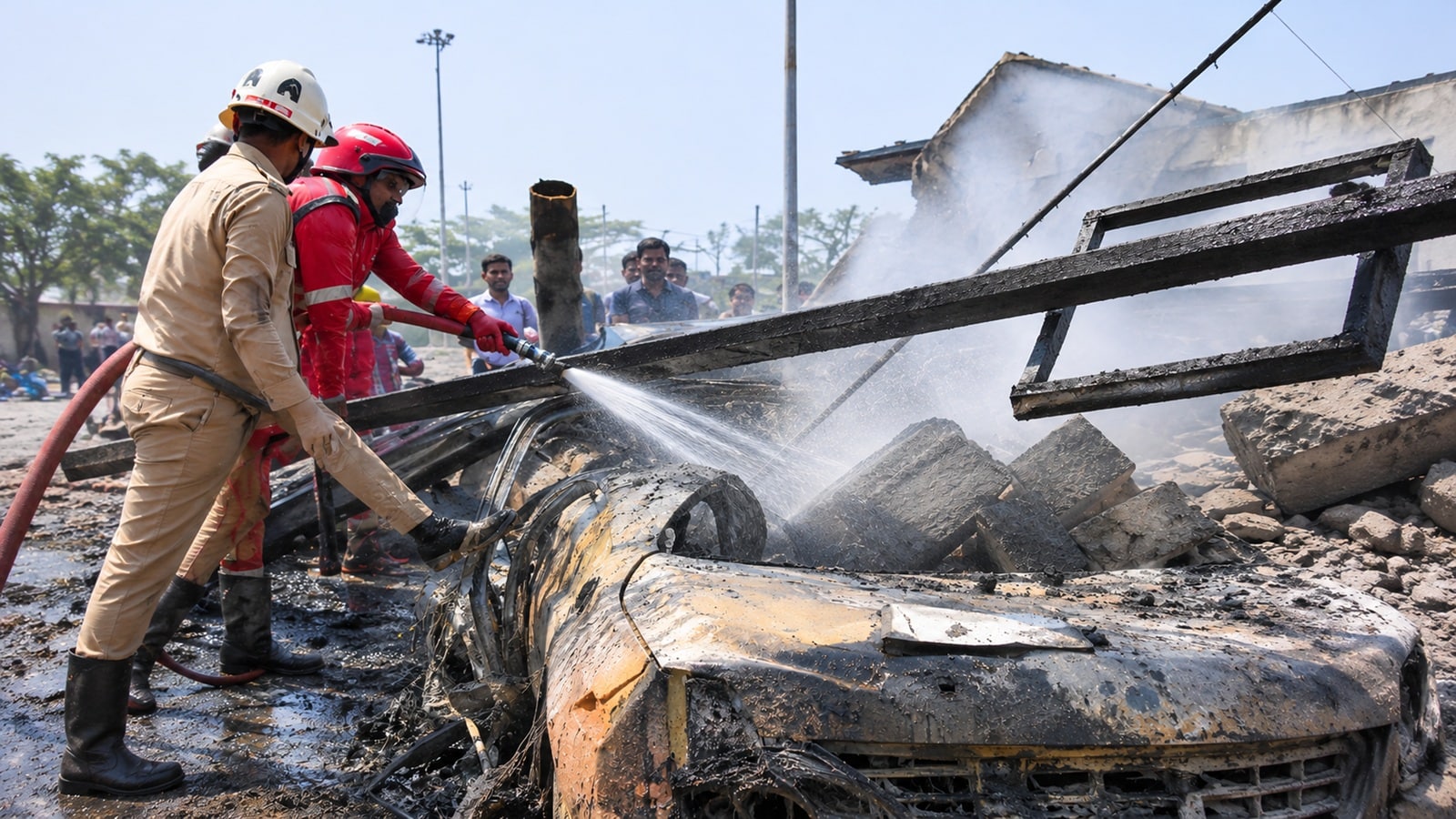
Think about the crews manning those air defense batteries along the coast, staring at green radar sweeps at three in the morning, knowing that a three-second lapse in focus could mean the difference between a loud noise in the upper atmosphere and a catastrophe on the ground. Think about the firefighters in heavy aluminized suits advancing toward a burning petrochemical manifold, acutely aware that pressurized gas does not care about courage. Think about the guest workers—engineers from India, welders from the Philippines, logistics managers from Egypt, safety officers from Bahrain—who leave their families behind to build and maintain the infrastructure that powers the modern world, suddenly finding themselves on the front line of a conflict they never asked to join.
In the morning light, after the flames are knocked down and the emergency crews roll up their hoses, the official narrative quickly pivots back to resilience. Statements emphasize that operations are stabilizing, that contingencies are in place, that critical supplies remain secure. And largely, that is true. The engineers of the Gulf are remarkably adept at patching wounds, rerouting flows, and restoring order with astonishing speed.
Yet resilience is not the same thing as immunity.
By midday, the traffic along the King Fahd Causeway flows again. The glass towers of Manama catch the blinding afternoon sun, reflecting the turquoise water of the Gulf as if nothing at all happened while the city slept. Out at the industrial zone, however, a crew in hard hats stands beside a blackened stretch of steel, measuring the heat still radiating from warped metal, waiting for the order to begin rebuilding what the night tore apart.