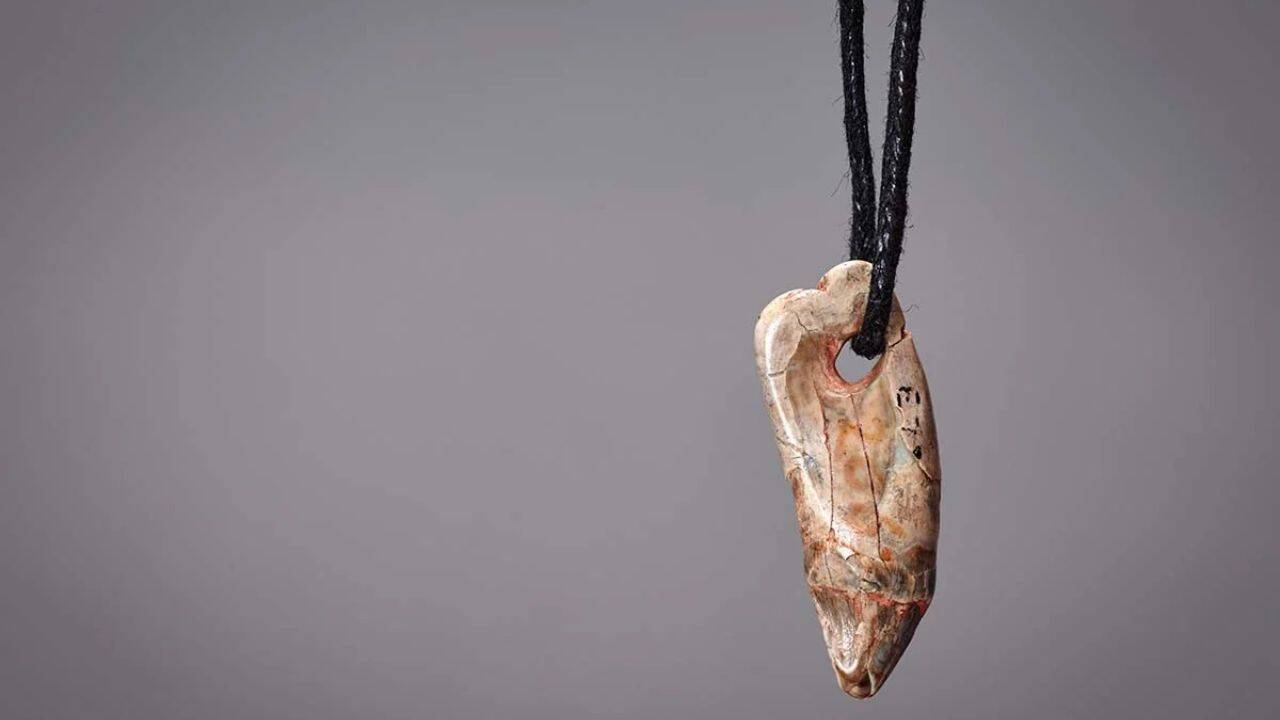
Archaeologists working in Britain have confirmed that a 15,000-year-old perforated seal tooth, originally unearthed in a Scottish cave, proves that Magdalenian hunter-gatherers maintained active social and trade networks stretching from continental Europe into the far northern reaches of Britain at the end of the last Ice Age. Rather than retreating to southern refuges during extreme cold snaps, these ancient groups navigated treacherous, newly exposed coastlines and bridged vast geographic divides through shared symbolic culture.
Most people picture Ice Age Britain as a frozen, empty wasteland. That image is wrong.
For decades, the consensus among paleoanthropologists relied heavily on a neat, tidy timeline of human recolonization. When the glaciers expanded during the Last Glacial Maximum, roughly 20,000 years ago, human populations abandoned northern Europe. They retreated south into Franco-Cantabrian refuges—modern-day Spain and southern France—waiting out the freeze. According to the traditional script, humans only trickled back north into Britain around 14,700 years ago, following the Bølling-Allerød warming event, and even then, they supposedly hugged the southern fringes of England.
The seal tooth from Scotland breaks that script entirely.
Anatomy of an Anomaly
To understand why a piece of marine mammal bone measuring just a few centimeters has caused such a tremor in European prehistory, you have to look at the object itself. Found in the late nineteenth century during early, somewhat chaotic excavations of coastal caves in Argyll, the artifact sat misidentified or underappreciated in museum collections for generations. Antiquarians of the Victorian era lacked the chronological tools to grasp what they were holding. To them, a pierced tooth was just another primitive trinket.
Modern radiocarbon dating and zooarchaeological analysis changed the math. By directly dating the collagen within the tooth and analyzing the microscopic wear patterns around the suspension hole, researchers established two critical facts. First, the tooth belonged to a grey seal or harbor seal living roughly 15,000 years ago—right on the jagged edge of the Younger Dryas and the preceding warming phase. Second, the perforation was not the work of a scavenging carnivore or natural erosion. It was intentionally drilled using a flint borer, leaving behind characteristic concentric striations that match the exact technological signature of the Magdalenian culture.
The Magdalenians were the premier artists and toolmakers of the Late Upper Paleolithic. They are the people who painted the bulls on the ceilings of Lascaux and carved intricate harpoons from reindeer antler in the Dordogne valley. Finding their calling card in western Scotland means they were not merely surviving on the margins of the habitable world. They were thriving there, thousands of kilometers north of their supposed heartland.
The Logistics of an Ice Age Highway
How does a piece of Magdalenian personal adornment end up in Scotland 15,000 years ago? The answer lies in a drowned world that no longer exists on modern maps.
During the late Pleistocene, global sea levels were roughly 100 meters lower than they are today. Massive amounts of the planet's water remained locked inside continental ice sheets. As a result, Britain was not an island. It was the northwestern peninsula of the European landmass, connected via Doggerland—a sprawling, low-lying plain of marshes, rivers, and rolling hills that now sits beneath the North Sea.
Yet geography alone does not explain the seal tooth. Having a land bridge is one thing; crossing a sub-arctic tundra battered by katabatic winds is another entirely.
- Coastal Navigation: While inland Doggerland offered herds of wild horse and reindeer, the western coast of Britain presented a labyrinth of fjords, sea lochs, and shifting pack ice. The presence of a seal tooth suggests these hunter-gatherers were intimately familiar with marine environments, likely utilizing skin boats to hug the coastline and exploit seasonal seal rookeries.
- Seasonal Mobility: Paleolithic bands did not wander aimlessly. They operated on precise seasonal rounds, tracking migratory prey across hundreds of miles. A group spending the summer hunting reindeer in the river valleys of what is now the English Channel could easily push north along the coastal corridors during milder months, trading goods and sharing information with neighboring bands.
- Information Networks: In low-density populations, isolation is a death sentence. If a small band suffers a bad hunting season or loses its primary flintknapper, it needs allies. Exchanging portable art—like pierced teeth, shells, and engraved bone—acted as a social insurance policy, cementing kinship ties across vast distances.
The tooth was not a stray piece of garbage dropped by a lost traveler. It was a deliberate marker of identity.
Why Victorian Archaeology Nearly Ruined the Evidence
There is an uncomfortable truth buried beneath this discovery, one that seasoned field archaeologists know all too well: our understanding of human prehistory is hostage to the sloppy habits of nineteenth-century collectors.
When early excavators dug into British caves like Gough's Cave in Somerset, Kent's Cavern in Devon, or the coastal caves of Oban and Argyll, they were hunting for trophies, not data. They shoveled through meters of stratified cave earth in days, tossing away "uninteresting" animal bones and failing to record the exact depth or soil layer where artifacts lay. Stratigraphy—the golden rule of modern archaeology, which dictates that deeper layers are older than upper ones—was routinely ignored.
Because of this early destruction, dozens of crucial Paleolithic sites in Britain were stripped of their context before modern science was even invented. Museums across the United Kingdom are currently filled with boxes of unprovenanced bones and stones, sitting in dusty storage drawers like unsolved cold cases.
The breakthrough with the Scottish seal tooth required treating museum archives as active excavation sites. By applying ZooMS (Zooarchaeology by Mass Spectrometry)—a technique that identifies animal species through tiny collagen peptide fingerprints—and utilizing Accelerator Mass Spectrometry (AMS) radiocarbon dating, researchers can now extract precise timelines from single, isolated artifacts without destroying them. We are essentially rescuing data from the wreckage of Victorian curiosity.
Challenging the Southern Bias
For generations, British Paleolithic research suffered from a severe geographical blind spot. Almost all major Upper Paleolithic discoveries in the UK clustered south of the Wash—a square-mouthed bay on the east coast of England. Sites like Creswell Crags in Derbyshire marked the supposed northern frontier of human habitation during the late Ice Age. Anything further north was assumed to be buried under impenetrable ice sheets or entirely devoid of human life.
This created a self-fulfilling prophecy. Because researchers believed Ice Age humans stayed in the south, they focused their funding, surveys, and excavations in southern England. They didn't look in Scotland because they didn't expect to find anything there.
The Argyll seal tooth exposes the flaw in that logic. Glaciologists have spent the last two decades refining their models of the British-Irish Ice Sheet, discovering that the ice retreated much faster and more unevenly along the western seaboard than previously calculated. Pockets of habitable, ice-free coastal terrain existed in western Scotland while the central highlands remained frozen.
Where there was open water and coastal tundra, there were seals, seabirds, and fish. And where there was reliable protein, there were humans.
The Economics of Prehistoric Jewelry
To modern eyes, a hole drilled through a seal's canine tooth looks like simple decoration. To a Magdalenian hunter-gatherer, it was high-stakes economics.
Manufacturing a pendant in the Upper Paleolithic required time, specialized tools, and raw materials that were not always locally available. You needed a sharp flint burin or awl capable of boring through dense, curved enamel without shattering the tooth. You needed sinew or plant fiber cordage strong enough to hold the weight against constant movement. Most importantly, you needed a reason to wear it.
In ethnographic studies of modern and historical Arctic hunter-gatherers—such as the Inuit and Yupik—personal ornaments made from marine mammals carry heavy symbolic weight. Wearing the tooth of a seal communicates competence as a hunter, affiliation with a specific clan, and spiritual respect for the animal that provided life-sustaining blubber and meat.
When Magdalenian groups moved across Europe, their jewelry remained remarkably standardized. Archaeologists have found nearly identical perforated teeth—from red deer, arctic fox, horse, and seal—at sites spanning from the Pyrenees to Poland, and now to the Scottish coast. This stylistic uniformity proves that these scattered bands were not isolated splinter groups developing weird, localized habits. They belonged to a cohesive cultural network that actively policed its shared identity through material culture.
Consider a hypothetical scenario to grasp the scale of this connection: a child born near the modern border of France and Spain could grow up wearing a pierced deer canine, migrate north with their extended family over several decades as the climate fluctuated, and eventually trade that same style of craftsmanship to a cousin living on the edge of a Scottish sea loch. The physical distance is immense, yet the cultural distance is virtually zero.
What the Critics Say
Not everyone in the archaeological community is ready to rewrite the textbooks based on a single tooth. Skepticism is healthy in a field where entire human migrations are sometimes inferred from a handful of bone fragments.
Some researchers point out the problem of curation and transport. High-value items like ivory carvings and pierced teeth were often kept as heirlooms, passed down through multiple generations, or traded from hand to hand across vast distances without the original maker ever setting foot in the final destination. In theory, a seal tooth could have been drilled on the coast of northern France, traded to a group in southern England, and carried north to Scotland decades later by people who had no direct connection to the coast.
Others raise valid questions about radiocarbon calibration curves during the late Pleistocene. Atmospheric carbon levels fluctuated wildly between 16,000 and 14,000 years ago due to massive meltwater pulses pouring into the North Atlantic and disrupting ocean currents. These fluctuations create "plateaus" in the radiocarbon timeline, meaning a date of 15,000 years ago carries a margin of error that could span several centuries. In Ice Age terms, three hundred years is the difference between a bitter glacial snap and a relatively balmy coastal summer.
Even accounting for these caveats, the core implication remains intact. Whether the person who drilled the hole walked into Scotland themselves or handed the pendant to a trading partner along the banks of a drowned Doggerland river, the network existed. Goods, ideas, and people were moving along the northern fringes of Europe far earlier and far more extensively than old models allowed.
The Drowned Evidence
If Magdalenian hunter-gatherers were regularly moving between continental Europe and northern Britain, why haven't we found dozens of their campsites in Scotland?
The ocean ate them.
Hunter-gatherers who rely on marine resources naturally camp near the shoreline. They process seals on the beach, repair their boats in sheltered coves, and discard broken tools right where they work. Because sea levels rose by over 100 meters as the glaciers melted, virtually every single coastal campsite used by these people between 16,000 and 10,000 years ago is now submerged beneath deep, cold, turbulent water.
The Scottish caves where the seal tooth survived are rare exceptions—places where steep coastal topography pushed habitable shelters high enough above the ancient shoreline to escape the rising tides. What we see in the archaeological record of northern Britain is not the main story; it is the microscopic fraction of debris that happened to wash up above the high-water mark.
Finding the rest of that story requires underwater archaeology, seismic mapping of the seabed, and dredging analysis—techniques that cost millions of dollars and yield results at a glacial pace. Until those submerged coastlines are systematically mapped, our picture of Ice Age Britain will remain fundamentally skewed toward inland and upland sites.
Reassessing Human Resilience
There is a tendency in popular science to view prehistoric humans as passive victims of climate change, helplessly pushed back and forth across the map whenever temperatures dropped or ice sheets advanced. The narrative usually paints our ancestors as desperate survivors clinging to life by their fingernails.
The evidence tells a different story. Magdalenian hunter-gatherers did not wait around for the weather to become pleasant before exploring the north. They possessed the technological toolkit—tailored fur clothing, composite bone-and-flint weaponry, reliable fire-starting methods, and likely watercraft—to master brutal environments on their own terms.
More importantly, they possessed the social software required to make high-risk exploration viable. By maintaining long-distance alliances and signaling their shared identity through objects like the Scottish seal tooth, they turned an empty, frozen continent into a connected neighborhood.
Museums across Britain still hold thousands of unanalyzed bone fragments pulled from coastal caves over the last two centuries, waiting for a technician with a mass spectrometer to take a closer look.