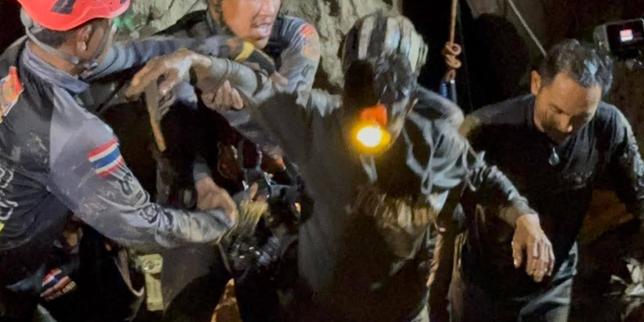
The human mind behaves differently when it realizes the ceiling has disappeared. For days, the darkness inside the Tham Nang Non cave network in Khammouane province, Laos, was not just an absence of light. It was a physical weight. Seven men, driven underground by the promise of discovery or perhaps just the routine of exploration, found themselves trapped in a subterranean labyrinth. The monsoon season is a fickle beast in Southeast Asia, but when the rains came, they did not fall as gentle showers. They fell as a deluge that swiftly choked the cave’s exits, transforming a familiar geological formation into a half-submerged trap.
Then, the water began to rise.
Cold. Muddy. Relentless.
When the news first broke, it arrived as a collection of cold data points. Seven individuals. A partially flooded cave system in central Laos. An ongoing rescue operation. But statistics do not shivering in the dark. They do not feel the agonizing sting of rising water against bare skin, nor do they calculate how many cubic meters of oxygen remain before the air turns toxic. To understand what happened deep within the limestone heart of Laos, one must look past the official press releases and step into the mud.
The Weight of the Limestone Sky
To understand the sheer terror of a cave inundation, consider a simple metaphor. Imagine being locked in a concrete room that is slowly, methodically filling with thick, opaque coffee. You cannot see your hand in front of your face. Every breath you take echoes off the walls, a reminder that the room is shrinking. Now, remove the floor. Make the walls jagged, sharp enough to tear flesh. That is the reality facing anyone trapped in a flooded karst cave system.
The geography of central Laos is breathtakingly beautiful above ground. Towering limestone cliffs rise like ancient giants from green paddies. But beneath this postcard-perfect landscape lies a Swiss-cheese network of tunnels, carved over millennia by water. When torrential rains hit, these tunnels act as natural storm drains. They fill up in minutes.
For the seven men, the initial realization must have come as a low hum. A vibration in the rock. In cave environments, sound travels differently, warped by the twists and turns of the stone. By the time the hum became a roar, the exit was already gone. They were forced upward, retreating into the few elevated chambers—champs, as cavers call them—where the water could not yet reach.
Days bled into each other. Without the sun, the human circadian rhythm shatters. Time stretches. A single hour feels like a week when the only sound is the drip of water and the collective, anxious breathing of six other souls. They were waiting for a miracle, or at least a sign that the outside world knew they were there.
The Breaking of the Silence
Outside, a chaotic symphony of hope and desperation was assembling. Local authorities, military personnel, and expert divers converged on the site. The logistical nightmare of a cave rescue is hard to overstate. It is not a matter of simply swimming in and pulling someone out. Cave diving is widely considered one of the most hazardous activities on the planet. Visibility is often zero. The currents can pin a diver against the rock face like a insect under a thumb.
But on a Tuesday that felt no different from any other day of darkness, the water stirred.
A light cut through the murk.
It was the first human face the men had seen since the mountain closed its jaws. The rescue team had breached the perimeter. Yet, the joy of discovery was instantly tempered by a brutal calculation. Finding them was only half the battle. Extracting them was an entirely different equation.
Consider the physical condition of the trapped men. They had spent days in a high-humidity, low-temperature environment with little to no food. Hypothermia is a quiet thief; it steals your ability to think clearly long before it stops your heart. Panic is the real enemy in cave diving. If a non-diver panics underwater, rips off their mask, or inhales a lungful of silt-laden water, the rescue becomes a recovery in seconds.
The decision was made to extract them one by one. A staggered, agonizingly slow procession through the flooded veins of the earth.
The First Step Into the Light
The first man to be brought out became a symbol, not just of survival, but of the razor-thin margin between life and death.
Reports from the scene described the moment he broke the surface of the water near the cave mouth. He was weak, exhausted, wrapped in emergency blankets, but he was breathing the humid, sweet air of the Laotian jungle. He had made it. He was safe.
But look closely at the mechanics of that escape. It required a flawless choreography of human courage. The diver guiding him had to navigate tight squeezes where their air tanks had to be unclipped and pushed ahead of them. They had to feel their way along a guide rope, navigating blindly through a liquid soup of mud and debris. The survivor had to place his entire life into the hands of a stranger, trusting that the regulator in his mouth would keep supplying air even as his body scraped against the ceiling of the tunnel.
One man was out. The crowd gathered at the entrance cheered. The media flashed their cameras.
But six men remained inside.
The Invisible Stakes
This is where the narrative usually shifts to celebration, but the true story lives in the tension that followed. The extraction of the first survivor proved the rescue plan was viable, but it also heightened the stakes for those left behind. The weather was not cooperating. Every hour the remaining six men spent in the cave was an hour where the water level could rise again, sealing them off forever.
The psychology of those remaining in the dark shifts dramatically after the first departure. Hope becomes a physical ache. You watch your companion disappear into the black water, accompanied by a diver, and you are left with the silence once more. The chamber feels smaller. The remaining air feels thinner. You wonder if the divers will make it back, or if the mountain will finally claim its dues.
Rescuers worked against the clock, deploying high-powered pumps to fight back the incoming water, a literal attempt to drain a mountain. Every centimeter of water lowered was a victory, a few more precious inches of air space that could mean the difference between a terrifying swim and a manageable wade.
The Final Chord
The story of the cave in Laos is not just a news item about a successful rescue operation. It is a stark reminder of the fragile contract we sign with nature whenever we step off the beaten path. The limestone hills of Khammouane are ancient, indifferent to the dramas of the humans who walk upon them or tunnel through them. They do not hold grudges, nor do they offer mercy.
As the operations continued into the night, the jungle outside the cave remained alive with activity. Headlights cut through the mist, generators roared, and mud-splattered volunteers drank lukewarm coffee, their eyes fixed on the dark opening in the rock face.
The first man who walked out into the Laotian night carried with him the hopes of an entire community. He left behind a dark chamber that still held six heartbeats, six pairs of eyes watching the water, waiting for the next light to pierce the gloom. The mountain had opened its mouth just wide enough for one to slip through, leaving the rest of the world to hold its collective breath, waiting to see if the earth would allow the remaining souls to return to the sun.