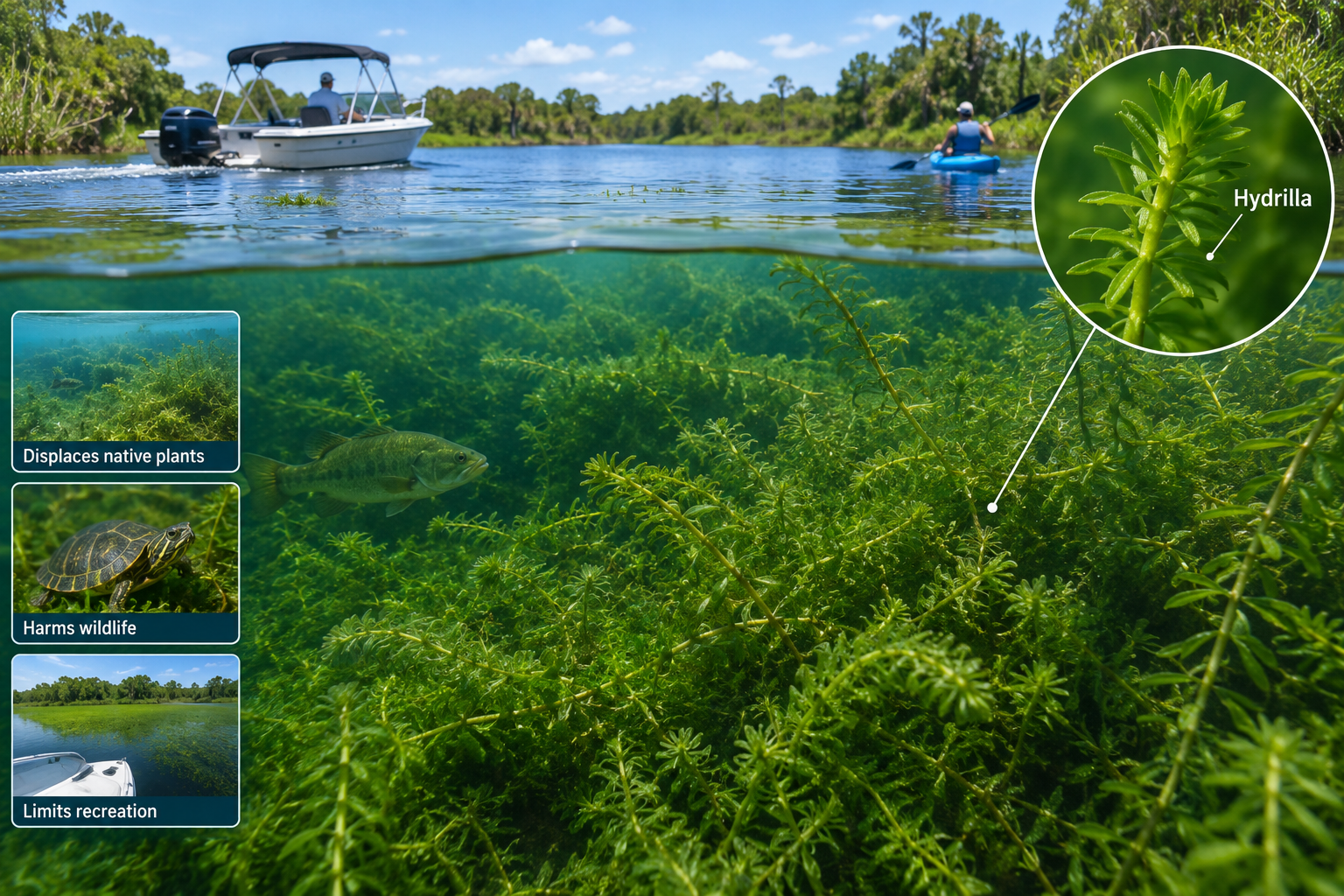
In less than four decades, Hydrilla verticillata spread from a handful of aquarium dump sites in Tampa and Miami to infest roughly 70 percent of Florida’s drainage basins. Introduced in the 1950s by tropical fish dealers who discarded excess stock into local canals, the submerged perennial exploited Florida’s warm climate, nutrient-rich runoff, and interconnected waterways to become the state's most expensive aquatic weed. By the 1990s, state agencies were spending tens of millions of dollars annually just to keep navigation channels open and prevent catastrophic flooding, marking one of the fastest and most destructive biological invasions in North American history.
Most accounts of the hydrilla invasion stop at the basic timeline. They mention the aquarium trade, note the plant's aggressive growth rate, and tally the taxpayer bill. That surface-level framing misses the actual mechanics of why Florida’s water infrastructure acted as an accelerant, and why the state’s earliest chemical interventions inadvertently bred a strain of super-weed that outsmarted modern herbicides. Meanwhile, you can explore related stories here: The Architecture of the Australia Canada India Technology and Innovation Partnership.
The Anatomy of an Aquatic Takeover
To understand how a single plant colonized nearly three-quarters of a state's watersheds in forty years, you have to look at its biology. Hydrilla verticillata is native to the warmer regions of Asia and Australia, where natural predators, seasonal water fluctuations, and competing flora keep it in check. Florida offered none of those guardrails.
The plant grows up to an inch a day under ideal conditions. Unlike native submerged vegetation such as eelgrass (Vallisneria americana), which requires relatively high light penetration to photosynthesize, hydrilla thrives in low-light environments. It can begin photosynthesizing at less than one percent of full sunlight. This allows it to germinate in deep, turbid water early in the morning before native plants even wake up. To see the complete picture, check out the detailed report by Associated Press.
Once it reaches the surface, hydrilla branches out laterally, forming dense, tangled mats that block sunlight from reaching the lakebed below. Native plants starve and die off. The ecosystem collapses into a monoculture.
Reproduction is where hydrilla truly separates itself from competitors. While it can reproduce via seeds and root crowns, its primary weapons are fragmentation and turions.
- Fragmentation turns mechanical harvesting into a distribution network. A single boat propeller slicing through a hydrilla bed can generate hundreds of viable stem fragments. Each node on that stem can sprout roots and establish a new colony miles downstream.
- Turions are compact, dormant buds formed in the leaf axils that break off and drift to the bottom.
- Subterranean tubers are potato-like structures buried up to a foot deep in the sediment. A single square meter of lake bottom can harbor thousands of tubers, and these structures can remain viable in the mud for over four years, surviving droughts, drawdowns, and chemical treatments that wipe out the surface canopy.
How Florida Built the Perfect Highway
Biological advantages alone do not explain a 70 percent watershed saturation rate in forty years. Florida engineered the ideal transmission grid for an invasive aquatic species.
During the mid-twentieth century, the U.S. Army Corps of Engineers and state water management districts aggressively drained, straightened, and connected Florida's natural wetlands. Canals were dug to link previously isolated lakes and rivers for flood control, agriculture, and navigation. The Kissimmee River was channelized into a straight ditch. Lake Okeechobee was diked and plumbed into coastal estuaries.
When hydrilla entered the Hillsborough River near Tampa and the canals near Miami in the late 1950s, it did not remain trapped in isolated ponds. It had direct access to a statewide hydraulic superhighway.
At the same time, post-war suburban expansion and industrial agriculture flooded those newly connected waterways with phosphorus and nitrogen. Fertilizer runoff from sprawling lawns, citrus groves, and cattle ranches turned oligotrophic (low-nutrient) lakes into eutrophic soup. Native Florida plants evolved in nutrient-poor systems and struggled to adapt to the sudden chemical overload. Hydrilla gorged on it.
Then came the human vector. Bass fishing exploded in popularity across the state during the 1970s and 1980s. Anglers trailered boats from Lake Tohopekaliga to the St. Johns River, then up to Lake Seminole on the Georgia border, rarely washing their hulls or trailers between launches. Hydrilla fragments clung to boat trailers, lower units, and livewells. By the time biologists realized the scope of the problem, the plant was already established in major river systems across the peninsula.
The Herbicide Trap and the Fluridone Backfire
For decades, state water managers treated hydrilla like an agricultural pest, relying heavily on chemical applications to clear waterways. That strategy produced one of the most sobering lessons in modern weed science.
In the 1980s, Florida regulators widely adopted fluridone, a systemic herbicide that inhibits carotenoid synthesis, effectively causing the plant to bleach out and die in sunlight. Fluridone was celebrated because it could be applied at low concentrations across entire water bodies, selectively killing hydrilla while leaving many native plants unharmed.
It worked brilliantly for about fifteen years. Then, in the late 1990s, lakes that had been successfully managed with fluridone suddenly stopped responding.
Biologists discovered that hydrilla had developed somatic mutations conferring resistance to the chemical. Because hydrilla in Florida reproduces almost exclusively through asexual cloning—specifically via female plants that spread through tubers and fragments—any single plant that developed a beneficial mutation passed that exact genetic trait to millions of clones. Within a few seasons, fluridone-resistant hydrilla dominated several major Florida lakes, forcing managers to abandon a primary tool and pivot to more expensive, less selective contact herbicides like endothall and diquat.
The Hidden Economic and Ecological Toll
When people hear about an invasive weed, they tend to picture an aesthetic nuisance—something that tangles fishing lines or looks ugly near a boat dock. In Florida, hydrilla is a direct threat to public safety and municipal infrastructure.
Dense hydrilla mats drastically reduce the flow capacity of flood-control canals. During heavy tropical rains or hurricanes, choked canals cannot move water off the land fast enough, backing water up into residential neighborhoods and agricultural fields. Water management districts have to clear millions of tons of biomass simply to ensure gravity-fed drainage systems function during storm events.
Ecologically, the consequences are severe and cascading.
- Dissolved Oxygen Crashes: While living hydrilla produces oxygen during the day, massive canopies restrict water circulation and gas exchange at the surface. When large mats die off naturally or are killed by herbicides, decomposing bacteria consume massive amounts of oxygen, triggering hypoxic zones and large-scale fish kills.
- Avian Vacuolar Myelinopathy (AVM): Researchers discovered a devastating link between hydrilla and fatal brain lesions in bald eagles and American coots. A specific cyanobacterium (Aetokthonos hydrillicola) grows on the undersides of hydrilla leaves. When exposed to bromide—often present in water bodies from natural sources, industrial runoff, or certain herbicides—this bacterium produces a potent neurotoxin. Waterfowl eat the hydrilla, contract AVM, lose motor control, and become easy prey for bald eagles, which then ingest the toxin and die.
- Thermal Stratification: Thick surface mats absorb solar radiation, heating the top layer of water while leaving the bottom cold and stagnant. This unnatural temperature gradient disrupts spawning cycles for native sportfish like largemouth bass and bluegill.
The Bass Angler Paradox
Any honest assessment of Florida’s hydrilla crisis has to confront a major political and cultural complication. Not everyone wants the plant gone.
Largemouth bass love hydrilla. Juvenile bass use the dense underwater canopy to hide from predators, while adult bass patrol the edges of the mats to ambush prey. In lakes where nutrient runoff has already wiped out native vegetation, hydrilla often becomes the only structural habitat left for fish.
During the 1980s and 1990s, some of Florida's most famous trophy bass fisheries—including Lake Toho and Lake Istokpoga—experienced booms in bass populations alongside massive hydrilla infestations. Tournament anglers and fishing guides quickly noticed that when state agencies sprayed a lake to eliminate hydrilla, fishing success often plummeted.
This created a bitter, ongoing conflict between the Florida Fish and Wildlife Conservation Commission (FWC), flood-control engineers, waterfront homeowners, and the recreational fishing industry. Anglers accused the state of destroying prime fish habitat to appease wealthy lakefront property owners and chemical companies. State biologists countered that unmanaged hydrilla inevitably leads to catastrophic oxygen depletion, navigation blockades, and the total loss of native plant diversity.
Today, Florida water managers rarely aim for total eradication in large public lakes; the subterranean tuber bank makes true eradication functionally impossible once the plant is entrenched. Instead, agencies practice maintenance control, using targeted herbicide applications, mechanical harvesters, and sterile grass carp (Ctenopharyngodon idella) to keep biomass at manageable levels.
What the Forty-Year Invasion Taught Water Managers
The forty-year conquest of Florida's watersheds by Hydrilla verticillata exposed fundamental flaws in how governments regulate imported species and manage freshwater ecosystems.
First, early detection and rapid response is the only cost-effective window. Once an invasive aquatic plant establishes a deep tuber bank in an interconnected watershed, taxpayers are locked into a permanent, multi-million-dollar maintenance contract. Florida hesitated in the early 1960s, assuming the plant would remain a localized curiosity in urban canals. By the time state funding caught up to the crisis in the 1970s, the window for eradication had slammed shut.
Second, chemical reliance without biological or mechanical rotation guarantees resistance. Treating a clonal organism with a single mode-of-action herbicide across millions of acres is an evolutionary experiment with a predictable outcome. Modern integrated pest management in Florida now requires rotating herbicide chemistries, deploying host-specific insects like the hydrilla tip-mining midge (Cricotopus lebetis), and aggressively replanting native species like eelgrass and bulrush immediately after clearing invasive mats so native roots can reclaim the sediment before hydrilla tubers sprout again.
Finally, invasive species management cannot be separated from watershed nutrient policy. As long as Florida's lakes and rivers receive excessive loads of phosphorus and nitrogen from septic tanks, urban fertilizers, and agricultural runoff, fast-growing opportunistic weeds will always hold a competitive advantage over native flora. Cleaning up the water column is the only way to tilt the ecological playing field back toward the plants that actually belong there.
