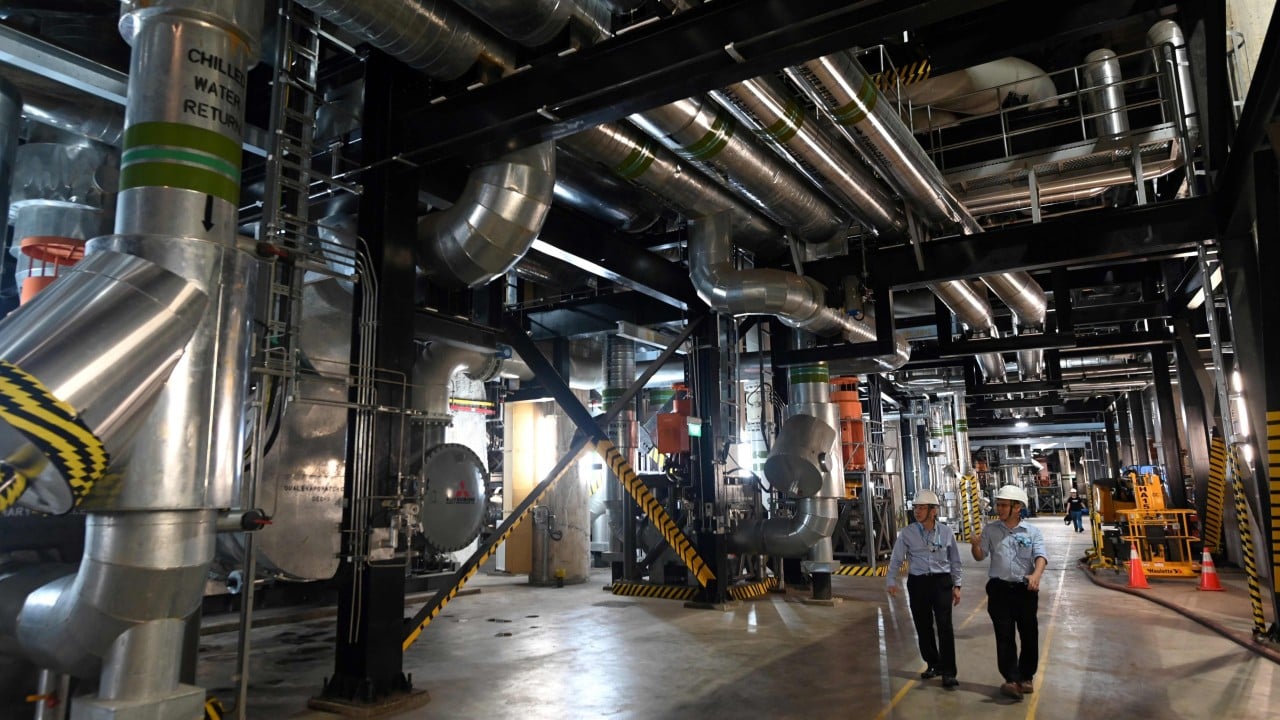
The tech elite have fallen in love with a subterranean fairy tale.
The narrative is seductive: Singapore, suffocating under the weight of tropical humidity and soaring air-conditioning bills, will simply dig its way out of the climate crisis. By moving data centers, utility networks, and pedestrian walkways deep underground, the city-state supposedly saves precious surface land while exploiting the earth's natural thermal mass to cool itself down.
It sounds brilliant on a slick PowerPoint slide. It is a financial and thermodynamic disaster in reality.
As an infrastructure engineer who has spent nearly two decades auditing deep-civil projects across Southeast Asia, I am terrified by the collective amnesia gripping urban planners. We are treating the underground as an infinite, magical heat sink. It is not. The current obsession with subterranean cooling is not a masterstroke of sustainability; it is a desperate, hyper-expensive relocation of a problem that will inevitably bite back.
The Thermodynamics They Choose to Ignore
Let us dismantle the core scientific premise of the "cooler underground" myth.
Proponents of subterranean development constantly point to the constant temperature of the earth. They observe that a few meters beneath the surface, soil and rock remain insulated from the blistering afternoon sun. This is undeniably true for a cellar or a passive wine cave.
It is patently false for an active, high-density urban ecosystem.
Rock is an excellent insulator. That means it holds onto heat. When you pack a subterranean cavern with high-voltage transformers, thousands of human bodies, mass transit systems, and rows of power-hungry servers, you are not placing them in a refrigerator. You are putting them in an oven.
$$Q = mc\Delta T$$
The basic equation for heat transfer reminds us that the temperature change ($\Delta T$) depends entirely on the mass ($m$) and specific heat capacity ($c$) of the medium absorbing the heat energy ($Q$). While rock can absorb initial thermal loads, its ability to dissipate that heat into the surrounding crust is notoriously slow.
Once the surrounding bedrock reaches thermal saturation, it stays hot. Forever.
I watched a multi-national tech firm pour $400 million into a cavern-based infrastructure project in northern Europe, expecting massive savings on ambient cooling. Within three years, the surrounding granite became so saturated with rejected heat that the ambient cavern temperature spiked by 12 degrees. They had to install a massive, traditional chilled-water plant at the surface just to keep the facility from melting down. They ended up paying double the cooling costs they would have faced on a standard above-ground plot.
The Invisible Cost of Moving Air
The lazy consensus ignores the mechanical reality of fluid dynamics. To make an underground space liveable or operational for machinery, you cannot rely on passive geology. You need ventilation. And pushing air vertically against gravity and through constricted subterranean shafts requires an absurd amount of mechanical energy.
Consider the physics of air changes per hour (ACH). A typical commercial office requires roughly 4 to 6 ACH. A deep underground facility, cut off from natural barometric shifts and plagued by radon mitigation needs, requires significantly higher airflow rates just to maintain safe oxygen levels and remove moisture.
- Surface Buildings: Utilize cross-ventilation, wind pressure differentials, and open facades to move air with minimal fan power.
- Subterranean Cavities: Rely entirely on axial fans running 24/7/365 to overcome the massive static pressure of vertical duct runs.
The friction losses alone in a 50-meter vertical ventilation shaft demand high-static blowers that consume exponentially more electricity than standard rooftop air handling units. By burying the infrastructure to escape the sun's heat, you end up burning more fossil fuels just to breathe and move air. You have traded a solar thermal load for a mechanical energy load. It is a net-negative trade.
The Carbon Lie of Deep Excavation
We cannot talk about cooling a future city without addressing the sheer, unadulterated environmental violence of creating underground space.
The building sector loves to brag about operational carbon savings while swept-under-the-rug embodied carbon continues to skyrocket. To dig deep into Singapore’s Jurong Formation or its Bukit Timah granite requires an astronomical volume of energy, heavy machinery, and explosives.
Once the hole is dug, you must line it. Because of the immense hydrostatic pressure from Singapore’s high water table, these caverns require specialized, ultra-high-strength concrete formulations packed with chemical sealants and massive steel reinforcement cages.
Concrete production is responsible for roughly 8% of global carbon emissions. The specialized, thick-walled shotcrete and cast-in-place linings needed to prevent a subterranean facility from collapsing or flooding carry an embodied carbon footprint that takes decades to offset through theoretical operational efficiencies.
If you emit 100,000 tons of carbon today to build a bunker that saves you 2,000 tons of carbon a year in cooling, you are in the red for half a century. In the context of our current climate timeline, that is not a solution. It is an acceleration of the crisis.
People Also Ask: Dismantling the Surface Bias
Doesn't burying data centers free up surface land for green parks that cool the city?
This is a classic false dichotomy. The assumption is that surface space and underground space exist independently. They do not.
Every subterranean structure requires a massive surface footprint for ingress, egress, emergency escape stairs, blast valves, and ventilation intake/exhaust plenums. You cannot plant a lush tropical rainforest on top of a subterranean roof deck because the soil depth is insufficient and the structural load limits prevent large root systems from developing. You do not get a park; you get a concrete plaza with some potted shrubs.
Can’t we just use deep-sea water cooling or geothermal loops to offset underground heat?
District cooling systems utilizing deep seawater are highly effective, but they work just as well—if not better—for surface structures. Connecting a subterranean cavern to a marine heat exchanger adds layers of pumping complexity. You are fighting both the static head of pumping water up from the sea and down into a deep cavern. The parasitic pumping losses quickly erode the efficiency gains of the cold water source.
The Real Fix: Architectural Radicalism on the Surface
Stop running away from the sun. Start building for it.
The obsession with going underground is a symptom of architectural laziness. We have spent the last sixty years building glass greenhouse towers in tropical climates, relying on brute-force air conditioning to make them habitable, and now that the grid is buckling, we want to hide in caves.
The solution is to radically redesign surface architecture to handle tropical realities natively.
1. Kinetic Hyper-Shading
We must mandate double-skin facades with automated, kinetic shading systems that track the sun's angle in real-time. By blocking solar radiation before it hits the thermal envelope of the building, you reduce cooling loads by up to 40% without moving a single shovelful of dirt.
2. High-Albedo Urban Canopies
Instead of spending billions digging tunnels, invest a fraction of that capital into retrofitting every roof and exposed concrete surface with ultra-white, radiative cooling paints. Materials engineered by researchers at Purdue University reflect up to 98.1% of sunlight and send infrared heat directly back into deep space, actively cooling surfaces below the ambient air temperature.
3. Decentralized Thermal Storage
Instead of continuous chilling, use ice-slurry thermal storage systems on intermediate mechanical floors. Freeze the medium at night when the grid load is low and ambient temperatures are cooler, then melt it during the peak afternoon heat to provide cooling without straining the electrical infrastructure.
The Uncomfortable Truth
Going underground is an admission of defeat. It is a sign of a society that has given up on engineering a harmonious relationship with its climate and has instead chosen to burrow like rodents into the dark.
The financial costs are staggering. The maintenance overhead is a ticking time bomb of moisture control, fungal mitigation, and structural grout injections. The thermodynamics are fundamentally flawed.
If Singapore wants to secure its future, it needs to stop looking down into the mud and start looking up at the sky. The tools to defeat the heat exist on the surface. We just need the courage to build them.