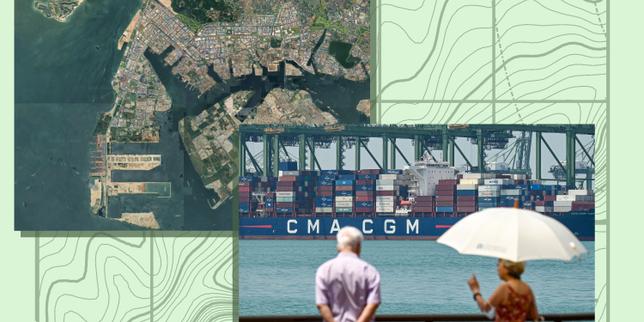
Every shipping analyst on the planet is currently swooning over the Tuas Port mega-project. They see 65 million TEUs of capacity, fully automated electric guided vehicles, and AI-driven crane operations, and they applaud. They call it a masterclass in supply chain dominance.
They are dead wrong.
What Singapore is actually doing is doubling down on a physical transshipment model that peaked five years ago. By sinking vast resources into becoming the ultimate middleman between the Indian Ocean and the Pacific, the island state is preparing for a world of centralized, high-volume, long-haul sea freight that is quietly dissolving beneath our feet.
The belief that controlling the Malacca Strait’s physical chokepoint guarantees eternal economic sovereignty is a lazy consensus. Modern trade routes are shifting, supply chain architecture is decentralizing, and the very concept of transshipment is turning into an expensive liability.
The Transshipment Delusion
Let’s dismantle the fundamental assumption driving this mega-expansion: the idea that mega-ships and hub-and-spoke networks are the permanent future of global trade.
For two decades, ocean carriers operated on a simple economic premise. Build bigger ships, reduce slot costs, dump thousands of containers at a massive central hub like Singapore, and let smaller feeder vessels distribute them across Southeast Asia.
It worked brilliantly—until it didn’t.
I have sat in boardroom strategy sessions where logistics directors calculate the true cost of this model. The hidden expenses are staggering:
- Excessive Dwelling Times: Container dwell times at major transshipment hubs spike exponentially during any minor supply chain disruption.
- Feeder Bottlenecks: Moving a container from a 24,000-TEU vessel to a 2,000-TEU regional vessel adds handling steps, insurance overhead, and massive carbon footprints.
- Inventory Carrying Costs: Modern enterprises no longer care solely about maritime freight rates per mile. They care about total velocity. Sitting in a queue outside a mega-port for four days waiting for a feeder connection destroys capital efficiency.
The industry is desperately trying to bypass the middleman. Direct point-to-point shipping routes between secondary ports are expanding faster than traditional hub connections. Regional ports in Vietnam, Malaysia, and Indonesia are upgrading their infrastructure precisely so they can accept direct calls from medium-sized vessels, completely cutting out the need to stop in Singapore.
When supply chains prioritize resilience over sheer scale, the value proposition of a giant transshipment hub erodes rapidly.
The Geographic Trap and the Kra Canal Reality
Singapore’s pitch has always been location, location, location. Nestled right at the narrowest point of the Malacca Strait, it naturally intercepts maritime traffic.
Except physical geography is losing its monopoly power.
First, consider the structural shifts in manufacturing. The "China Plus One" strategy isn't just sending factories to Vietnam or Indonesia; it is redistributing regional origin points. When manufacturing moves to Northern Vietnam, shipping routes naturally align toward direct Pacific paths, bypassing the Malacca Strait altogether.
Second, the northern sea routes and alternative infrastructure projects are no longer science fiction. While the proposed Thai Canal (Kra Isthmus) project gets repeatedly written off by traditionalists as politically impossible, the pressure to bypass the congested, strategically vulnerable Malacca Strait is growing among East Asian superpowers. A single alternative bypass route reduces transshipment volumes through the strait drastically.
Singapore isn't just competing with regional ports like Port Klang or Tanjung Pelepas. It is competing against a fundamental alteration of Asian manufacturing geography. Building a massive automated port doesn't change where factories are located.
Automation Cannot Fix a Structural Bottleneck
Proponents point to Singapore’s technological deployment—automated guided vehicles, predictive analytics, digital twin technology—as an unassailable moat.
This confuses operational efficiency with strategic necessity.
Automating a process makes it faster and cheaper, but it does not make it indispensable. If a manufacturer in Thailand can ship directly to Los Angeles or Rotterdam via a regional port with zero transshipment handling, a 10% efficiency gain at Singapore's automated terminal is completely irrelevant. Zero handling costs always beat optimized handling costs.
I’ve seen port operators throw hundreds of millions at terminal automation only to realize that their real vulnerability wasn't labor cost or crane speed—it was schedule reliability from international shipping lines. You can deploy all the automated equipment you want, but when shipping lines blank sailings, alter port calls, or deploy smaller vessels directly to secondary markets, your mega-port sits underutilized.
The reality of port infrastructure:
| Port Strategy | Traditional Hub Model | Decentralized Direct Route |
|---|---|---|
| Primary Metric | Volume / TEU Throughput | Velocity & Direct Connectivity |
| Vessel Reliance | Ultra Large Container Vessels (20,000+ TEU) | Mid-Sized / Regional Direct Calls |
| Supply Chain Risk | Single Point Congestion Bottleneck | Distributed Network Redundancy |
| Cost Driver | Double-handling & Feeder Feeds | Slightly Higher At-Sea Transit Costs |
The table above illustrates the mismatch. Singapore is optimizing for column one while the global trade system is actively migrating toward column two.
The Nearshoring Threat No One Talks About
The most direct threat to Singapore’s port hegemony isn't another port in Asia—it is the death of long-distance trade integration altogether.
Nearshoring, friendshoring, and regional trade blocs are actively shrinking the physical distance between production and consumption. As Western markets move assembly closer to home—Mexico for North America, Eastern Europe and North Africa for the EU—the massive ocean trade corridors between Asia and the West face long-term structural deceleration.
Transshipment hubs thrive exclusively on high-volume, long-distance intercontinental trade. They are the arterial junctions of global trade. If global trade becomes regionalized, regional trade networks do not need massive central ocean hubs. They need light, agile, local port networks.
Singapore is essentially building a massive ocean hub for a world that is actively learning how to trade over shorter distances.
The Uncomfortable Truth
None of this means Singapore is going to collapse. The nation-state is remarkably adaptable, and its financial and maritime services sectors are world-class.
But the narrative that its new port expansion represents an unassailable future for global trade is pure PR spin. It is a defensive strategy dressed up as an offensive conquest. It is a high-stakes bet that the old world of massive container ships, centralized routing, and globalized supply chains will remain unchanged for the next thirty years.
It won't.
The future of logistics is fragmented, regional, direct, and unpredictable. Building the world's largest automated transshipment hub doesn't control that future—it just makes you the biggest target when trade flows redirect elsewhere.
Stop evaluating maritime power by counting cranes and measuring terminal acreage. Start looking at where the goods are actually going, how few times they are touched, and who is cutting out the middleman.
The world is moving past the transshipment model. Singapore is just building a very expensive, very efficient monument to it.