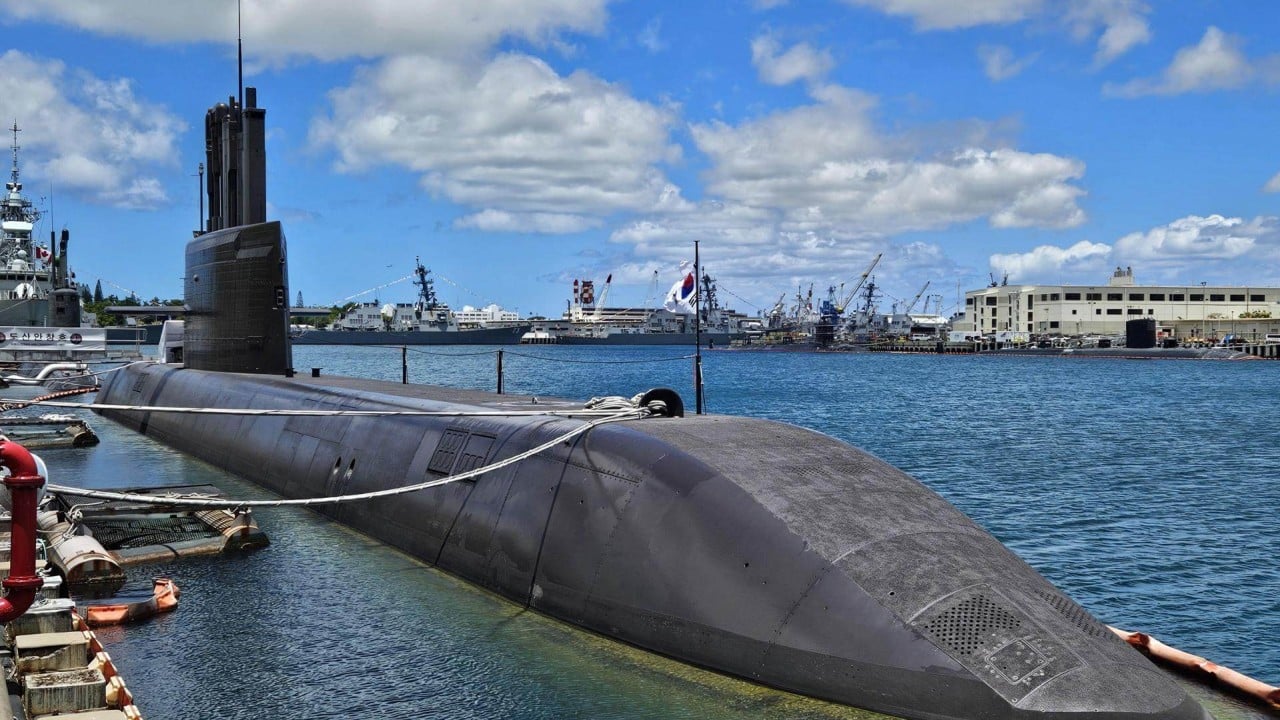
Two hundred meters below the surface of the East Sea, the world goes completely blind.
Sunlight dies long before you reach that depth. Radio waves refuse to penetrate the crushing, salt-heavy blackness. Down there, survival belongs entirely to the ear. It belongs to the patient, unblinking technician staring at a waterfall display of green sonar lines, praying the rhythmic thump of his own diesel engines does not betray him to whatever is hunting in the dark.
Think of a hypothetical young sonar operator—let us call him Min-ho—serving aboard a conventional South Korean submarine. Every few days, his boat must perform a deadly ritual. Because diesel-electric batteries eventually drain, the vessel must creep toward the surface and raise a snorkel mast to gulp down fresh air. For those agonizing minutes, the submarine roars like a freight train underwater. Satellites can spot its thermal wake. Enemy patrol aircraft can sniff its exhaust. In a real conflict against a nuclear-armed neighbor capable of firing ballistic missiles from submerged vessels, coming up for air is not a routine maintenance task. It is a coin toss with death.
This claustrophobic reality is the invisible engine driving Seoul’s decades-long obsession with nuclear-powered submarines. Yet the fate of those vessels, and the young sailors who would crew them, does not rest in the shipyards of Geoje Island or the war rooms of Seoul. It rests inside the marble corridors of Capitol Hill in Washington, D.C., where shifting political tides threaten to strangle the ambition before a single reactor is welded into a hull.
The suffocating math of the diesel trap
To understand why South Korean defense planners lose sleep over naval propulsion, you have to understand the geography of a peninsula that functions like an island. Cut off from the Asian mainland by the heavily fortified Demilitarized Zone, South Korea breathes through its sea lanes. Ninety-nine percent of its trade moves by water.
For years, Seoul has built remarkably quiet conventional submarines, such as the Dosan Ahn Changho-class boats. These vessels use air-independent propulsion systems to stay submerged longer than older diesel boats. Still, physics imposes a hard ceiling. An air-independent system is like holding your breath while swimming across a pool; eventually, your lungs burn, and you must surface. A nuclear reactor, by contrast, is like growing gills.
Nuclear propulsion does not mean carrying nuclear weapons. That distinction gets lost constantly in public debate, muddying the waters with unnecessary panic. A nuclear-powered attack submarine runs on a compact nuclear reactor that generates heat, turns water into steam, and spins turbines for decades without needing a single drop of oxygen or refueling. It can sprint across oceans at high speeds, dive deeper, and vanish into the acoustic shadows of the Pacific for months at a time, limited only by the food stored in its galley and the psychological endurance of its crew.
When North Korea began testing submarine-launched ballistic missiles, the strategic math in Northeast Asia snapped in half. Tracking a mobile missile launcher hidden inside a mountain tunnel is hard enough. Tracking a diesel submarine carrying nuclear warheads through the complex, noisy currents of the East Sea using conventional boats is nearly impossible. By the time a diesel submarine surfaces to recharge, the target it was shadowing has slipped into the abyss.
I have spent years watching defense policy collide with human emotion in Seoul, and there is a distinct, lingering vulnerability whenever this topic arises. South Koreans remember history. They know what happens when a smaller nation relies entirely on the promises of distant allies while its neighbors sharpen their knives. Asking for nuclear propulsion is not an act of chest-thumping aggression for Seoul. It is an act of claustrophobic desperation.
A seventy-year-old lock on the fuel tank
If South Korea possesses the world’s most advanced commercial shipbuilding industry and builds nuclear power plants for export around the globe, why has it not simply built a nuclear submarine already?
The answer lies in a legal and diplomatic straitjacket forged in the aftermath of the Korean War. Under the bilateral nuclear cooperation agreement between Washington and Seoul—commonly known as the 123 Agreement—South Korea is strictly prohibited from enriching uranium or reprocessing spent nuclear fuel without explicit American consent. Even more critically, the agreement bars the use of nuclear material supplied or derived from American technology for any military purpose.
Washington wrote those rules to prevent nuclear weapons proliferation on the Korean Peninsula. In the 1970s, when South Korea briefly pursued a clandestine atomic bomb program, the United States intervened forcefully to shut it down, offering its nuclear umbrella in exchange for Seoul’s nuclear abstinence. That bargain held for half a century.
Now, however, that same nonproliferation guardrail blocks South Korea from acquiring the low-enriched or high-enriched uranium fuel needed to power a naval reactor. Even if Seoul designed a reactor entirely with domestic blueprints, sourcing the fuel without violating international norms and triggering a diplomatic rupture with its sole treaty ally remains an insurmountable wall.
When the United States, the United Kingdom, and Australia announced the AUKUS security partnership, agreeing to help Canberra acquire nuclear-powered submarines, shockwaves rattled through Seoul. Australia had no domestic nuclear power industry to speak of, yet Washington was willing to bend decades of strict nonproliferation precedent to share naval reactor technology. South Korea, a frontline ally facing an active nuclear adversary just thirty miles north of its capital, watched from the sidelines. The message felt unmistakable, even if unintended: some allies are trusted with the keys to the deep, while others must keep waiting outside.
Enter the partisan storm on Capitol Hill
For a brief window, momentum in Seoul seemed to be building toward a breakthrough. Political shifts in Washington opened doors for transactional diplomacy, where defense burden-sharing, shipbuilding partnerships, and counterbalancing regional rivals took center stage over rigid arms-control orthodoxy. South Korean officials quietly hoped that the sheer industrial value of their shipyards—yards capable of building and repairing American naval vessels at a fraction of the time and cost of struggling US docks—might serve as the ultimate bargaining chip to unlock nuclear submarine cooperation.
Then comes the counter-current of American domestic politics.
Imagine a Democratic-led United States Congress stepping onto the stage, wielding oversight committees, budget appropriations, and statutory vetoes like a scalpel. To understand how a Democratic majority views South Korea’s nuclear submarine ambitions, you cannot look at it through the lens of Seoul’s survival anxiety. You have to look at it through the ideological DNA of arms-control advocates in Washington.
Within the Democratic Party, a powerful wing of foreign policy lawmakers and nonproliferation experts views the spread of naval nuclear reactors with deep alarm. Their argument is not rooted in hostility toward South Korea. It is rooted in a fear of dominoes.
Consider what happens next if Washington grants South Korea an exemption to use enriched nuclear fuel for military propulsion. Lawmakers in Washington immediately ask a terrifying question: how do you say no to Japan the next morning? How do you stop Brazil, Saudi Arabia, or Iran from arguing that their own naval reactor programs are purely peaceful propulsion projects, while quietly stockpiling weapons-grade enriched uranium under the guise of naval fuel?
Naval reactors, particularly those modeled on American designs, often use highly enriched uranium—material that is uncomfortably close to the fissile core of a nuclear bomb. Even if South Korea opts for a reactor running on low-enriched uranium, critics in Congress warn that creating a reactor complex capable of naval propulsion lowers the technical and political threshold for a future South Korean government to sprint toward nuclear weapons if the American security guarantee ever wavers.
The weight of the gavel
In the United States system, a president cannot simply wave a magic wand and hand over nuclear fuel technology. Modifying the 123 Agreement or granting a statutory exemption requires Congressional review. Under a Democratic-led Congress, key committees—such as the Senate Foreign Relations Committee and the House Foreign Affairs Committee—hold immense power to stall, amend, or outright block nuclear cooperation deals.
Picture a senior committee staffer in Washington—a hypothetical analyst we can name Elena—sifting through classified intelligence briefings late at night. On one side of her desk sits a plea from Seoul, detailing North Korea’s growing underwater missile fleet and the strategic necessity of persistent undersea surveillance. On the other side sits a thick dossier from nonproliferation watchdogs, warning that eroding the global norm against military enrichment will unravel fifty years of nuclear containment.
Elena’s bosses in Congress do not face voters in Busan or Incheon. They face voters in districts worried about global instability, nuclear proliferation, and the unpredictable consequences of arming allies with sensitive dual-use technologies. When a Democratic-led Congress scrutinizes a nuclear submarine deal for South Korea, they will demand airtight safeguards, intrusive international inspections, and strict limits on domestic enrichment.
Those demands strike directly at the heart of what Seoul wants: autonomy.
If South Korea must buy sealed reactor cores from the United States, submit to exhaustive monitoring that compromises naval secrecy, and still remain dependent on Washington for every refueling cycle, the strategic appeal dims considerably. Conversely, if Seoul insists on enriching its own fuel to achieve true underwater independence, a Democratic Congress will almost certainly slam the brakes, viewing the move as a dangerous step toward a nuclear-armed Korean Peninsula.
The industrial leverage that might bend the rules
Yet writing off South Korea’s nuclear submarine dream as dead on arrival misunderstands the sheer desperation of the American naval predicament.
Walk through a US Navy shipyard today, and you will witness a quiet crisis. Submarines sit waiting for months or years for basic maintenance. Dry docks are bottlenecks. Skilled welders are scarce. Meanwhile, rival navies are churning out warships at a blistering industrial pace. The United States needs hulls in the water, and it needs industrial capacity yesterday.
South Korea possesses the exact industrial muscle Washington lacks. Companies like Hanwha Ocean and HD Hyundai Heavy Industries operate massive, automated shipyards that build complex vessels on schedule and on budget. Increasingly, lawmakers on both sides of the aisle in Washington recognize that the US Navy cannot maintain maritime dominance without tapping into allied shipyards.
This creates a fascinating, high-stakes collision inside a Democratic-led Congress. On one hand, the progressive and arms-control wings of the party recoil at loosening nuclear proliferation rules. On the other hand, pragmatic defense Democrats from coastal states and industrial hubs see South Korean shipbuilding partnerships as vital to American national security and supply chain resilience.
If Seoul frames its nuclear submarine ambition not as an isolated request for nuclear fuel, but as part of a grand industrial bargain—where Korean yards help rebuild American naval capacity while jointly developing undersea deterrence—the political math in Washington shifts. It becomes much harder for a Congressional committee to kill a deal that directly bolsters American maritime security.
Still, uncertainty hangs heavy over every negotiation. Political winds in Washington shift every two years. A promise made in the White House can evaporate in a Congressional hearing room.
Living with the shadow
For the strategists in Seoul, this transatlantic tug-of-war is exhausting. Defense planning operates on thirty-year horizons; it takes more than a decade to design, build, test, and commission a nuclear-powered submarine. American congressional politics, by contrast, operates on twenty-four-month election cycles fueled by domestic outrage and shifting coalitions.
Trying to build a long-term undersea deterrent under those conditions feels like trying to construct a cathedral during an earthquake.
I often think back to the cold, metallic reality of the East Sea. While lawmakers debate nonproliferation precedents and draft legislative riders in climate-controlled hearing rooms thousands of miles away, the water off the Korean coast grows darker and more crowded every year. Submarines from multiple nations glide silently through those depths, playing a lethal game of hide-and-seek where a single acoustic mistake can spark an unthinkable escalation.
A Democratic-led Congress will not automatically kill South Korea’s nuclear submarine dream, nor will it rubber-stamp it. Instead, it will force Seoul through an ideological gauntlet—demanding proof that a nuclear engine beneath the waves will not eventually lead to a nuclear warhead above them.
Down in the crushing silence two hundred meters beneath the surface, Min-ho checks his battery gauges one more time, watching the needle creep steadily toward the red line, waiting for the order to rise toward the light and the danger waiting above.