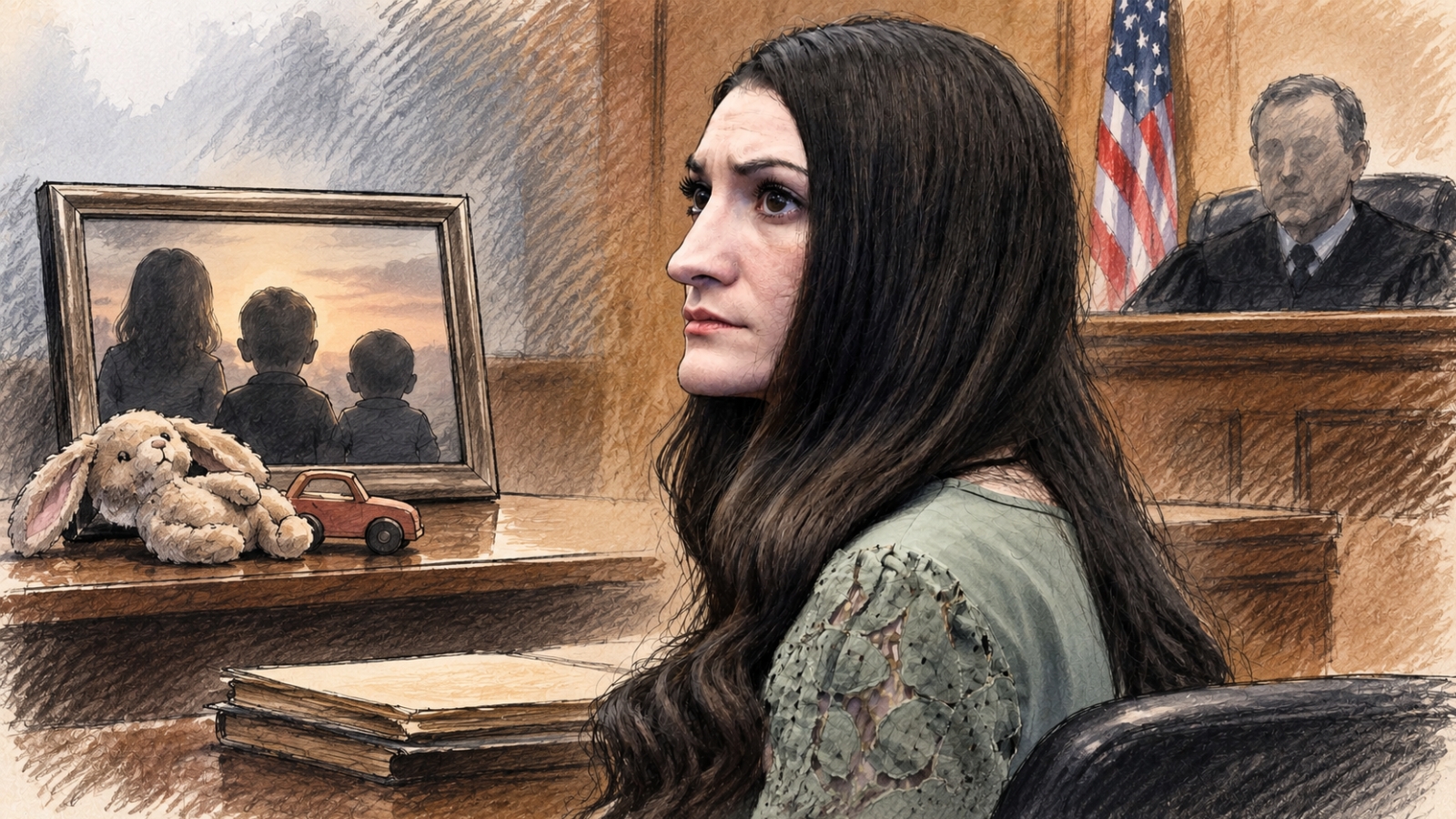
The rain against a courthouse window in Massachusetts does not sound like justice. It sounds like impatience. It sounds like water finding every crack in old mortar, slowly eroding the facade of certainty until nothing is left except wet stone and cold air.
Inside that room, twelve minds had fractured. If you enjoyed this piece, you might want to check out: this related article.
We think of a jury as a monolith. We picture a stoic lineup of citizens marching into a chamber, nodding at exhibits, and emerging with a neat, sanitized truth stamped in ink. But anyone who has ever sat on a wooden juror's bench knows the truth is far messier. It is a crucible of exhaustion, bad cafeteria coffee, conflicting memories, and the crushing weight of another human being's shattered life.
Consider what happens when the legal machinery collides with the unquantifiable tragedy of postpartum psychosis. For another angle on this story, see the recent update from The Washington Post.
For months, the public chewed on the facts of the Lindsay Clancy case like dry bone. A nurse, a mother of three young children, a woman drowning in invisible chemical storms behind a smiling Instagram grid. On a freezing January evening in Duxbury, that storm made landfall. Three little lives extinguished in a house that should have smelled of cinnamon and wet mittens. Then, an attempted leap from a second-story window. A body broken, but alive enough to face a courtroom.
The defense pointed to the gray matter. They pointed to overmedication, a brain hijacked by a pharmacological cocktail prescribed to patch the leaks of a mind fracturing under the sheer, unmapped weight of modern motherhood. They argued she was legally insane, caught in the grip of a nightmare she never chose.
The prosecution pointed to the footsteps. The locked door. The deliberate acts of a woman who, in their view, knew right from wrong and chose the dark anyway.
Two narratives. Both built from facts. Both entirely irreconcilable.
And so they deliberated. Day after gray day. Until the walls of the jury room felt like they were closing in.
Then came the crack. Not a bang, but a whisper.
Months after the mistrial was declared—after the hung jury walked out into a world that wanted simple answers and got only an echoing void—one of those jurors broke the silence. An anonymous voice stepping out from behind the shroud of anonymity to explain the unexplainable.
They weren't fighting about malice. They were fighting about comprehension.
"We tried," the voice seemed to say through the veil of court reporters and legal analysis. "We tried to hold the weight of it, but our hands were too small."
There is a profound loneliness in sitting judgment over a mother who has broken the foundational law of human existence. It goes against every drop of biological programming. Every instinct we possess screams that mothers protect; they do not destroy. When a mind breaks so violently that it violates that primal contract, our collective psyche convulses. We want to label it pure evil because pure evil is easy to file away. It has sharp edges. It belongs in a box.
Mental illness, particularly the terrifying spectrum of postpartum psychiatric crises, is not a box. It is a fog.
When you sit in a deliberation room trying to decide whether a human being possessed intent, you are essentially trying to measure the velocity of a ghost. How do you quantify the fog? How do you look at medical records detailing a catastrophic descent into despair, insomnia, and hallucinations, and reconcile them with the physical actions of hands that once held rattles and teething rings?
You don't. You argue. You shout. You weep over stale donuts. You look at strangers across a table and realize they see the exact same evidence and arrive at opposite shores of reality.
Some jurors looked at the clinical notes—the rapid-fire switching of psychiatric drugs in the weeks leading up to the tragedy—and saw a chemical lobotomy in real-time. They saw a healthcare system that handed out pills like Tic Tacs to a woman begging for sleep, begging for relief, while her brain slowly unspooled. They saw a system on trial just as much as the woman in the wheelchair.
Others looked at the timeline. The deliberate choices. The quiet moments between the chaos. They feared the precedent. If a mother can slip beyond the reach of accountability because the darkness got too loud, what does that mean for the safety of the most vulnerable among us? Where is the line between a broken brain and a culpable soul?
That is the question that split the room. That is the question that remains hanging in the Massachusetts salt air, unresolved and bleeding.
We are obsessed with closure. Hollywood has trained us to expect the verdict. The gavel falls, the music swells, the credits roll, and we are absolved of the messy discomfort of ambiguity. Real life does not grant such mercy. Real life leaves us standing in a mistrial, staring at a jury split down the middle, forced to confront the horrifying reality that some human tragedies are too vast for our legal vocabulary to contain.
Lindsay Clancy remains institutionalized, her body healing from a fall that should have killed her, her mind anchored in a reality the rest of us can scarcely fathom. The children are gone. The father is left to walk through rooms that hum with an unbearable absence. And the jurors have gone back to their lawns, their grocery shopping, their quiet kitchens, forever changed by the week they spent staring into the abyss of a human mind pushed past its absolute breaking point.
They couldn't agree on guilt. They couldn't agree on innocence.
Perhaps because we are asking the wrong questions.
We treat postpartum psychosis as an outlier, a bizarre glitch in the maternal matrix. We whisper about it behind closed doors and quickly change the subject to something safer, something sunnier. We build a society that demands women bounce back from childbirth with the elasticity of rubber bands, returning to work, to caregiving, to perfection, without ever acknowledging the sheer biological earthquake that pregnancy and postpartum hormone drops detonate inside the skull.
We isolate new mothers in suburban fortresses, strip away the communal village that once shared the burden of night wakings and mental fatigue, and then express shock when the seams split.
The jurors weren't just arguing about Lindsay Clancy. They were arguing about all of us.
They were arguing about a culture that looks away from maternal mental health until the sirens start wailing. They were arguing about the distance between what we expect women to endure and what human biology is actually capable of surviving.
When the holdout juror finally spoke, they didn't offer a neat resolution. They didn't point a finger and say this is the truth. Instead, they left us with something much more unsettling.
They left us with the silence.
It is the silence that follows a door closing on a shattered family. It is the silence of a jury room after the final argument has faded into nothing. And most of all, it is the quiet, persistent hum of a society that still refuses to look directly at the darkness growing in the next room, waiting for the floorboards to creak.