The air up there does not merely chill; it strips you down. At altitudes where the sky bruises into a deep, indifferent violet, every breath is a deliberate transaction. You trade warmth for silence, comfort for scale. Thousands of miles away from the damp, familiar green of British valleys, families check their phones every thirty seconds, watching a spinning cursor, waiting for a signal that refuses to bridge the impossible distance between an ordinary living room and the jagged spine of the Himalayas.
Right now, the numbers are cold, terrifying abstractions on a news crawl. At least thirty-three Britons are unaccounted for following catastrophic flash floods that tore through the mountain passes of Nepal and Tibet. Thirty-three lives reduced to a shifting tally. Behind each digits lies a discarded hiking boot left outside a teahouse, an unmailed postcard of prayer flags snapping in a gale, a suitcase sitting quietly in a hallway in London or Manchester, waiting for an owner who may never walk through the door.
Water in the mountains does not behave like water in the lowlands. It arrives without a polite warning. There is no rising tide, no gentle pooling on the lawn. It is a wall. It is twenty tons of glacial silt, ancient rock, and liquefied earth tearing down a gorge at the speed of a freight train, snapping pine trees like toothpicks and erasing stone bridges in a single, roaring heartbeat.
Consider what happens in the valleys below. The monsoon rains, bloated by a warming atmosphere, push against the earthen dams of high-altitude glacial lakes until something has to give. When it breaks, the mountain liquidates. It turns solid rock into a slurry of destruction.
For the traveler caught in that path, the transition from awe to terror is instantaneous. One moment you are adjusting your pack strap, marveling at the sheer vertical drop of a Tibetan canyon, and the next, the earth beneath your boots is moving. The sound is deafening, a low tectonic groan that bypasses the ears and vibrates straight through the chest cavity. There is nowhere to run up. There is only the frantic scramble for higher ground, a desperate calculation made in fractions of seconds.
And then comes the silence.
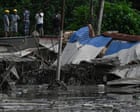
Days later, the mud dries into a fine, choking grey dust. The rescue helicopters fight against treacherous downdrafts, their rotors beating thin air, searching for glints of Gore-Tex or human movement among the grey debris fields. Communications are severed. Power lines lie tangled in the silt like broken spiderwebs. In this digital age, we have grown accustomed to the illusion of permanent connection. We believe that because satellites orbit above, no one is ever truly lost. We think an Apple AirTag or a WhatsApp message can pierce any wilderness.
The Himalayas offer a brutal correction to that arrogance.
Entire trekking routes have vanished. Villages built of stone and timber over generations have been swept clean off the ledges, leaving behind only raw scars of red clay where hearths used to burn. Local guides, men and women who know these mountains as intimately as their own hands, shake their heads in disbelief. The storms are shifting. The weather is heavier, angrier, less predictable than it was even a decade ago.
Back in Britain, the waiting rooms of the Foreign Office are filled with a very specific kind of agony. It is the agony of ambiguity. Grief has a shape, a gravity that pulls you downward, but uncertainty is a vacuum. It keeps you suspended. Every ring of the telephone is a potential lifeline or a final, devastating blow. Parents, partners, and siblings scroll through photographs taken just days before—smiling faces framed by blue skies and distant white peaks—trying to find some hidden omen in an ordinary snapshot, as if a frozen image could tell them whether their loved one beat the wall of water or was swallowed by it.
The search teams press on through the mud, stepping carefully over boulders the size of delivery vans. Every turned stone is a question. Every bend in the swollen, chocolate-colored river holds a possibility.
Up on the roof of the world, the wind continues to blow, indifferent to the smallness of human grief, indifferent to the thirty-three names on a manifest, blowing the prayer flags into ribbons against an unforgiving sky.