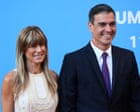
The Spanish judicial system has stepped directly into the private quarters of the Prime Minister, and the resulting tremors are shaking the foundations of the European socialist movement. Begoña Gómez, the wife of Prime Minister Pedro Sánchez, finds herself at the center of a criminal investigation involving allegations of influence peddling and corruption in business. This is no longer just a headline for the tabloids. It is a procedural reality that has forced a sitting European leader to briefly contemplate resignation and, more recently, to adopt a strategy of aggressive counter-attack against the judiciary itself.
At the heart of the matter is whether Gómez used her position to secure backing for her master’s degree program at the Complutense University of Madrid and whether her letters of recommendation influenced the awarding of lucrative government contracts. Specifically, the probe looks at her relationship with Carlos Barrabés, a consultant who received significant public contracts, and Globalia, the parent company of Air Europa, which received a massive taxpayer-funded bailout during the pandemic.
The Paper Trail of Influence
To understand the gravity of the situation, one must look past the partisan shouting matches in the Spanish Congress. Investigative journalism thrives in the gray areas of administrative law. The investigation, spearheaded by Judge Juan Carlos Peinado, focuses on a series of letters of support signed by Gómez. In the world of high-stakes public procurement, a signature from the spouse of the person chairing the Council of Ministers carries a weight that is difficult to quantify but impossible to ignore.
The legal question isn't whether Gómez liked these businesses, but whether her intervention created an unfair advantage that distorted the market. Spanish law on traffic of influences is notoriously specific. It requires proof that a private individual exerted pressure on a public official to obtain a resolution that generates a profit. Here, the "public official" is the entire state apparatus overseen by her husband.
The Globalia Connection
The timing of certain meetings has become the primary target for investigators. In 2020, as the aviation industry collapsed under the weight of global lockdowns, Globalia was desperate for a lifeline. During this period, Gómez reportedly met with Javier Hidalgo, the CEO of Globalia. Shortly thereafter, the Spanish government approved a €475 million bailout for Air Europa.
Critics argue this was a conflict of interest that should have prompted Sánchez to recuse himself from the cabinet meeting that approved the funds. The government’s defense is simple: the bailout was handled by SEPI (the state holding company) and followed rigorous technical criteria applied to all "strategic" companies. They claim the Prime Minister’s wife was simply acting in her capacity as a professional in the third sector, fostering partnerships that had nothing to do with state coffers.
A Judicial System Under Fire
Sánchez has not taken these developments lying down. He has characterized the investigation as a "political hit job" orchestrated by far-right interests, specifically citing the group Manos Limpias (Clean Hands), which filed the initial complaint. This group has a long history of filing lawsuits against high-profile figures, many of which eventually collapse.
However, the case gained teeth when the UCO (the Civil Guard's elite judicial police unit) was ordered to search the offices and homes involved. While an initial UCO report suggested they found no immediate evidence of criminal wrongdoing by Gómez, the judge pushed forward, citing enough "logical clues" to justify a deeper dive.
This tension highlights a growing rift in Spanish society. One side sees a necessary check on power where no one, not even the Prime Minister’s family, is above the law. The other sees the judicialization of politics, where judges use their benches to influence the electoral cycle. When Sánchez took a five-day "sabbatical" to reflect on his future, he wasn't just resting. He was gauging the public’s appetite for a populist defense of his administration.
The Business of Academics
Beyond the government contracts, the investigation into Gómez’s role at the Complutense University of Madrid reveals the messy intersection of prestige and power. Gómez did not hold a traditional doctoral degree, yet she co-directed a Master’s program in Competitive Social Transformation.
The university has since moved to distance itself, but the damage to its reputation is significant. Investigations have looked into whether private companies sponsored the program in exchange for proximity to the Moncloa Palace. In a country where youth unemployment remains high and the "meritocracy" is often questioned, the optics of a Prime Minister's spouse navigating the academic world without standard credentials are toxic.
The Barrabés Factor
Carlos Barrabés is perhaps the most critical link in this chain. An entrepreneur credited with helping bring e-commerce to the Spanish mountains, he became a key figure in Gómez’s professional circle. His companies won several tenders from Red.es, a public corporate entity.
The defense argues that Barrabés was a pioneer in his field and would have won those contracts regardless of who signed a letter of recommendation. But in a criminal court, "would have" is a weak shield. The prosecution is looking for a quid pro quo. They are hunting for the moment a recommendation turned into a mandate.
Power and the Press
The role of the media in this saga cannot be overstated. Spain is currently a laboratory for polarized journalism. Outlets on the right have pursued every lead, sometimes blurring the lines between fact and speculation. Meanwhile, pro-government outlets have focused almost entirely on the flaws of the accusers, effectively ignoring the substance of the judicial orders.
As an analyst, I see this as a breakdown in institutional trust. When the Prime Minister calls journalists "tabloid hitmen" and the opposition calls the Prime Minister a "corrupt autocrat," the truth is often the first casualty. The reality is that the European Union is watching. Spain is a major recipient of NextGenerationEU funds, and any hint that these funds are being distributed based on personal connections rather than objective merit could trigger audits from Brussels.
The Recuse Argument
The most potent legal threat to Sánchez himself—not just his wife—is the allegation that he failed to recuse himself. Under the Law Regulating the Exercise of High Office, a minister must abstain from decisions that involve a "personal interest."
If it is proven that the Air Europa bailout or the Red.es contracts provided a direct or indirect benefit to his wife’s professional career, the political fallout would be irreversible. Sánchez has survived every political "death" imaginable, earning him the nickname "The Survivor." But a formal judicial finding of a conflict of interest is a different beast than a lost vote in Parliament.
The Tactical Counter-Suit
In a bold move that many saw as a declaration of war against the judiciary, the State Attorney, acting on behalf of Pedro Sánchez, filed a lawsuit against Judge Peinado for malfeasance. They claim the judge made "unjust" decisions intended to damage the Prime Minister’s reputation.
This is a dangerous game. By using the State Attorney—a body funded by taxpayers—to sue a judge investigating his wife, Sánchez is leaning into a narrative of executive overreach. It shifts the focus from "Is Begoña Gómez corrupt?" to "Is the judicial system biased?"
The European Context
Spain does not exist in a vacuum. Around the world, we see a trend of leaders under investigation turning the tables on the investigators. From the United States to Brazil, the playbook is consistent: delegitimize the court, mobilize the base, and frame the legal process as a coup.
For the Spanish economy, this instability is a drag. International investors prize legal certainty. When the leadership of a country is in a direct legal battle with its own judiciary, that certainty evaporates. The Ibex 35 index may not show it yet, but the conversations in the boardrooms of London and Frankfurt are increasingly focused on Spanish sovereign risk.
The Silence of the Partners
Sánchez’s government relies on a fragile coalition of far-left parties and regional separatists. For now, they are standing by him, not out of loyalty, but out of necessity. If Sánchez falls, their influence disappears. However, their silence is becoming louder.
If more evidence emerges regarding the use of public funds, the "clean" image that the Sumar party tries to project will be compromised. The junior partners in the coalition are essentially hostages to the Moncloa situation. They cannot leave without triggering an election they might lose, but they cannot stay without being tainted by the Gómez affair.
Technical Nuances of the Case
We must look at the specific crime of private corruption. This occurs when an individual in the private sector receives, asks for, or accepts an unjustified benefit to favor another in the purchase or sale of goods. The investigation into Gómez’s university software—which she allegedly registered in her own name despite it being developed for the university—falls under this umbrella.
The defense claims the software was a "pro bono" contribution and that no public money was stolen. But the registration of intellectual property is a form of wealth. If that property was created using university resources or corporate sponsorships intended for the institution, the legal ground shifts beneath her.
The Fragility of the Executive
Spain is currently governed by a leader who has mastered the art of the narrow escape. But the Gómez case represents a new frontier. Previous scandals involved party financing or lower-level officials. This one sits at the breakfast table of the Prime Minister.
The investigative focus will now turn to the digital footprint. Emails, WhatsApp messages, and calendar entries from the Moncloa Palace are being scrutinized. In the modern era, the "how" of corruption is rarely found in brown envelopes full of cash; it is found in the metadata of a "quick check-in" meeting or a "cc" on a strategic email.
The Path Forward for the Prosecution
Judge Peinado has shown no signs of backing down. Despite the pressure from the government and the State Attorney's office, he has continued to call witnesses, including business leaders and university officials. The strategy is clear: build a map of the network surrounding Gómez and see where the lines of public money and private influence intersect.
The next phase will likely involve forensic accounting. Investigators will track the flow of sponsorship money from companies like Indra and Telefónica into the university programs Gómez managed. They will look for anomalies—payments that exceed market value or services that were never rendered.
Spanish democracy is facing a stress test. On one hand, you have a Prime Minister who believes he is protecting the office from a "lawfare" campaign. On the other, you have a judge who insists that the law must be blind to the status of the person in the dock. There is no middle ground in this fight.
The outcome of this investigation will define the remainder of the Sánchez era. If Gómez is cleared, Sánchez will emerge with a mandate to "reform" the judiciary, likely by increasing executive control over judge appointments. If the case proceeds to a formal trial, the legislative session is effectively over, and Spain will enter a period of prolonged political paralysis. The stakes are not just about the career of one woman, but about the integrity of the Spanish state's procurement and the independence of its courts.
Watch the documents, not the speeches. The truth in the Gómez case is buried in the fine print of university contracts and the timestamps of government bails. Everything else is just noise designed to keep you from looking at the ledger.
Stop looking for a graceful exit from this crisis. There isn't one. Either the judiciary proves its independence by holding the highest levels of power to account, or the executive proves that with enough political capital, the law is merely a suggestion. Spain is currently deciding which of those two versions of itself it wants to be.