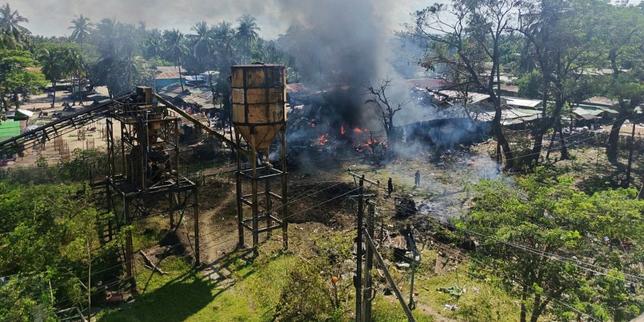
Another headline drops. Fifty dead in a marketplace. Humanitarian sources point fingers at the sky, condemning a junta jet that unleashed death over stalls selling rice and fish in Rakhine State. The international community gasps on cue, issues a sternly worded statement, and rolls over to the next geopolitical catastrophe.
Stop right there. For an alternative view, consider: this related article.
If you think this is merely a story about a rogue pilot dropping ordnance on a civilian market, you are falling for the exact lazy consensus the commentariat wants you to swallow. You are looking at the smoke while missing the entire structural fire. The outrage machine focuses on the gruesome body count because outrage is cheap, measurable, and easily digestible. It hides the mechanical reality of a state in terminal, mathematical collapse.
The Logistics of a Failed Air Force
Let us look at the operational reality. Modern military analysts love to talk about air superiority as if the Myanmar military operates like a Western coalition force with precision-guided munitions and real-time intelligence feeds. They do not. Similar insight regarding this has been provided by Reuters.
I have watched defense budgets and operational logs across Southeast Asian theaters long enough to know what happens when a conventional military loses ground connectivity. The Tatmadaw is being chewed alive on the ground by coordinated ethnic armed organizations and the Arakan Army. When infantry units are cornered, isolated, and running out of ammunition, the air arm becomes an indiscriminate panic button.
It is not grand strategy. It is institutional desperation.
When you lose control of roads, rivers, and outposts, every civilian infrastructure node looks like a supply line to a paranoid general. Treating these strikes as isolated acts of cartoonish villainy misses the point. They are the predictable output of an army that has completely severed its feedback loop with reality. They bomb markets because they no longer possess the capability to map the battlefield.
The Convenient Blind Spot of Humanitarian Dependency
The second layer of lazy consensus belongs to the aid ecosystem. Every time a tragedy like the Kyauktaw strike hits, the press cycle relies entirely on local "humanitarian sources" and remote NGO briefs.
Do not misunderstand me—the dead are real, the blood is real, and the grief is catastrophic. But the framing is routinely flattened to fit a clean narrative of absolute good versus absolute evil, stripping away the multi-sided dynamics of a fractured civil war. Insurgencies use crowded civilian spaces for logistics, taxation hubs, and administrative centers. When an asymmetric war merges with urban and rural commerce, the friction point becomes a slaughterhouse.
International bodies issue warnings about international humanitarian law as if the junta reads Geneva Convention handbooks before scrambling a jet. Appealing to international norms when dealing with a fractured, collapsing military dictatorship is like yelling legal statutes at a hurricane.
The Question Everyone Avoids
People ask: How can the international community stop these atrocities?
The question is fundamentally flawed. It assumes the international community has leverage it lost years ago. Sanctions leak like sieves through regional neighbors, fuel imports find backdoor channels, and domestic resistance movements are already fighting a total war of survival.
The real question you should be asking is what happens to a nation of fifty million people when the state institutionalizes automated cruelty simply because it has nothing left to offer its population.
We are watching the slow-motion dissolution of a country's economic and physical grid. Markets, schools, and clinics are not collateral damage; they are the remaining pulse points of a civilian economy that the state is actively trying to atomize to deny resources to the advance of the opposition.
Stop reading these reports as breaking news tragedies. Start reading them as autopsy markers for a dying state.
50 Killed, 58 Wounded In Airstrike - UN Alarmed Over Deadly Violence
This video provides direct coverage and international context regarding the deadly market airstrike in Rakhine State.


