Qatar spends money on art. A lot of it. But if you think Doha is just buying up masterpieces to show off its wealth, you are missing the entire point.
For the past two decades, Sheikha Al-Mayassa bint Hamad bin Khalifa Al Thani has quietly orchestrated one of the most aggressive cultural land grabs in modern history. As the chair of Qatar Museums, she handles an annual acquisition budget that experts estimate routinely hits the hundreds of millions. She is the sister of the ruling Emir, which means she has the backing of an entire nation state. Learn more on a similar topic: this related article.
But this is not about vanity. It is soft power.
By positioning Doha as a global cultural crossroads, Sheikha Al-Mayassa turned art into a diplomatic shield. When you own the world's most celebrated contemporary masterpieces and build museums designed by Pritzker Prize winners, the global elite pays attention. You are no longer just a small gas rich peninsula in the Gulf. You are an indispensable player in international affairs. Further reporting by TIME highlights comparable perspectives on this issue.
Here is how she did it, why the strategy works, and what it tells us about the intersection of oil wealth, culture, and global politics.
The Strategy Behind the Billions
Western critics love to focus on the price tags. When Qatar bought Paul Cézanne’s The Card Players for a reported $250 million in 2011, the art world gasped. When they picked up Paul Gauguin’s When Will You Marry? for close to $300 million a few years later, it made front page news.
The focus on the money misses the macro view.
Sheikha Al-Mayassa views these acquisitions as long term infrastructure. Just like building airports or roads, acquiring top tier art builds national identity. Qatar is preparing for a post oil economy. To do that, it needs tourism, prestige, and intellectual capital.
You cannot buy a century of cultural heritage overnight. But you can buy the art that defines it.
The real brilliance lies in how these acquisitions plug into Qatar National Vision 2030. The goal is to transform the country from a carbon based economy into a knowledge based one. Art serves as the catalyst. By bringing the finest examples of global creativity to Doha, the state introduces its citizens to diverse viewpoints while demanding that the international community treat Qatar as an equal peer.
Museums as Diplomatic Monuments
Look at the Doha skyline. The buildings themselves tell the story of this cultural push. Sheikha Al-Mayassa did not just hire local firms to build standard galleries. She courted the biggest names in architecture to create physical landmarks that demand global recognition.
The Museum of Islamic Art was designed by I.M. Pei. He was coaxed out of retirement for the project and spent months traveling the Muslim world to find inspiration. The result is a masterpiece of geometric light and shadow sitting on its own purpose built island.
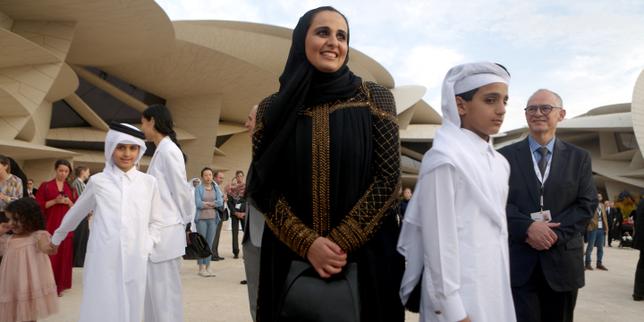
Then there is the National Museum of Qatar, designed by Jean Nouvel to look like a desert rose crystal. It is massive, sprawling, and instantly recognizable.
These buildings are diplomatic calling cards. When foreign dignitaries, heads of state, and corporate titans visit Doha, they are not just shuttled between government ministries and luxury hotels. They are taken to these cultural cathedrals. It shifts the conversation. It changes how the world views Qatari capability.
Bridging East and West
The exhibitions curated under Sheikha Al-Mayassa's watch are intentionally provocative and global. She brought Damien Hirst’s controversial The Miraculous Journey—a series of 14 giant bronze sculptures depicting the gestation of a fetus—to the sidewalk outside a women’s hospital in Doha. It was a bold move in a conservative society.
She brought Richard Serra’s massive steel monoliths, East-West/West-East, into the middle of the Qatari desert.
These projects show that Qatar is willing to host difficult, modern conversations. It signals to the West that Doha speaks its cultural language, even while maintaining its traditional Gulf identity. It is a delicate balancing act that requires immense political skill.
The Inner Circle and the Art Market Power
You do not rewrite the rules of the global art market without making some waves. For years, major auction houses in New York and London knew that if a truly historic piece came to market, Qatar was the buyer to beat.
Sheikha Al-Mayassa operated with a level of secrecy that drove dealers crazy. She utilized a network of elite advisors, including high profile figures like Christie's former chairman Edward Dolman, to navigate the opaque waters of blue chip art acquisition.
At one point, ArtReview named her the most powerful person in the art world. She beat out mega dealers like Larry Gagosian and international artists like Ai Weiwei.
Think about that for a second. A young royal from the Middle East topped the Western dominated art hierarchy simply by outthinking and outspending everyone else.
But this aggressive buying spree created domestic challenges. Spending billions on Western art while local artists struggled for recognition caused friction. Sheikha Al-Mayassa responded by expanding the remit of Qatar Museums to heavily support regional talent. The Fire Station artist in residence program in Doha is a direct result of this shift, giving young Qatari and Arab creators the studio space and funding to develop their voices.
When Culture Meets Geopolitics
The true test of Qatar's cultural diplomacy came in 2017. Saudi Arabia, the United Arab Emirates, Bahrain, and Egypt hit Qatar with a brutal diplomatic and economic blockade. They shut down borders, closed airspace, and tried to isolate the country completely.
In the past, a blockade like that might have crippled a small nation. But Qatar had spent the previous decade building deep cultural alliances across the globe.
During the blockade, Qatar's cultural institutions did not shut down. They expanded. They launched major international exhibitions in Washington, Paris, and Berlin. They showed the world that while their neighbors were flexing military and economic muscle, Qatar was focusing on high culture and global connection.
It worked. The blockade eventually collapsed in early 2021. Qatar emerged from the crisis with its international reputation largely intact, if not enhanced. The billions spent on art and museums suddenly looked like an incredibly smart investment in national security.
The Blueprint for Cultural Influence
If you want to understand how a modern state builds influence from scratch, study the Qatari model. It requires three specific steps that any organization or nation can adapt.
First, identify the gaps in your global profile. Qatar had wealth but lacked institutional prestige. Art filled that void faster than any traditional public relations campaign ever could.
Second, commit to the highest possible standard. Do not cut corners. If you are going to build a museum, hire a Pritzker winner. If you are going to buy art, buy the absolute best piece available on the market. Mediocrity gets ignored; excellence commands respect.
Third, tie your cultural investments directly to your broader strategic goals. Sheikha Al-Mayassa did not buy art just because she likes paintings. She bought art because it serves the economic and political survival of her country. Every acquisition, every gallery opening, and every international partnership serves that singular goal. Culture is not a luxury. It is a core strategic asset.