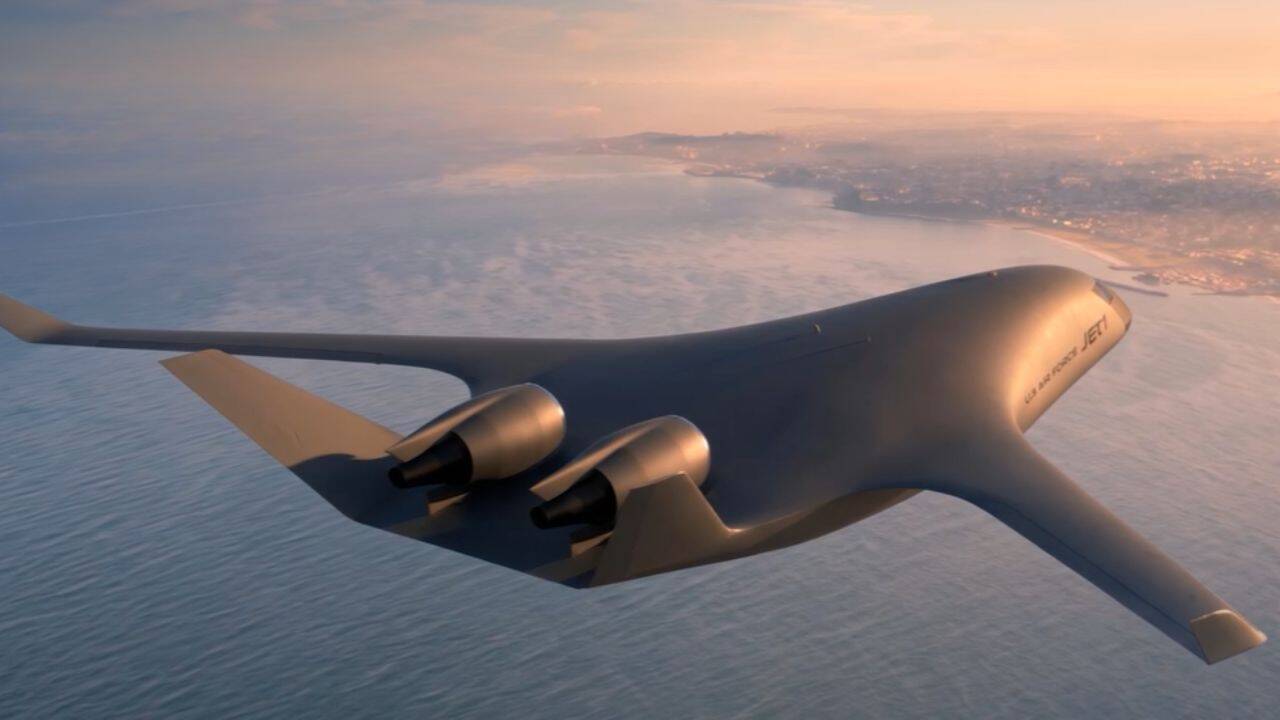
Look up from the window seat of any modern airliner, and you are staring at a tube.
For nearly a century, humanity has taken to the skies inside a glorified aluminum pipe. We bolt two wings to the sides, strap screaming engines beneath them, and pressurize a long cylinder to thirty-five thousand feet. It works. It moves millions of us across oceans in hours. But that shape—efficient for holding pressure, disastrous for aerodynamic grace—has reached the absolute edge of its physics. Every extra passenger means a longer tube. A longer tube means more weight. More weight means an insatiable appetite for fuel, burning through the thin blue edge of our atmosphere with a quiet, persistent roar.
We have accepted this shape because we assumed there was no other choice.
Enter a startup in California called JetZero, working out of Long Beach with an ambition that sounds absurd until you look at the math. They are building a thirty-hundred-million-dollar bet on a radically different geometry: the Blended Wing Body.
Picture a flying V, or a giant, sloping manta ray that blurs the line between wing and cabin. There is no distinct fuselage here. The entire aircraft generates lift. The passenger compartment is wide, open, and cavernous, shaped like a low-slung theater rather than a narrow hallway.
The promise is staggering. Fifty percent less fuel burn. Fifty percent fewer emissions. Space for two hundred and fifty passengers spread across a layout that feels less like a commuter bus and more like a floating lounge.
Yet, numbers on a slide deck do not capture the weight of what is happening. To understand why this matters, you have to remember what it feels like to stand on a tarmac at dawn, smelling the sharp, biting scent of jet exhaust, knowing that every single flight overhead carries an invisible mortgage written in carbon.
My grandfather worked on the flight lines of early commercial jets in the 1960s. He wore heavy ear protection and watched silver birds climb into the overcast sky with a sense of boundless optimism. To him, the airplane was freedom. It was the shrinking of the globe, the death of distance.
Decades later, that same freedom carries an existential shadow. We know what the sky costs us now. We watch the weather reports. We feel the subtle, creeping dread of a warming world.
When you talk to aerospace engineers about the current state of aviation, they do not speak with the wide-eyed wonder of the sixties. They speak with the tired exhaustion of accountants balancing an impossible ledger. Traditional aircraft design has squeezed out every last drop of efficiency. Modern turbofans are marvels of material science and fluid dynamics, but they are strapped to a design architecture that was locked in stone decades ago. You can only polish a tube so much before the drag wins.
This is where JetZero steps past the incremental and into the radical.
By merging the wing and the body, engineers solve a fundamental physics problem. Instead of a narrow tube fighting the air, a blended wing distributes the weight and the lift across the entire surface. The air flows over the top and underneath the craft in a continuous, uninterrupted sweep. Lift is multiplied. Drag is slashed in half.
Imagine riding inside that cabin. In a traditional plane, you are trapped in a tight row, staring at the back of a plastic headrest three feet in front of you. In a Blended Wing Body, the interior width changes everything. The cabin is wider, allowing for multi-aisle configurations that feel more like a hotel lobby than a cattle car.
(Note: While structural layouts are still undergoing rigorous Federal Aviation Administration testing, early concept cabin mockups emphasize panoramic viewing zones and vastly improved passenger circulation.)
Crucially, this architecture creates a massive physical platform on top of the rear fuselage, perfectly positioned to embrace the next generation of propulsion systems. Whether powered by advanced sustainable aviation fuels, hydrogen combustion, or hybrid-electric architectures, the airframe acts as a blank canvas for zero-emission technology.
Change in aviation does not happen overnight. It moves at the speed of safety, which is to say, it moves at a glacial pace.
Skeptics point out the obvious hurdles. How do you evacuate two hundred and fifty passengers quickly from a wide, non-traditional cabin layout during an emergency? How do existing airport gates handle an aircraft with a significantly wider wingspan? Where do you even find the capital to build a brand-new commercial airframe from scratch in a market dominated by duopoly giants?
These are valid questions. They are questions born of hard-earned caution. Aviation is an industry where mistakes are written in headlines.
Yet, history shows us that whenever an industry hits a brick wall of diminishing returns, a radical redesign becomes inevitable. Think of the transition from propeller-driven piston engines to the jet age. The old guard scoffed at the fuel consumption and complexity of early jets. They argued that propellers were reliable, familiar, and cheaper to operate.
They were right, right up until the moment they were obsolete.
The aviation industry is currently responsible for roughly two and a half percent of global CO2 emissions, and a much larger climate footprint when accounting for high-altitude contrails and nitrogen oxides. As global travel demand surges—projected to double over the next two decades—incremental tweaks will not save us. Lighter winglets and slightly better fan blades are administrative adjustments on a sinking ship.
We need a different ship.
Consider what happens next: JetZero aims to have a full-scale demonstrator in the air by the end of this decade, with commercial entry targeted for the 2030s. Backed by strategic partnerships and interest from both commercial airlines and the United States military—which sees immense potential in the design for long-range cargo and refueling tankers—the project has moved out of the realm of science fiction and into the harsh, rigorous light of engineering reality.
If they succeed, the visual language of our skies will change forever.
Children growing up in the twenty-first century will look up and see manta rays gliding silently above the clouds, leaving faint, vanishing wisps of vapor instead of thick, persistent scars across the blue. They will board planes that feel spacious rather than suffocating. They will travel the world without leaving a smoking crater in the climate ledger.
The tube is dying. Long live the wing.