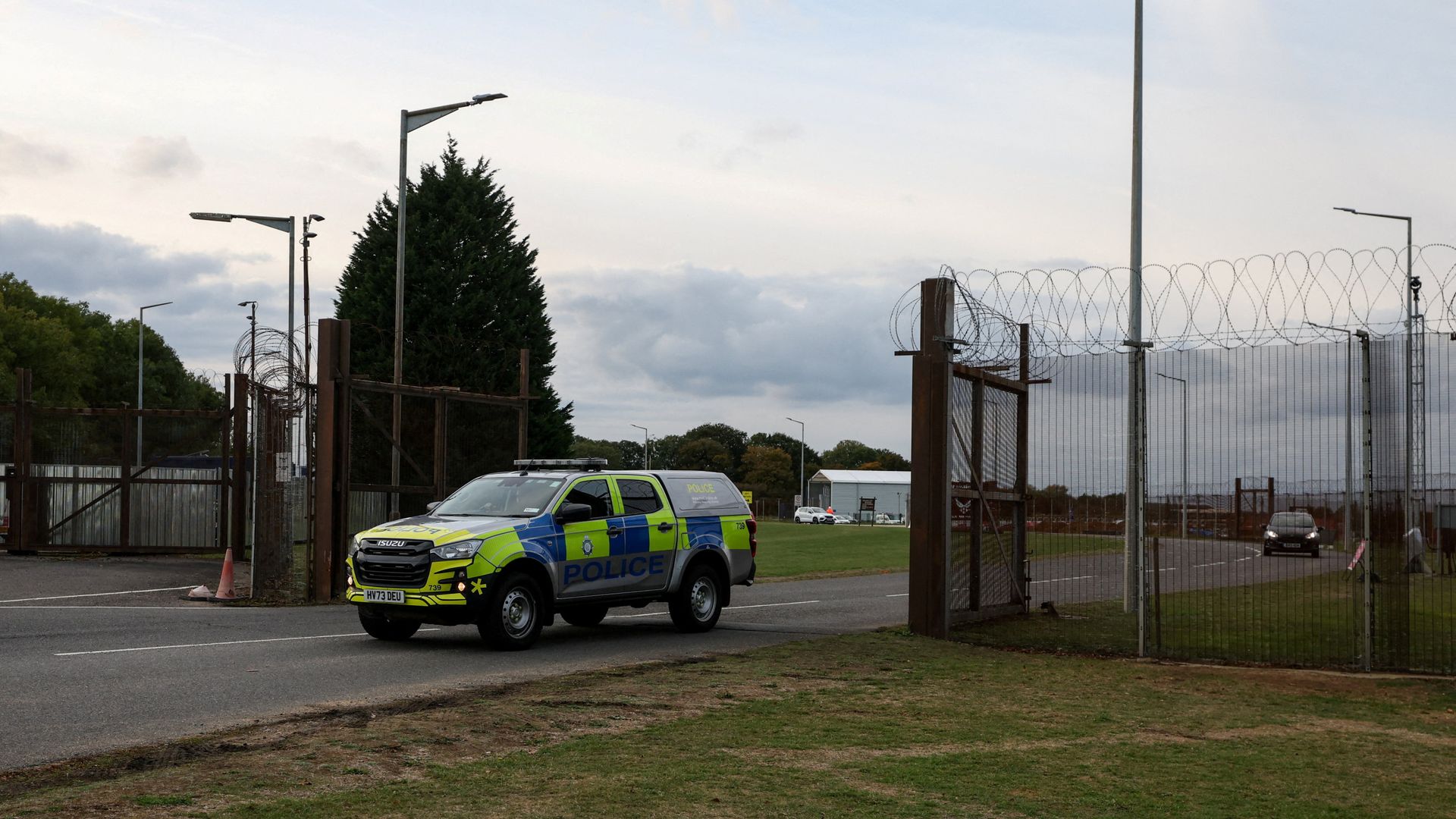
Two Latvian nationals found themselves in handcuffs outside the razor wire of a British military installation last week, touching off quiet panic within intelligence circles across Europe. The incident at RAF Lakenheath was officially categorized as a routine trespassing case by local constabulary. But seasoned defense analysts know better. When foreign nationals manage to breach the perimeter of a vital air station housing sensitive tactical assets, the local police blotter offers only a sanitized facade for a much deeper security failure.
The core event is straightforward. Two individuals originating from the Baltic state walked onto the operational grounds of a premier Royal Air Force base utilized by the United States Air Force. These facilities house complex logistical networks and forward-deployed capabilities that demand absolute perimeter integrity. Yet, a simple trespass charge fails to capture the systemic rot plaguing defense infrastructure across the continent. Recently making waves recently: The Shadow Over the Ballot Box.
Security perimeters do not fail overnight. They erode through complacency, outdated sensor arrays, and a dangerous disconnect between traditional gate guards and modern electronic surveillance. For decades, military bases operated on the assumption that a sturdy chain-link fence and a pair of armed guards were enough to deter casual interlopers. That era is dead. Today, reconnaissance probes take many forms, ranging from low-cost drone flyovers to human intelligence probes designed to test response times and identify blind spots in closed-circuit camera coverage.
Intelligence vectors point toward a troubling reality. Critical defense installations face constant probing from hostile actors looking to map electromagnetic signatures, evaluate local police reaction windows, and test the physical mettle of perimeter defenses. When two foreign nationals penetrate a sensitive zone with zero tactical resistance, every defense contractor and base commander in the alliance takes notice. The incident forces an uncomfortable reckoning regarding how well Western military installations protect themselves against low-signature intrusions. Further insights into this topic are detailed by The Guardian.
Physical security updates cost money, and defense budgets are constantly stretched thin between personnel costs, equipment maintenance, and modernization programs. Perimeter security often falls into a funding purgatory. It is neither glamorous enough to capture political attention nor cheap enough to ignore until something goes wrong. Automated motion detectors, thermal imaging grids, and AI-driven intrusion analytics exist, but retrofitting legacy Cold War-era airfields with modern defense architectures requires staggering capital outlays.
The geopolitical backdrop complicates matters further. The Baltic region serves as a primary friction point between NATO and external adversaries. Intelligence operatives and sympathetic proxies operate with high motivation in these contested geographic corridors. Latvia remains a steadfast Western ally with robust domestic security cooperation, but the actions of individual citizens operating outside state control highlight the unpredictable nature of modern security threats. A state intelligence service seeking to test a British base does not send an active-duty officer in uniform; they employ deniable assets, casual travelers, or opportunistic freelancers to gather baseline observations.
Investigative inquiries into base security protocols usually reveal a predictable pattern of bureaucratic deflection. After an intrusion, commanders promise comprehensive reviews, upgraded cameras, and reinforced patrols. Yet, within months, fiscal realities and institutional inertia take over. The gate guards return to their routines, the cameras remain unmonitored by predictive software, and the fence stays vulnerable to anyone willing to brave a minor legal infraction for a major intelligence coup.
Modern electronic warfare and cyber espionage dominate defense headlines, creating a blind spot for physical incursions. Command structures assume that if digital firewalls hold, the installation remains secure. This dichotomy proves fatal to comprehensive defense strategies. A thumb drive dropped in a server room or a clandestine photograph of a tarmac layout bypasses every firewall ever written. Physical access remains the ultimate trump card for serious intelligence gathering.
Addressing these vulnerabilities requires a fundamental shift in how military installations manage risk. Perimeter security must evolve from a static defense mechanism into an active intelligence-gathering apparatus in its own right. Every fence line should double as a sensor array. Every trespasser must be treated not as a confused wanderer, but as a potential vector for hostile reconnaissance until proven otherwise.
The two Latvian nationals arrested at RAF Lakenheath will cycle through the judicial system, facing minor fines or deportation depending on the final legal determinations. Their names will fade from the headlines within days, replaced by the next transient crisis in a volatile global landscape. But the gate they walked through remains where it was, waiting for the next test.