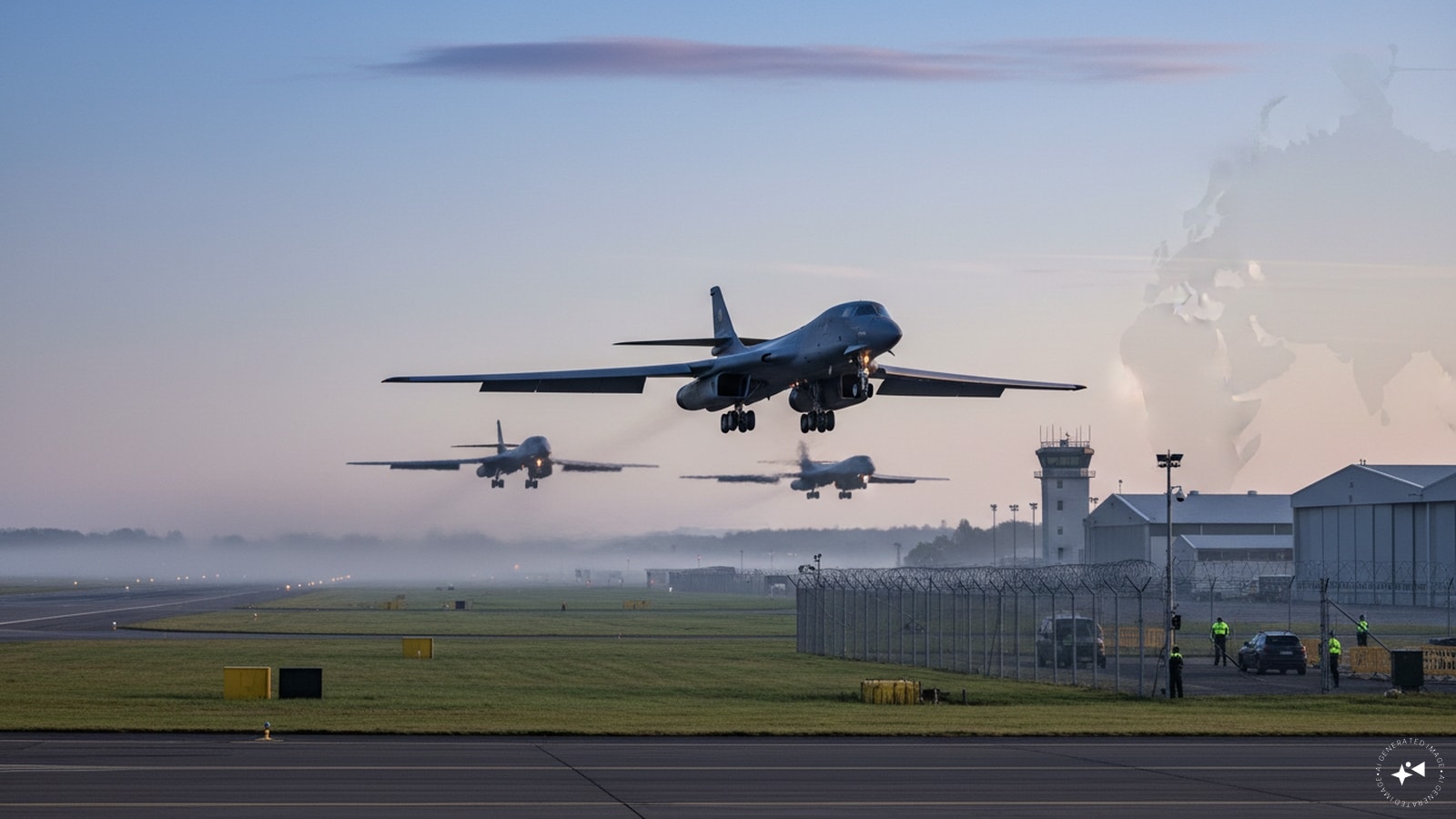
The concrete at Royal Air Force Fairford does not talk, but if you press your hand against it in the damp English dusk, you can still feel the ghost of a tremor.
For months, the local children in the Gloucestershire villages had learned to set their wristwatches by the thunder. At precisely two in the afternoon, the sky would tear open. A pair of B-1B Lancers—swept-wing, long-range heavy bombers painted in a camouflage so dark it seemed to swallow the gray English clouds—would roar overhead on their way out to the North Sea or the Baltic. They were machines out of myth, nicknamed the Bone for the phonetic abbreviation of B-1. They carried no nuclear cargo under their bellies, but they carried something heavier in diplomatic weight: an unmistakable message of deterrence written in Pratt & Whitney afterburners.
Then, the silence came.
Not a gradual thinning out of sorties, but a sudden, administrative hush. Overnight, the flight line emptied. The maintenance crews packed their tool chests into steel containers. The pilots, veterans of missions spanning decades from the deserts of the Middle East to the chilly maritime borders of Europe, boarded transport aircraft and flew west.
The official statements from defense ministries were neat, bureaucratic, and bloodless. A redeployment. A routine adjustment. A matter of security concerns.
Airbases do not close because of weather. They close because the math of the world has changed.
To understand why the B-1 bombers were pulled from British soil, you have to look past the press releases and stand on the perimeter fence of Fairford on a freezing morning. You have to understand what it means to house a machine that costs roughly sixty thousand dollars an hour to fly, a Cold War relic retrograded into the twenty-first century as a supersonic truck for precision-guided munitions.
Imagine a master clockmaker who spends fifty years crafting a mechanical bird of prey. It is terrifying, beautiful, and deafening. It requires an army of specialists just to keep its wings from freezing in the damp. But as the decades roll on, the rules of the forest change. The wolves are no longer fighting with teeth; they are hunting with invisible wires.
The B-1 was never built for subtlety. It was built for speed, low-level terrain-following penetration, and brute-force tonnage. When the United States Air Force deployed these bombers to Fairford—operating under the banner of Bomber Task Force Europe—the goal was simple: remind Moscow that the Atlantic is a bridge, not a moat. Every time a B-1 lifted off from British tarmac and tracked toward the Barents Sea, Russian interceptors scrambled. Radar screens lit up across Scandinavia. The geopolitical pulse quickened.
Yet, proximity breeds vulnerability.
In modern warfare, a stationary base is a target with a zip code. As long-range reconnaissance, hypersonic capabilities, and asymmetric gray-zone tactics evolve, concentrating massive, high-value strategic assets within striking distance of contested borders becomes an expensive gamble. The decision to pull the B-1s back was not a retreat from commitments; it was an acknowledgment of a harsher reality. When the security environment shifts—when the theater becomes too transparent, too crowded with eyes and missiles—the oldest rule of survival applies: you move the shell before the pea disappears.
Consider what happens inside the planning rooms when these orders drop.
An operations officer stationed at Fairford doesn't get a dramatic warning. They get a secure email, encrypted and terse. Execute retrograde operations. Suddenly, the rhythm of life—the endless cups of instant coffee in the briefing room, the grease-stained flight suits, the quiet camaraderie of men and women who maintain engines capable of breaking the sound barrier—collapses into logistics.
Master Sergeant Vance had spent twenty-two years turning wrenches on heavy iron. When I spoke to him near the base gates—his breath pluming white in the Gloucestershire chill—he didn't talk about grand strategy or NATO alliances. He talked about the moisture.
"People don't realize what this air does to a bird," he told me, pulling his jacket tighter against his chest. "England is beautiful, but it eats aluminum for breakfast. We spend half our lives fighting corrosion. When you're told to pack up and leave in a hurry, part of you feels like you're abandoning a post. But another part—the part that looks at the threat assessments every morning—knows we're just playing musical chairs with a very old, very heavy deck of cards."
The departure of the bombers leaves a vacuum, and vacuums in geopolitics never remain empty for long.
Local pub owners in Fairford noticed the drop in trade immediately. The Americans tipped well, drank modest amounts of warm bitter, and asked endless questions about English football. But beyond the local economy, the absence of the bombers changes the strategic acoustics of the region. The deterrent umbrella has not closed—it has simply been folded and moved further away, perhaps dispersed across smaller, more agile forward locations, or anchored deeper within the continental United States via the promise of global reach.
This is the invisible story of modern defense. It is no longer about planting a flag and parking a fortress in the front yard of your adversary. It is about mobility, deception, and the terrifying speed at which power can be projected across oceans without ever needing to touch down on a foreign runway.
The B-1s are gone from Britain now. The hangars at Fairford echo with a different kind of quiet. The crows wheel over the damp runways, undisturbed by the thunder that once made the tea cups rattle in cupboards three villages away.
But down in the control centers, the screens remain lit. The satellites keep their silent vigil overhead. The game hasn't ended; the players have simply stepped back into the mist, leaving behind an empty tarmac and a world holding its breath to see where the shadows fall next.


