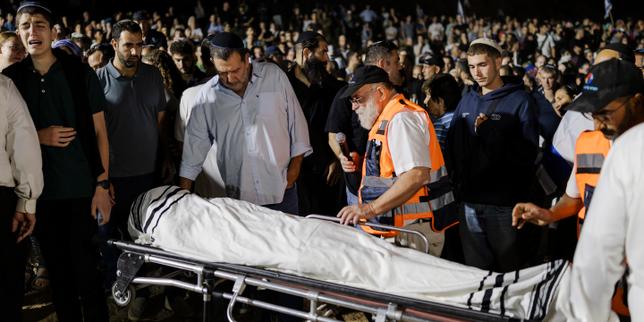
The asphalt of Route 60 does not care who is walking on it. It stretches across the spine of the West Bank like a gray scar, indifferent to the olive trees that cling to the terraced hills or the checkpoints that slice the horizon into jagged fragments. On this road, the air often feels thin, charged with a quiet, suffocating tension that every resident knows by heart. It is the weight of history waiting for the next shoe to drop.
When a life is extinguished here, the shockwave does not dissipate into the wind. It ricochets. It hits the concrete walls of settlements and the narrow, winding alleys of nearby villages within seconds.
Consider a hypothetical afternoon in this fractured geography. A car slows down near a junction. A sudden, violent disruption tears through the afternoon quiet. Within minutes, sirens drown out the wind rustling through the olive leaves. A settler is dead. A community is plunged into a familiar, jagged grief. And across the valley, families in a neighboring town bolt their doors, knowing instinctively that the price of this single act of violence will be extracted from the entire community, tenfold.
But beneath the immediate sorrow and the rising smoke lies another, quieter machinery. It is the machinery of the law, or what passes for law in a land suspended in perpetual occupation. It is a system of military decrees, closed-door tribunals, and dormant statutes that can suddenly be jolted back to life like a corpse wired to a generator.
In the wake of the murder, the political chatter in the capital shifts overnight. Voices rise in anger and demand retribution. They do not just want justice; they want a demonstration. They want the ultimate penalty. They want to revive a ghost that has long haunted the codebooks of military governance.
The specter of the death penalty.
It sounds like a relic from an archaic era, a legal artifact buried under decades of dust. Under the military law governing the West Bank, military courts theoretically possess the authority to hand down capital punishment. Yet, for decades, this power has remained an unpulled trigger. It is a weapon kept in a glass case, admired by hardliners, feared by human rights advocates, and rarely, if ever, deployed.
Why? Because the architects of the occupation always understood a grim calculus: once you cross that threshold, once you turn the scaffold into a routine instrument of state control, you cross a line of no return. It transforms a volatile security crisis into an ideological holy war with no off-ramps.
Yet, when grief turns to fury, logic often takes a back seat.
Following the killing, politicians begin to circle the microphones. They invoke the death penalty not as a measured legal remedy, but as a moral imperative, a cathartic release for a public exhausted by endless security failures. The media picks up the drumbeat. Op-eds are written. Talk shows echo with righteous indignation. The Palestinian assailant, currently sitting in an interrogation room nursing broken ribs or a shattered spirit, becomes a symbol. To one side, he is a monster who deserves the absolute erasure of his breath. To the other, he is a product of a suffocating system, a symptom of an occupation that breeds despair, now facing the ultimate display of disproportionate power.
This is the psychological labyrinth of the West Bank. Every tragedy is instantly weaponized, coded into a narrative where compromise is a dirty word and mercy is viewed as weakness.
To understand how a legal system functions here, one must look past the polished courtrooms of modern democracies. The military courts operating in the West Bank are an anomaly. They are courts where soldiers act as judges, where conviction rates hover near absolute certainty, and where the accused—often a young man from a refugee camp whose world has shrunk to the size of a concrete cell—faces a system designed not to weigh evidence impartially, but to maintain control.
Introduce another hypothetical perspective. Imagine a defense lawyer walking into one of these military tribunals. The room smells of old paper, sweat, and stale coffee. The neon light hums with a low, headache-inducing frequency. Across the table sits a prosecutor armed with classified files, administrative detentions, and the full weight of a military bureaucracy.
The lawyer knows the game. They know that winning rarely means proving innocence; it means mitigating catastrophe. It means keeping a client breathing, keeping the sentence locked in decades rather than eternity.
When the threat of the death penalty enters this room, the air changes. It is no longer just a trial about a specific crime on Route 60. It becomes a test of political will. Will the military court system, traditionally cautious about inviting international condemnation or triggering an uncontrollable uprising, bow to the populist pressure of the moment? Will they pull the trigger on a statute that has gathered dust for half a century?
The public rarely sees this quiet theater of desperation. They see the headlines. They hear the chants at the funerals. They watch the politicians posture on television screens, trading human lives for political currency.
The tragedy of the West Bank is not merely that people die. It is that every death is immediately conscripted into an eternal war of narratives. When a settler is murdered, the loss is real, absolute, and devastating to the family left behind. When a Palestinian village faces the collective punishment of lockdowns, raids, and now the terrifying whisper of capital trials, thousands of innocent people hold their breath, bracing for the fallout.
Neither side is allowed to simply mourn. Grief here is public property. It is immediately politicized, weaponized, and recycled to fuel the next cycle of violence.
Consider what happens next in this grim choreography. If the state pursues the death penalty, it crosses a Rubicon. It invites international outrage, hardens resistance, and turns the accused into a martyr whose face will be painted on concrete walls from Ramallah to Gaza. If the state backs down, facing the pragmatic advice of security chiefs who warn that executions will only pour gasoline on an already burning fire, the politicians who demanded blood will cry betrayal, accusing the legal system of coddling terrorists.
There is no good outcome. There is only a slow, grinding escalation.
The road where the initial violence occurred will be paved over, the glass swept up, the blood washed away by the next rain. But the structural rot remains. The laws remain. The hatred remains, passed down like a family heirloom from one generation to the next.
We are left watching a society trapped in a loop of its own making. Every crisis is treated as a new beginning, even though it is just the oldest story in the world repeating itself with new actors. The characters change, but the script is written in stone.
Silence falls over the valley as evening approaches. The checkpoints close their iron gates for the night. The hills turn a bruised, bruised purple in the fading light. Somewhere in a military prison, a young man sits in the dark, waiting to find out if he will become a political pawn in a game he never fully understood. And on a hilltop settlement, a family sits in a quiet house, staring at an empty chair at the dinner table, wondering why the world continues to spin when their private universe has stopped.
Nothing is resolved. The shadow lengthens. The valley waits.