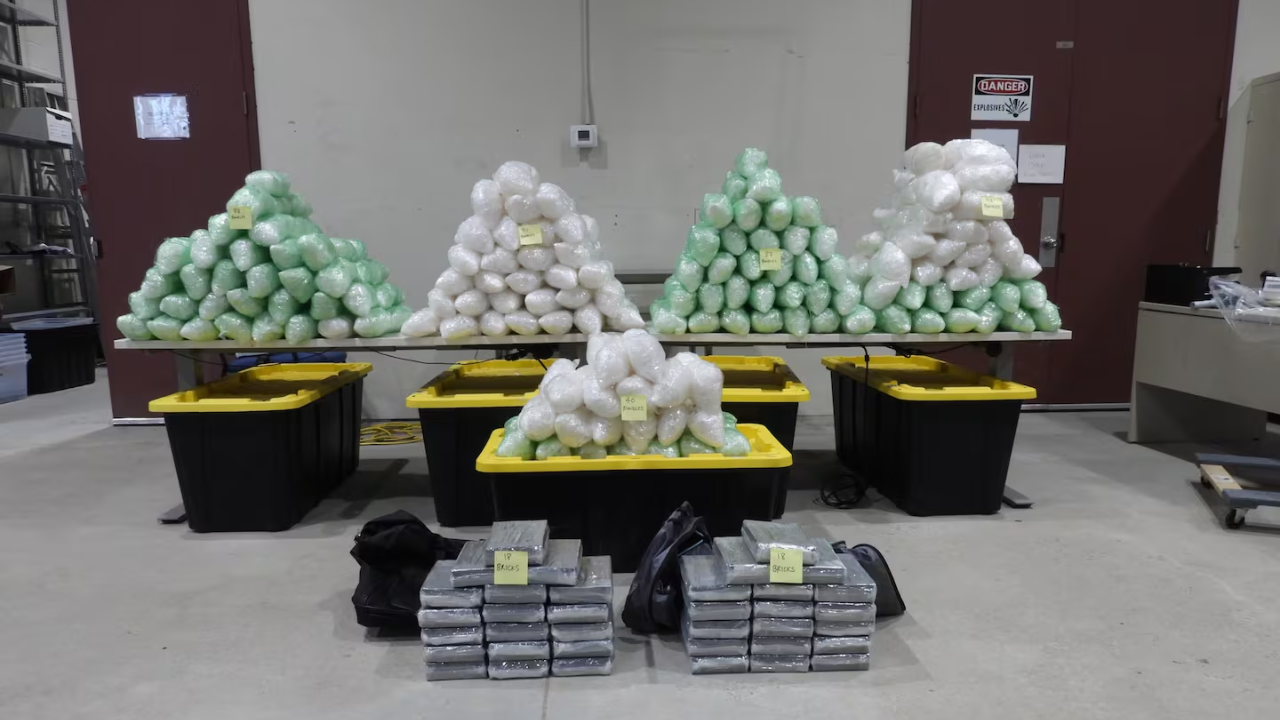
Law enforcement agencies across North America celebrated a historic strike against international drug syndicates when Canadian and American authorities unsealed 102 charges against 21 individuals tied to a $139 million cross-border smuggling ring. Dubbed Project Bay, the joint investigation netted nearly 1.7 metric tonnes of illegal narcotics, including 973 kilograms of cocaine, 660 kilograms of methamphetamine, and 49 kilograms of opium. Yet behind the press conference podiums and tables covered with seized contraband lies a far more uncomfortable truth for border security and supply chain executives.
The criminal syndicate did not rely on clandestine tunnels, fast boats, or low-flying drones. They exploited the backbone of North American commerce: long-haul commercial trucking.
By weaponizing a broker-style transportation model, the network embedded illicit shipments directly inside legitimate freight routes crossing the United States-Canada border. The scheme depended on dispatchers, freight brokers, and commercial drivers who willingly converted standard supply chain infrastructure into a massive narcotics pipeline.
The operation unspooled over eighteen months of covert surveillance and cross-border coordination. What it exposed was not an isolated criminal gang, but an industry-wide vulnerability where legitimate cargo paperwork acts as an impenetrable shield for contraband worth tens of millions of dollars.
The Windsor Gateway and the Genesis of Project Bay
The investigation began quietly in January 2025 when the Windsor Police Service detected unusual patterns in regional narcotics distribution. Windsor, sitting directly across the Detroit River, represents the busiest commercial border crossing in North America. Thousands of heavy trucks move through the Ambassador Bridge and the surrounding transit corridors daily, carrying automotive components, agricultural goods, and consumer products.
Recognizing that the volume of drugs flowing into southwestern Ontario far exceeded local distribution capacity, Windsor detectives engaged the Canada Border Services Agency (CBSA) in February 2025. As the wiretaps and physical surveillance expanded, the scale of the operation forced a broader multi-agency response. The Ontario Provincial Police (OPP) stepped in to coordinate interprovincial targets, pulling in the Border Enforcement Security Task Force (BEST) and the Border Drug Interdiction Task Force (BDIT) alongside municipal forces like Peel Regional Police and Toronto Police Service.
Across the border, American authorities matched the effort. Homeland Security Investigations (HSI) and the Drug Enforcement Administration (DEA) tracked shipments originating in the southwestern United States and transit hubs in the Midwest.
By mid-2026, investigators had mapped a complex distribution web centered heavily in Brampton, Ontario—a major logistics hub northwest of Toronto. Between late June and late July 2026, tactical teams executed 22 search warrants across Ontario, raiding residential properties and commercial transport premises in Brampton, Windsor, LaSalle, Corunna, Kleinburg, Markham, and Caledon.
The arrests swept up 19 individuals, with outstanding arrest warrants issued for two others. A vast majority of those charged share roots in the Indian-origin community concentrated around Brampton and the Greater Toronto Area's transport sectors, including key suspects identified as Gagandeep Thindal, Simranjit Singh, Jatinderpal Singh, Jasvinder Sohi, and Tejwinder Sandhu.
┌─────────────────────────────────────────────────────────┐
│              PROJECT BAY: SEIZURE BREAKDOWN             │
├────────────────────────────────┬────────────────────────┤
│ Illicit Commodity              │ Quantity               │
├────────────────────────────────┼────────────────────────┤
│ Suspected Cocaine              │ 973 kg                 │
│ Suspected Methamphetamine      │ 660 kg                 │
│ Suspected Opium                │ 49 kg                  │
│ Oxycodone                      │ 230 tablets            │
│ Estimated Street Value         │ $139 Million (CAD)     │
├────────────────────────────────┼────────────────────────┤
│ Armaments & Equipment          │ Quantity               │
├────────────────────────────────┼────────────────────────┤
│ Firearms (incl. Anti-Tank)     │ 17 units               │
│ Encrypted Devices & Laptops    │ 49 units               │
│ Currency Seized                │ $90,000 (CAD/USD)      │
└────────────────────────────────┴────────────────────────┘
How the Shadow Freight Brokerage Worked
To understand how nearly 1.7 tonnes of heavy narcotics moved across international lines without triggering border alarms, one must look at how modern freight brokerages function.
In standard logistics, a freight broker connects a manufacturer who needs goods moved with an independent trucking company that has empty trailer space. In a criminal freight brokerage, that exact structure is mirrored to obscure ownership and liability.
The Project Bay syndicate operated an internal dispatch network. Shadow brokers inside the operation matched illicit cargo loads with recruited commercial drivers who owned or operated tractor-trailers. These drivers were not unwitting victims. Police statements confirm that drivers knowingly transported the contraband within legitimate commercial supply chains.
The Mechanics of the Smuggling Run
A typical run followed a carefully orchestrated sequence designed to defeat random inspections at port-of-entry facilities.
- Legitimate Cover Cargo: A compliant freight broker or dispatcher booked a real cargo load—such as frozen produce, dry food goods, or industrial materials—from an innocent third-party manufacturer.
- The Staging Ground: The driver loaded the legitimate goods at a warehouse in California, Texas, or the US Midwest. The truck then detoured to a secure, gang-controlled staging warehouse where the illicit narcotics were packed alongside or behind the legitimate cargo.
- Paperwork Sanitization: The driver received genuine Bills of Lading, customs declarations, and seal numbers. If border officials checked the manifest against digital customs databases, everything appeared completely standard.
- Border Crossing: The driver utilized commercial lanes at high-density ports like the Ambassador Bridge or the Blue Water Bridge. Because the transport company held active carrier authority and valid customs filings, the rig often qualified for expedited primary inspection.
- The Unloading Split: Once across the border into Ontario, the driver proceeded to a secondary yard in Brampton or Windsor. The narcotics were offloaded into stash houses before the driver completed the delivery of the legitimate goods to an unsuspecting retail warehouse.
This division of labor created built-in deniability for everyone except the driver and the immediate dispatcher. If a truck was selected for secondary X-ray scanning at the border, the cartel viewed the loss of a single rig as an acceptable operational cost—a minor write-off balanced against the multi-million-dollar yield of the trucks that slipped through.
The Weaponry and Financial Assets Recovered
When tactical units breached the 22 search locations across southern Ontario, they found evidence of an organization prepared to defend its distribution network with military-grade violence.
Alongside $80,000 in Canadian currency, $10,000 in US currency, high-end jewelry, and industrial money counters, police confiscated 17 firearms. Among the handguns, extended magazines, and prohibited brass knuckles was an unexpected discovery: an anti-tank rifle.
The presence of heavy anti-materiel weaponry inside suburban Brampton and Kleinburg properties signaled a dangerous shift in organized crime logistics. Historically, cross-border drug couriers operated with low profiles to minimize law enforcement scrutiny. The recovery of high-caliber military hardware indicates that the transport operators were engaged in fierce territorial disputes or feared hostile hijackings from rival criminal syndicates targeting high-value loads.
Investigators also seized 43 mobile cellphones and six laptops. These devices form the core of the ongoing forensic investigation. Analysis of encrypted messaging platforms and digital dispatch logs is expected to expose financial conduits used to wash the proceeds through foreign exchange accounts, real estate purchases, and equipment leases.
Why the Commercial Border Infrastructure Is Failing
The success of Project Bay in taking $139 million in narcotics off the street is a victory for law enforcement. Yet it highlights a structural flaw in how Canada and the United States manage commercial border security.
The cross-border supply chain prioritizes velocity above almost all else. Just-in-time manufacturing models used by auto assembly plants and national supermarket chains depend on trucks moving across the border with minimal delay. A delay of two hours at the Ambassador Bridge can stall factory assembly lines across Michigan and Ontario, costing automotive manufacturers millions of dollars an hour.
As a result, border agencies are forced to balance enforcement with economic flow.
Customs officers inspect fewer than five percent of commercial trucks crossing the northern border. Cartels understand this mathematical reality. They recognize that if they run twenty loaded rigs across the border in a month, seventeen or eighteen will cross without experiencing anything more than a brief glance at a driver’s manifest and identification.
Furthermore, the trucking industry in North America suffers from systemic oversight gaps in broker licensing and carrier verification.
- Low Barrier to Entry: Obtaining a freight broker license or establishing an independent trucking fleet requires relatively minimal capital and background screening compared to other regulated infrastructure sectors.
- Double Brokering Exploits: Legitimate shipments are frequently resold or re-routed through multiple layers of digital brokers. This practice obscures who is physically handling the freight at any given point between origin and destination.
- Driver Exploitation and Recruitment: Long-haul trucking faces severe economic pressures, including stagnant freight rates, high fuel costs, and predatory equipment leases. Shadow networks target financially vulnerable owner-operators, offering cash payments ranging from $50,000 to $100,000 for carrying a single hidden load across the border.
The Human and Financial Cost to the Transportation Sector
The fallout from Project Bay extends far beyond those named in the 102 charges.
The vast majority of commercial truck drivers operating between Canada and the United States are law-abiding professionals performing essential labor under difficult conditions. Yet operations of this scale cast a persistent shadow over the entire commercial freight sector.
Insurance rates for cross-border fleets in Ontario have surged in recent years due to rising cargo theft and border compliance risks. When criminal networks corrupt logistics routes, legitimate carrier companies face increased secondary inspections, delayed delivery schedules, and reputational damage.
The presence of 49 kilograms of raw opium among the seized commodities points to another unsettling trend. Opium processing requires direct connections to international production centers in Southwest and Southeast Asia. Its recovery in Ontario indicates that the criminal network was operating multi-commodity distribution channels, supplying local processing labs that convert raw materials into high-potency opioids and synthetic narcotics.
Fixing the Border Logistics Vulnerability
Disrupting shadow brokerage networks requires more than periodic multi-jurisdictional busts. It demands a fundamental redesign of how commercial freight identity and cargo integrity are verified.
Law enforcement agencies cannot inspect their way out of this crisis. Physical checks at border crossings will never keep pace with the volume of daily freight without triggering severe economic disruption.
Real reform requires structural accountability inside the freight ecosystem.
- Mandatory Chain-of-Custody Digital Seals: Modern supply chains must transition to tamper-evident, GPS-linked smart seals that broadcast real-time data to border authorities. Any unauthorized opening of a trailer door between the origin loading dock and the border checkpoint should trigger an automatic, mandatory secondary inspection.
- Rigorous Freight Broker Vetting: Regulatory bodies must overhaul the vetting process for dispatchers and freight intermediaries. Corporate entity tracking should be enforced to prevent convicted individuals from re-registering shell brokerages under family members or associates.
- Enhanced Biometric Carrier Verification: Border clearance programs must cross-reference driver identities with real-time biometric verification and carrier assignment registries. This prevents unauthorized or unvetted relief drivers from taking over a rig mid-route.
- Targeted Financial Intelligence on Fleet Operations: Financial intelligence units must increase scrutiny on small-to-medium transport companies whose revenue far exceeds their documented fleet size or typical freight rates. Sudden spikes in cash flow or unexplained asset acquisitions within transport fleets are clear indicators of illicit freight activity.
The 21 individuals facing prosecution in connection with Project Bay represent a significant link in a chain. But until regulatory authorities and supply chain leaders close the structural loopholes in commercial transportation, new shadow brokers will step forward to fill the void, turning the highways of North America back into high-margin corridors for illicit cargo.


