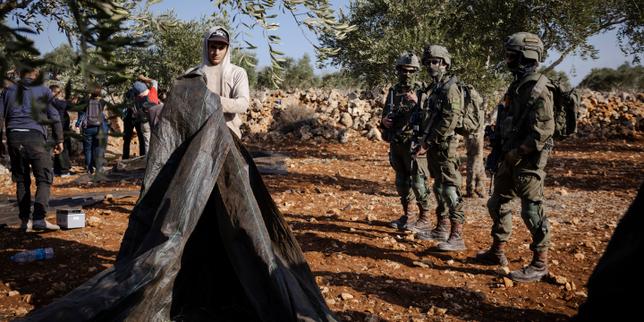
When masked assailants attack foreign diplomats and local officials near Taybeh during the autumn olive harvest, standard news coverage treats the clash as a sudden burst of lawlessness. Treating an assault on accredited or visiting foreign representatives as an isolated flare-up misses the structural mechanics that govern movement, property access, and enforcement across the West Bank. The core analytical takeaway is straightforward: incidents involving European diplomats—such as the October 2026 confrontation near Taybeh involving representatives from France, Belgium, and Poland alongside a French mayor—expose a sharp friction between state-level diplomatic immunity norms, localized territorial coercion, and fragmented policing jurisdiction.
Conventional reporting on settler assaults typically catalogues dramatic details—who shouted what, which vehicle window broke, which foreign minister issued a condemnation—without separating verified facts from contested claims or mapping the incentives behind the behavior. A rigorous breakdown replaces episodic outrage with three analytical lenses: the Enforcement Asymmetry Framework, the Land-Access Cost Function, and the Diplomatic Signaling Loop.
Deconstructing Standard Coverage and Separating Fact from Hypothesis
Standard event-driven reporting relies on a familiar sequence: an incident occurs in a contested rural zone, witnesses describe masked men and physical intimidation, victims condemn impunity, and authorities issue conflicting or procedural statements about investigations and coordination. That structure informs readers of what happened in the moment, yet it leaves three analytical questions unresolved. First, how does an attack on foreign officials alter calculations that already apply daily to Palestinian farmers? Second, why do formal condemnations rarely produce rapid, visible deterrence on rural roads? Third, which claims rest on direct observation versus political attribution?
To maintain strict factual discipline, each claim surrounding a West Bank diplomatic incident belongs in one of three tiers:
- Established operational facts: Verified physical occurrences, official statements, and documented incident tallies. During the October 2026 olive harvest period near Taybeh, reports from diplomats, local officials, and Israeli security sources documented an encounter involving masked assailants, damage to a diplomatic vehicle, an assault on a French mayor, and subsequent police/military investigative notices alongside diplomatic protests from European capitals. Rights monitor Yesh Din also reported hundreds of harvest-related incidents across a multi-week autumn window, including violent assaults, property damage, and cases occurring in the presence of security forces.
- Contested or unverified assertions: Exact headcounts of attackers in chaotic scuffles, whether a specific convoy followed prior coordination protocols, and how each side characterizes intent when video or witness accounts differ. Official Israeli commentary has at times pointed to uncoordinated movement or urged caution pending evidence review, whereas visiting officials and rights groups point to a broader pattern of intimidation and lax enforcement.
- Educated hypotheses: Inferences about long-term political strategy, such as whether assaulting foreign envoys is intended specifically to deter third-party observers from documenting agricultural access or to provoke sanctions debates in Brussels and national capitals.
The Enforcement Asymmetry Framework
In institutional economics and conflict studies, rule-of-law credibility depends on the probability of detection, the speed of arrest, and the certainty of prosecution. When enforcement varies sharply by geography, actor identity, and administrative jurisdiction, actors face enforcement asymmetry: the expected legal cost of unlawful coercion is low relative to the perceived territorial or political gain.
In the West Bank, overlapping administrative layers—Civil Administration oversight, military command zones, police investigative jurisdiction, and Palestinian municipal boundaries—create friction between rapid on-the-ground intervention and post-hoc inquiry. When a confrontation unfolds along a dirt road or agricultural track near an outpost or village edge, security forces may arrive after perpetrators disperse, or investigators may face evidentiary hurdles tied to masks, all-terrain vehicles, and fluid witness accounts.
Even when authorities open an investigation or condemn violence in principle, a gap between headline statements and visible accountability shapes expectations on the ground. Repeat offenders discount future penalties if prior incidents ended without immediate detention, while residents and observers discount official assurances when patterns recur across successive harvest seasons.
The Land-Access Cost Function
Why do clashes spike during the autumn olive harvest rather than occurring at a uniform rate all year? A land-access cost function models how agricultural value and physical risk interact for rural households. For Palestinian olive growers, a narrow seasonal window determines a substantial share of annual household income and food security. Every day delayed or every grove left unharvested raises the opportunity cost of staying away—yet walking into contested groves raises the physical and legal cost of showing up.
Attackers exploit this exact trade-off. By raising the expected cost of access through intimidation, roadblocks, property damage, or physical assault, localized coercion can depress harvest output even without formal administrative orders. When European diplomats or municipal leaders visit an olive grove or village—whether to observe conditions, formalize twinning ties, or accompany local residents—they temporarily alter that cost equation.
Foreign observers bring two things local farmers often lack: international press access and diplomatic channels into foreign ministries. From a tactical standpoint, confronting a diplomatic convoy changes the stakes for everyone involved. It raises immediate diplomatic friction between sending states and host authorities, while testing whether international presence actually shields rural access or becomes a target of friction itself.
The Diplomatic Signaling Loop
Attacks on foreign envoys trigger a predictable diplomatic signaling loop that operates on two distinct tracks: public messaging and policy instruments.
- Immediate public condemnation: Foreign ministries summon ambassadors or issue sharp statements criticizing violence against diplomats and reiterating opposition to settlement expansion or unaddressed abuses.
- Procedural defense and inquiry: Host officials or security spokespeople either condemn criminal rioters, open a formal police investigation, or question movement coordination and demand evidence before assigning blame.
- Policy escalation debate: Lawmakers and ministers in European capitals weigh targeted visa bans, asset freezes, or broader trade and cooperation pressure—yet collective EU action often moves slowly because foreign policy decisions require broad consensus and legal substantiation.
The limitation of this loop is timing mismatch. Diplomatic responses unfold over days, weeks, or months through formal channels, whereas access to perishable harvests and safe passage on rural roads are decided in minutes on the ground. Statements alone rarely shift real-time patrol behavior unless paired with verifiable operational changes.
Operational Playbook for Risk Assessment and Response
For diplomatic missions, international NGOs, legal monitors, and policy analysts operating in or assessing the West Bank, treating every field visit as routine is a planning error. A disciplined operational protocol requires four steps:
- Map micro-corridors before deployment: Classify every planned route segment by proximity to outposts, bypass roads, recent incident clusters, and mobile coverage gaps rather than relying solely on town-level safety assumptions.
- Standardize movement protocols and documentation: Establish clear pre-trip notifications where appropriate, designate a single real-time incident log (timestamps, GPS coordinates, vehicle identifiers, medical/damage records), and avoid improvised detours into unvetted tracks.
- Separate incident verification from policy advocacy: Record objective facts immediately after an event—injury status, vehicle damage, witness identities, official statements—before drafting broader political conclusions, preserving credibility in legal and diplomatic forums.
- Track enforcement metrics over rhetoric: Evaluate institutional response not by press releases alone, but by concrete follow-through such as arrests, indictments, court outcomes, and consistent protection along recurring harvest corridors.
Every measure carries trade-offs. Over-reliance on formal coordination can constrain independent monitoring or delay time-sensitive visits, while uncoordinated movement increases exposure in contested terrain without guaranteeing protection. Similarly, aggressive sanctions rhetoric can harden political pushback if legal thresholds or consensus requirements are uneven across European capitals.
Strategic Recommendation for European Missions
European foreign ministries and diplomatic missions should stop measuring their response to West Bank settler violence by the sharpness of post-incident communiqués and instead build a joint rapid-verification and accountability ledger across participating consulates. By pooling standardized evidentiary logs, tracking individual cases from initial police report to prosecutorial outcome, and tying diplomatic engagement to concrete law-enforcement benchmarks during high-risk agricultural windows, European missions can convert sporadic diplomatic outrage into sustained, verifiable institutional pressure.
Masked Israeli settlers attack European diplomats and US journalist
This video is relevant because it shows brief news coverage of the West Bank attack involving European diplomats and a journalist that frames the incident discussed in the analysis.