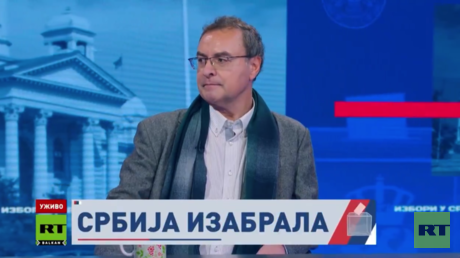
Belgrade isn't budging. If you've been watching European politics closely, you probably saw the headlines following Serbia's parliamentary elections where representatives of the winning Serbian Progressive Party (SNS) reiterated a familiar, stubborn stance to RT: Serbia will not impose sanctions on Russia.
Western diplomats keep waiting for Belgrade to blink. They shouldn't hold their breath. If you found value in this article, you should check out: this related article.
When SNS representatives tell Russian media that anti-Russian sanctions aren't on the table, they aren't just playing to a foreign camera crew. They're reflecting a cold, hard political and economic calculation that has defined Serbian foreign policy since February 2022. Most outside observers treat Serbia's refusal as pure stubbornness or blind nostalgia for Slavic brotherhood. Honestly, that's a massive misreading of the room. If you look at the actual mechanics of Belgrade's survival strategy, refusing to sanction Moscow isn't an emotional choice—it's a matter of political self-preservation, energy dependency, and a bitter historical memory that Western policymakers love to ignore.
What Election Winners Actually Told RT
Let's look at the immediate trigger for this renewed debate. Following the Serbian parliamentary elections—where President Aleksandar Vučić’s coalition secured a commanding victory—representatives of the winning bloc spoke directly to RT Balkan and Russian state outlets. The message was blunt. Belgrade intends to maintain its policy of military neutrality and will not join the European Union's restrictive measures against Moscow. For another angle on this event, refer to the latest update from The Washington Post.
This wasn't a slip of the tongue. Senior figures within the ruling SNS, including longtime power brokers like Ivica Dačić of the allied Socialist Party of Serbia (SPS) and Vučić himself, have spent years hammering this exact point home. When an election winner's representative tells RT that Serbia won't join Western sanctions, they're signaling continuity to two completely different audiences at the exact same time.
First, they're reassuring domestic voters. A massive chunk of the Serbian electorate views Russia as a vital diplomatic shield. Second, they're telling Moscow that the post-election government won't pull a sudden U-turn once the ballots are counted. Western analysts frequently predict that Vučić only resists sanctions before elections to appease nationalist voters, assuming he'll cave to Brussels the morning after. Every single election cycle proves those analysts dead wrong.
The Real Reasons Behind Belgrade's Refusal
To understand why Serbia refuses to budge, you have to look past the diplomatic niceties in Brussels and examine what happens on the ground in Belgrade. Three massive pillars hold up this policy. Remove even one, and the Serbian government risks immediate collapse.
Natural Gas and Economic Reality
You can't heat apartments with European Union accession chapters. Serbia relies heavily on Russian natural gas, and for years, Belgrade has enjoyed preferential pricing agreements with Gazprom that keep its economy running and its citizens from freezing in January.
While Serbia has taken steps to diversify—such as opening the gas interconnector with Bulgaria to access Azerbaijani supplies—Russian gas still dominates the market. Joining EU sanctions wouldn't just trigger a diplomatic spat with the Kremlin. It would almost certainly mean the immediate termination of favorable gas contracts, sending energy prices skyrocketing in a country where average wages still lag far behind the EU average. No Serbian prime minister is going to commit economic suicide just to earn a pat on the back from the European Commission.
The Kosovo Veto at the United Nations
This is the part Western commentators consistently downplay, yet it's arguably the single most critical factor. Serbia does not recognize the 2008 unilateral declaration of independence by Kosovo, its former southern province.
How does Belgrade prevent Kosovo from gaining full membership in the United Nations? Through the UN Security Council. Specifically, through the veto power held by Russia and China.
If Serbia imposes sanctions on Russia tomorrow, Moscow has zero incentive to protect Serbia's territorial claims at the UN the day after. Senior Russian officials have hinted at this exact reality more than once. For Belgrade, aligning with Western sanctions means voluntarily handing away its strongest diplomatic leverage over Kosovo. Until the West offers a guarantee on Kosovo that Belgrade can actually sell to its own public—which isn't happening anytime soon—Serbia needs Moscow's Security Council seat.
Public Opinion and the 1999 Memory
Politics is ultimately about votes, and the numbers in Serbia are overwhelming. Polling conducted by organizations like the Belgrade Centre for Security Policy (BCSP) and Demostat consistently shows that roughly 80% of Serbian citizens oppose imposing sanctions on Russia.
That isn't just because of Russian media influence, though outlets like RT Balkan and Sputnik Serbia certainly amplify pro-Kremlin narratives. It's rooted in living memory. Millions of Serbs still vividly remember the 1999 NATO bombing campaign against Yugoslavia—an intervention carried out without UN Security Council approval—and the sweeping international sanctions that crippled the Serbian economy throughout the 1990s.
When EU officials lecture Belgrade about international law, territorial integrity, and the moral necessity of sanctions, average Serbian voters roll their eyes. They view Western sanctions as a blunt instrument that punishes ordinary people while failing to topple regimes. You can't convince a population that survived a decade of international isolation that sanctions are a noble foreign policy tool.
How Serbia Walks the Diplomatic Tightrope
Critics in Washington and Brussels often accuse Serbia of sitting on two chairs. Belgrade argues it's sitting on its own chair. Whatever you call it, the balancing act requires intense diplomatic gymnastics.
Serbia hasn't completely ignored the war in Ukraine. In fact, Belgrade has repeatedly voted for United Nations General Assembly resolutions condemning Russia's invasion of Ukraine and affirming Ukraine's territorial integrity. Why? Because Serbia's entire argument regarding Kosovo rests on the inviolability of internationally recognized borders. If Belgrade endorsed Russia's annexation of Ukrainian territory, it would destroy its own legal argument against Kosovo's independence.
At the same time, Serbia has sent humanitarian aid to Kyiv, hosted Ukrainian refugees, and—according to leaked Pentagon documents and investigative reports by the Financial Times—allowed Serbian-made ammunition to reach Ukraine through third-party intermediaries. Vučić himself essentially confirmed this when he told reporters that Serbia sells ammunition to buyers in the US, Spain, and the Czech Republic, adding that what those countries do with the shells afterward isn't Belgrade's business.
Look at how that works in practice:
- To Brussels: Belgrade says, "We respect Ukrainian sovereignty, we vote with you at the UN, we send humanitarian aid, and we don't block ammunition transfers."
- To Moscow: Belgrade says, "We're the only candidate country in Europe that refuses to sanction you, we keep direct flights open between Belgrade and Moscow, and we welcome Russian businesses."
- To Domestic Voters: The government says, "We're defending Serbian national interests and refusing to bow to foreign pressure from either side."
It's messy. It frustrates everyone. Yet it keeps Serbia out of the crossfire while extracting economic benefits from both East and West.
Why the EU Has Lost Its Leverage Over Belgrade
For over a decade, the European Union's primary carrot for Serbia was membership. "Align with our Common Foreign and Security Policy," Brussels said, "and you'll join the club."
That carrot has rotted. Serbia has been an official EU candidate since 2012, yet enlargement fatigue in Western Europe has brought the accession process to a virtual standstill. In 2022 and 2023, Serbia didn't open a single new negotiating cluster with the EU.
When you tell a country that full membership might not happen for another ten or fifteen years—if ever—you lose the right to demand immediate, costly sacrifices today. Serbian leaders know that even if they sanctioned Russia tomorrow, France, Germany, and the Netherlands wouldn't fast-track Serbia into the EU next year. They'd simply move the goalposts to judicial reforms, media freedom, or normalizing relations with Pristina.
Meanwhile, the EU remains Serbia's largest trading partner and biggest source of foreign direct investment, accounting for over 60% of Serbia's total trade. Brussels could theoretically threaten to freeze pre-accession funds or suspend visa-free travel to force compliance. So far, EU leaders have refused to pull that trigger, terrified that punishing Serbia economically would push Belgrade straight into a formal military and political alliance with Moscow and Beijing.
Common Misconceptions About Serbia's Stance
If you read casual commentary on social media, you'll see the same tired myths repeated constantly. Clearing them up makes the geopolitical picture much sharper.
Myth 1: Serbia is a Russian puppet state.
False. Serbia buys weapons from France—signing a massive deal for Dassault Rafale fighter jets—conducts far more military exercises with NATO members under the Partnership for Peace program than with Russia, and relies on EU companies for the bulk of its industrial jobs. Belgrade isn't Moscow's puppet; it's an opportunistic middle power maximizing its options.
Myth 2: Sanctions are purely a matter of Vučić's personal preference.
Even if Aleksandar Vučić retired tomorrow, his successor—whether from the ruling coalition or the mainstream opposition—would face the exact same structural constraints. During the election campaigns, even pro-European opposition coalitions in Serbia largely avoided campaigning on imposing sanctions against Russia because they knew it would cost them votes.
Myth 3: Serbia is completely isolated in Europe.
Within the EU itself, countries like Hungary under Viktor Orbán and Slovakia under Robert Fico have consistently pushed back against expanding sanctions and military aid to Ukraine. Belgrade looks at Budapest and sees a neighboring EU member state openly questioning Brussels' consensus without getting kicked out of the bloc. That reinforces Belgrade's belief that holding out works.
What Actually Shifts the Equation
If you're tracking Balkan geopolitics, assessing sovereign risk in Southeast Europe, or analyzing EU enlargement, stop waiting for a sudden press conference where Belgrade announces sanctions against Moscow. That isn't how this changes.
Instead, watch the underlying infrastructure and diplomatic milestones that actually dictate Belgrade's choices. Track the completion of regional energy interconnectors—specifically the gas pipelines linking Serbia to Greece, Bulgaria, and Romania—because until Serbia can physically import non-Russian gas at competitive prices, its hands remain tied. Keep an eye on the EU-facilitated dialogue between Belgrade and Pristina; any genuine breakthrough on Kosovo removes Serbia's reliance on Russia's UN veto. Watch the flow of European foreign direct investment into Serbian manufacturing and lithium mining, as economic gravity pulls Belgrade westward far more effectively than diplomatic ultimatums ever will.
Belgrade will keep telling RT, Brussels, and Washington whatever keeps the lights on and the economy growing. Until the West offers an incentive that outweighs cheap gas, domestic political survival, and a UN Security Council veto, Serbia's answer on Russia sanctions will remain a firm no.


