You learn to read the city by its frequencies.
Long before you see the amber strobe bouncing off apartment brick or catch the diesel tang hanging heavy in an intersection, you feel it in the soles of your feet. The asphalt hums. A low, subterranean vibration travels up through the rubber soles of your shoes, telling you something heavy is moving fast.
Then comes the audio. Not just noise, but displacement. A wall of compressed air shoved down a narrow concrete canyon, parting traffic like an invisible plow. We have all stepped aside a thousand times. We hear the wail, we check our mirrors, we drift toward the curb, and we let the red iron pass. We assume the red iron always knows where it is going and that the red iron always arrives.
We rarely think about what happens when the physics fail.
The Intersection at Zero Hour
A fire engine does not drive like a car. It is a massive, multi-ton wall of specialized steel, water tanks, and pressurized hoses, engineered to force its way through chaos. When a Los Angeles Fire Department apparatus enters an intersection with lights flashing and sirens splitting the midnight damp, it carries momentum that defies ordinary human reflexes.
Picture the geometry of a typical L.A. street corner. Block buildings crowding the sidewalks, parked sedans cutting off peripheral vision, headlights blooming against wet pavement.
Now, imagine the weight.
Vehicles of that scale do not stop on a dime. They require distance, calculation, and a terrifying amount of trust between the person holding the wheel and every other human being sharing the pavement. On an ordinary Tuesday, that trust holds. The choreography works.
Until it doesn't.
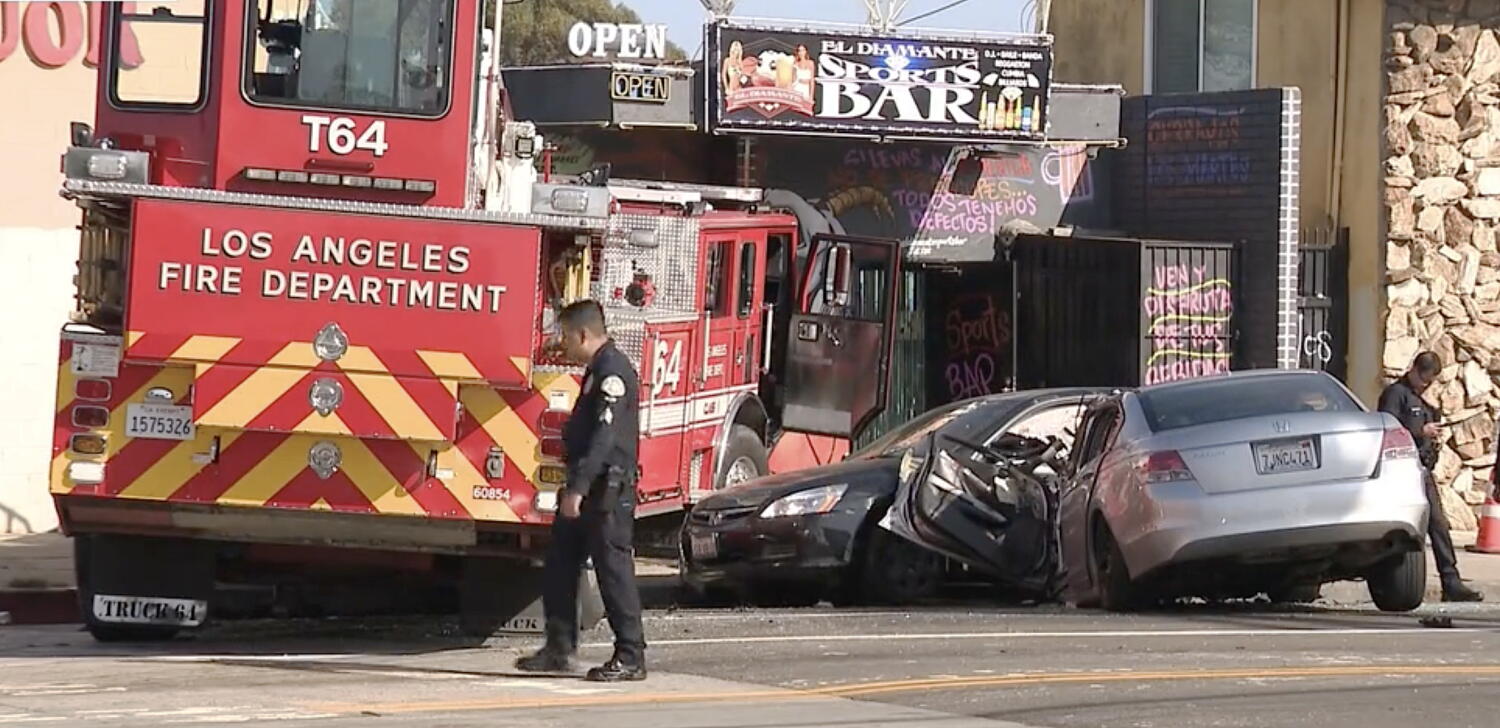
When a collision occurs involving emergency apparatus, the shockwave is entirely different from a routine fender-bender. It is a sudden, violent convergence of urgency and accident. Seven people found themselves swept into that exact convergence when an LAFD truck collided with civilian traffic, sending injuries rippling outward through the asphalt. Seven stories fractured in a single second. Among them, a firefighter—someone whose entire professional existence is built on running toward the smoke, suddenly forced to wait for help to arrive.
The Anatomy of a Split Second
Why does it happen?
We tend to look for villains in wreckage. We want someone to blame, a clear line drawn between right and wrong, safe and reckless. Human nature rebels against randomness. We prefer a narrative where mistakes belong exclusively to the careless.
Yet, emergency response is a masterclass in calculated exposure.
Consider the sensory overload inside the cab of a fire truck under code-three response. Sirens wail at decibels designed to penetrate insulated car cabins and deafen the unwary. Lightbars throw blinding strobe patterns across windshields and wet storefronts, reflecting off rearview mirrors in a chaotic strobe dance. The driver is working the wheel, managing a massive turning radius, watching traffic lights, listening to dispatch chatter over the radio, and scanning for erratic pedestrian movements.
On the civilian side, the experience is equally disorienting. Modern cars are soundproofed cocoons. Drivers are often listening to podcasts or navigation prompts. A siren can echo off concrete buildings, bouncing sound waves in ways that make it nearly impossible to pinpoint which direction the emergency vehicle is actually approaching from. You hear the scream of the air horn, you freeze, you look left, you look right, and for one paralyzed heartbeat, time stretches.
That is where the math breaks down. That is where a multi-ton engine and a family sedan occupy the exact same spatial coordinate.
The Ripple Effect
When seven people are loaded into ambulances following a crash with an emergency vehicle, the immediate headlines focus on the hospital counts and the blocked lanes of traffic. But the true impact extends far beyond the yellow police tape.
For the firefighter injured in the rig, the uniform changes overnight. The person who yesterday was climbing ladders into superheated air is now a patient in a sterile gown, staring at hospital ceiling tiles, grappling with the strange vulnerability of needing the very system they usually serve. There is a psychological toll to being on the receiving end of trauma, especially when your identity is wrapped up in being the rescuer.
For the civilians involved, the ordinary rhythm of life shatters instantly. A grocery run, a late-night shift change, a drive home after a long day—interrupted by the screech of tearing metal and the terrifying realization that life can pivot on a decimal point.
And for the department, every such collision triggers a quiet, heavy internal reckoning. Fleet safety officers comb through dashcam footage, telemetry data, and radio logs. They look at approach angles, speed telemetry, and right-of-way protocols. Not to point fingers, but to understand how to prevent the unpreventable next time. Because every second saved racing to a fire is meaningless if the truck never makes it through the intersection.
The Cost of Urgency
We demand impossible things from our emergency responders.
We expect them to arrive instantly when our world is burning, when a loved one stops breathing, when a car accident traps a neighbor in twisted wreckage. We want them to navigate congested city streets like ghosts, slipping through gridlock without friction or delay.
We forget that ghost-work requires heavy machinery. It requires steel and diesel and human beings with beating hearts gripping steering wheels in the dark.
The sirens will keep wailing tonight. Somewhere in the city, another heavy rig will roll out of a station bay, red lights painting the night walls in rhythmic flashes. Traffic will part. Drivers will glance in their mirrors, swearing softly at the delay, or nodding in silent acknowledgment of the crisis unfolding down the block.
Remember the geometry of that moment. Remember the weight of the machine, the blur of the strobes, and the fragile, breathing humans sitting inside the steel.
The asphalt hums beneath your feet. The sound approaches. The city holds its breath, waiting to see if everyone makes it through.