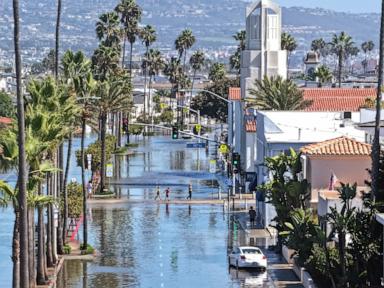
The coffee cup was still warm on the wooden counter of the beachside diner when Elena first heard the wood groan. It wasn't the usual rhythm of the coast—that familiar, comforting percussion of surf hitting dry sand a hundred yards out and dissolving into foam. This sound was heavier. Deeper. It carried a distinct note of violence.
She walked out the screen door, wiping her hands on her apron, expecting the bright morning stretch of amber shore where locals jogged with golden retrievers and tourists chased their runaway umbrellas.
Instead, there was nothing.
The Pacific had moved in. It didn't ask permission, and it didn't leave room for footprints. The water was right there, lapping aggressively against the concrete pilings of the boardwalk, swallowing the beach whole. Where children built castles just twenty-four hours before, gray swells churned with the dark debris of a boundary crossed.
Across the sun-bleached coast of California, a quiet emergency was unfolding. Beaches that had stood as permanent fixtures of West Coast life for generations were suddenly shuttered, barricaded behind yellow tape and urgent warnings. Unusually high ocean water levels, driven by a convergence of king tides, storm surges, and persistent offshore thermal shifts, were transforming the state's iconic shorelines into danger zones.
This is not a story about weather. It is a story about the illusion of permanence.
We grow up believing in the map. We draw lines in the sand quite literally, building our cities, our highways, and our lives around the comforting notion that the ocean stays where it belongs. We treat the coastline as a fixed edge, a hard boundary between human civilization and the wild blue unknown.
Yet the ocean has its own schedule.
Consider what happens when meteorological forces conspire. When astronomical high tides—the king tides that occur when the gravitational pull of the moon and sun align—coincide with elevated sea levels and heavy coastal swells, the margin for error evaporates. Water levels rise feet higher than normal baselines. For anyone who has stood on a California seawall during these events, the feeling is visceral. You realize with a jolt that the beach is not a floor; it is a sponge. And when the sponge is full, the water has nowhere to go but up, and in.
Local authorities in places like Ventura, Pacifica, and parts of Orange County found themselves facing an impossible arithmetic. When the ocean reaches the base of coastal homes and spills across Pacific Coast Highway, closing the beaches is no longer an abundance of caution. It is survival. Lifeguard towers are surrounded by churning foam. Parking lots turn into salt-water lagoons. Boardwalks buckle under the relentless battering of saltwater hydraulic pressure.
Elena stood watching a stray lifeguard sign, half-submerged in the wash, bobbing helplessly in the froth.
For decades, coastal communities have played a high-stakes game of engineering
The Ocean Always Collects What We Forget
news, travel
The coffee in my travel mug was cold before I reached the seawall. It was five in the morning, the hour when the coastline belongs exclusively to the gulls and the salt air is thick enough to chew. Down in Ventura, the asphalt of the beach parking lot usually met the sand with a predictable, polite boundary. Not today.
Today, the Pacific had quietly evicted the parking lot.
Gray, foam-laced water rolled across the curbs, swirling around rusted storm drains and licking at the foundations of beachfront cafes where tourists would normally sip mimosas in a few hours. There was no theatrical storm, no cinematic wall of water crashing down from a bruised sky. Just an eerie, heavy swelling. The ocean had simply decided to occupy a few more feet of California than it had yesterday.
And so, the yellow tape went up. The beach closures followed.
For the casual weekend visitor, a closed beach is a mild annoyance, a disruption to a Saturday itinerary. But stand there long enough, watching the water swallow the dry sand where you built sandcastles last summer, and the abstract headlines about unusually high ocean water levels transform into something far more visceral.
Consider what happens next: a combination of astronomical tides, lingering swells from distant winter storms, and an insidious background hum of rising sea levels converge on a fragile coast. It is a slow-motion collision between human permanence and liquid geology.
We build our lives on the edge of things. We pour concrete, lay asphalt, and string fiber-optic cables right up to the high-tide line, as if daring the water to cross. We treat the coastline like a permanent real estate asset rather than what it actually is: a dynamic, breathing frontier.
When those closures hit Ventura, Santa Cruz, or parts of the San Mateo coast, the immediate culprit is often a confluence of atmospheric pressure and king tides. These are the peak high tides that occur when the gravitational pulls of the moon and sun align most strongly with Earth's orbit. Throw in a few rogue swells traveling thousands of miles across the Pacific, and the water level jumps a foot or two higher than expected.
To a statistician, a two-foot anomaly is a data point. To a lifeguard locking a rusted gate against the rising tide, it is a boundary line being redrawn in real-time.
(Note: When I speak of the ocean reclaiming its territory, I am using a physical metaphor. The water is not malicious; it is merely obeying physics, expanding into the spaces we thought we could tame.)
Walk with me down to the barricade. A local surfer named Marcus leans against his truck, watching the sets roll in over what used to be a dry volleyball court. He has lived in the same coastal town for forty years. He remembers when the dunes were fifty yards wider, when the kelp beds stayed a quarter-mile offshore, when the idea of closing a public beach because the water simply refused to recede would have sounded like science fiction.
"It is not that the ocean is angry," Marcus says, wiping salt spray from his sunglasses. "It is just tired of waiting."
He is right. Every time a coastal community scrambles to throw up sandbags or close parking lots because of sudden tidal flooding, we are reminded of a fundamental truth we spend billions of dollars trying to ignore. Water always wins.
The economic ripples of these closures extend far beyond the wet sand. Down the block, a boutique hotelier watches reservations cancel as guests see news footage of waves washing over the coastal highway. A cafe owner calculates the cost of lost morning foot traffic. The infrastructure of our coastal economy—designed for a static ocean—is forced to reckon with a fluid reality.
Yet, there is a strange beauty in the disruption. For a brief moment, stripped of our beach towels, surfboards, and umbrellas, we are forced to look at the Pacific with respect rather than entitlement. The locked gates are not just a safety precaution; they are a boundary marker set by nature, telling us where human engineering ends and the wild world begins.
The tide will eventually recede. The municipal workers will sweep the seaweed off the pavement. The parking lots will reopen, and the illusion of control will return, slick and shiny like wet asphalt under a midday sun.
Until the next moon alignment. Until the next distant storm whispers its energy across the basin.
Until the ocean remembers, once again, that it owns the edge.

