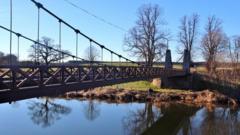
The Union Chain Bridge isn't just a hunk of iron spanning the River Tweed. It's a lifeline to a past where engineering was as much about guts as it was about math. When news broke that this historic Borders bridge secured £250,000 for its restoration project, locals breathed a sigh of relief. You should too. This isn't just another dry heritage grant. It’s a desperate, necessary intervention for a structure that literally held the world record for span length when it opened in 1820.
If we let these structures crumble, we lose the physical proof of how we moved from horse-drawn carts to the industrial age. The Union Bridge connects Fishwick in Scotland to Horncliffe in England. It’s a handshake across a border that has seen more than its fair share of conflict. This new funding injection from the National Lottery Heritage Fund and local councils ensures that the "Chain Bridge" doesn't become a cautionary tale of neglect.
The Engineering Genius We Almost Forgot
Captain Samuel Brown didn't just build a bridge. He changed how we think about tension. Before the Union Bridge, suspension bridges used vertical masonry or clunky wooden beams. Brown used wrought iron chains. It was radical. It was risky. Some people at the time probably thought he was out of his mind.
The bridge spans 137 meters. In 1820, that was unheard of. It remained the longest iron suspension bridge in the world for six years until the Menai Suspension Bridge took the crown. But the Union Bridge is still here. It’s the oldest suspension bridge in the world still carrying vehicular traffic. Think about that. A bridge designed for carriages is still handling modern cars. That’s not just good luck. It's over-engineering at its finest.
The restoration isn't just a fresh coat of paint. We’re talking about a full-scale dismantling. Every single link in those massive chains has to be inspected. If a link is cracked, it’s replaced with a replica that matches the original metallurgical profile. It’s painstaking work. It’s expensive. And honestly, it’s about time we put this kind of money into rural infrastructure that doubles as a global landmark.
Why the £250,000 Grant is a Big Deal
You might hear £250,000 and think it sounds like a lot for a bridge in the middle of the countryside. It isn't. In the world of civil engineering and heritage conservation, that’s a drop in the bucket. However, this specific chunk of change is the "finishing touch" funding. It builds on previous multi-million pound investments from the Northumberland County Council and Scottish Borders Council.
The money goes toward more than just iron and bolts. It funds the educational programs that keep the story alive. If kids in the Borders don't understand why this bridge is special, they won't fight to save it in fifty years. The project includes "STEM" outreach to local schools. We need more engineers. We don't need more social media managers. Showing a ten-year-old how a chain holds up a ton of steel is a pretty good way to spark that interest.
The Border Identity and Tourism
The Borders region often feels forgotten by the big hubs like Edinburgh or Newcastle. But the Union Bridge is a massive draw for "slow tourism." This isn't the type of place you rush through. You go there to walk the banks of the Tweed, to look at the way the light hits the ironwork, and to feel the slight sway of the deck under your feet.
Restoring the bridge isn't just about sentimentality. It's about cold, hard cash for the local economy. When the bridge is closed, the detour for locals is miles long. When it’s open and looking glorious, it brings in photographers, hikers, and history buffs. They buy coffee. They stay in B&Bs. They keep the villages of Horncliffe and Fishwick on the map.
What Happens if We Stop Investing
Ignoring heritage is a slow-motion disaster. Corrosion doesn't take days off. The wrought iron used in the 1800s is incredibly durable, but it’s not invincible. Rust is the enemy of tension. Once those chain links start to fail, the entire structural integrity of the bridge vanishes.
We’ve seen what happens when maintenance is deferred. Bridges get closed to cars. Then they get closed to pedestrians. Then they become "at risk" ruins that cost ten times as much to fix. This £250,000 prevents that death spiral. It ensures that the bridge remains a functional piece of the UK’s transport network, not just a pretty relic behind a fence.
Real Talk on Heritage Costs
Some critics argue we shouldn't spend millions on old bridges when roads have potholes. I get it. It’s a frustrating trade-off. But a road can be repaved any year. Once a 200-year-old suspension bridge collapses, it’s gone forever. You can’t "rebuild" the oldest suspension bridge in the world. You can only build a replica, and replicas don't have soul.
The Union Chain Bridge Project is a masterclass in cross-border cooperation. It’s rare to see two different national governments and multiple local councils play nice. They did it because they realized the bridge is bigger than politics. It’s a shared heritage.
If you want to support this kind of work, go visit. Seriously. Walk across it. Feel the history. The best way to ensure these projects keep getting funded is to prove that people actually care about them. Drive down to the Borders. Take the long way. Look at those chains and realize that 200 years ago, someone had the audacity to think they could hang a road from them. That’s worth every penny of the restoration budget.
Check the local council heritage websites for the latest bridge opening times and pedestrian access updates before you travel, as the heavy lifting of the restoration often requires temporary closures. Pack a camera and a pair of boots. The river paths around the bridge offer the best angles for seeing the scale of the wrought iron work up close.