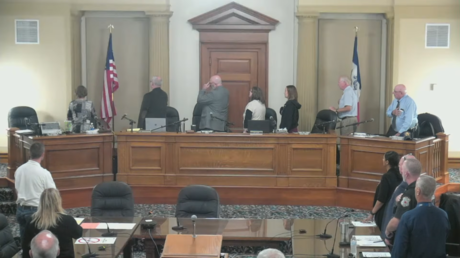
When a local government opens its doors to a group invoking Satan for a legislative prayer, the predictable outrage machine grinds into motion immediately. Pickets form, local news anchors adopt grave expressions, and social media feeds fill with hand-wringing about the moral decay of civic institutions. Everyone misses the point entirely.
This spectacle is not a sign of societal collapse. It is the legal system working exactly as designed, stress-testing the architectural integrity of the First Establishment Clause. If you only want prayer when it aligns with your personal theology, you do not want religious freedom. You want a state religion with a rotating cosmetic lineup.
The lazy consensus in mainstream coverage treats these invocations as deliberate provocations designed solely to offend. That interpretation is shallow. When organizations like The Satanic Temple step into public forums, they are executing a brilliant, high-stakes constitutional audit. They take the rules written by the majority and apply them literally. The discomfort you feel watching a city council meeting kick off with alternative metaphysics is the price of admission for living in a pluralistic society.
The Legal Architecture Behind The Podium
To understand why these invocations are legally bulletproof, look at the Supreme Court precedent that built the modern public forum. In the landmark 2014 case Town of Greece v. Galloway, the Supreme Court ruled that legislative bodies can open meetings with prayer, provided the practice does not coerce participation or proselytize aggressively against minority faiths.
Crucially, the court established that local governments cannot discriminate based on religious viewpoint when opening up their podiums. Once a city council invites local clergy to offer a blessing, it opens a limited public forum. Under constitutional law, the government cannot screen out applicants because their theology makes the aldermen squirm.
If a municipal body accepts a Baptist minister, a Catholic priest, and a local rabbi, it cannot legally slam the door on a satanist, a Wiccan, or a secular humanist without inviting a federal lawsuit it will lose in thirty minutes. The legal bill alone would bankrupt a mid-sized municipality.
I have watched local politicians blow thousands of taxpayer dollars trying to block non-traditional groups from public spaces, only to hand the plaintiffs a settlement check and a megaphone. The math is brutal. You either open the microphone to all legal philosophies, or you close it to all of them. There is no middle ground where you get to pick and choose based on who makes the chamber feel comfortable.
The Myth Of The Secular Vacuum
Critics love to argue that public meetings should simply ban all prayer to avoid the circus. On paper, that sounds clean. In reality, it ignores the historical roots of municipal governance and introduces a different kind of dogmatism.
Municipal prayer is as old as the republic. The first Continental Congress opened with prayer. The rationale was never about forcing citizens to worship; it was about grounding earthly legislation in a higher moral framework, reminding imperfect politicians that their power is temporary and accountable.
When you scrub every vestige of traditional observance from public life to avoid offense, you do not create a neutral space. You create a void. And human governance abhors a void. Replace traditional invocations with absolute secularism, and you simply substitute one orthodoxy for another.
Furthermore, the panic over alternative prayers assumes citizens are fragile creatures incapable of hearing words they disagree with without having their worldview shattered. That is patronizing. A thirty-second invocation at the start of a zoning board meeting about sewer lines does not establish a state church, nor does it compel anyone in the audience to convert. It is ceremonial speech, protected by the exact same legal shields that protect political protests and artistic expression.
The Hypocrisy Of Selective Outrage
The most glaring flaw in the mainstream narrative is the selective memory of the protestors. For decades, many of the same people cheering when a sectarian Christian prayer dominates a government meeting are the first to shriek censorship when the shoe is on the other foot.
You cannot demand the protections of the First Amendment for your own rituals while weaponizing social pressure to deny those exact protections to your ideological adversaries. The constitution is not an à la carte menu where you pick the freedoms you like and cross out the ones that offend your sensibilities.
When a city council opens with a nontraditional invocation, it forces the community to confront a vital question: Do we actually believe in pluralism, or was that just a nice slogan we used when everyone looked and thought alike?
If your devotion to free expression ends the moment someone invokes a dark literary figure instead of a traditional deity, your principles are worthless. They are mere preferences disguised as morals.
The Practical Reality For Local Governments
City councils caught in these culture-war crossfires usually panic, and panic leads to terrible governance. They try to rewrite their policies overnight, adopting vague screening criteria that inevitably violate viewpoint neutrality.
The playbook for a modern municipality should be straightforward, even if it requires swallowing some pride.
First, establish a clear, neutral chaplaincy rotation policy based on registered tax-exempt religious organizations within city limits. Do not vet the theology. Vet the organizational status.
Second, recognize that legislative prayer is meant to solemnize the room, not test the orthodoxy of the attendees. If a group comes in and uses their allotted slot to deliver a political rant or insult the audience, cut the microphone under standard time-and-manner restrictions that apply to any speaker. But do it based on conduct, not creed.
Third, stop treating the podium like a sacred altar. It is a piece of municipal furniture rented by the public for the people.
The next time a local council meeting makes national headlines because someone invokes Satan, do not waste energy clutching your pearls. Look at it as a live demonstration of our messy, beautiful, uncompromising constitutional machinery doing its heavy lifting.
True freedom is rarely polite, frequently annoying, and entirely non-negotiable. Get used to it.