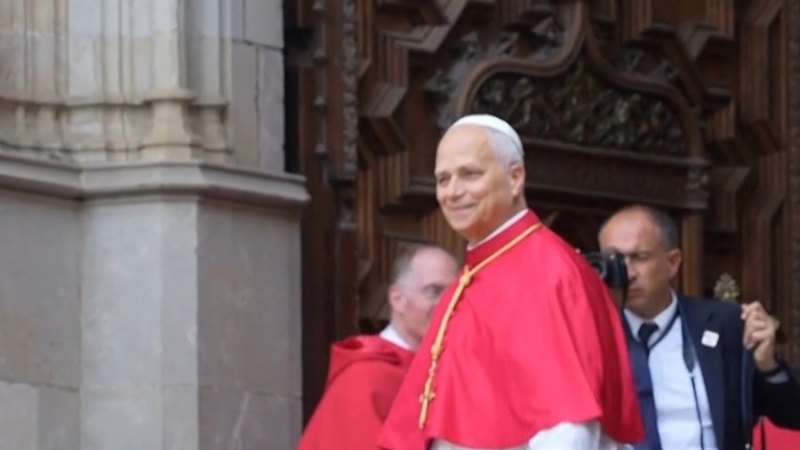
A towering stone forest is finally scraping the heavens at 172.5 meters. Barcelona has watched this happen block by block, century by century. Now, Pope Leo XIV is stepping onto Catalan soil to mark a moment that feels almost mythical. June 10, 2026, isn't just another date on the liturgical calendar. It is exactly 100 years since a tram struck down Antoni Gaudí, a man who left behind a half-finished vision that many assumed would never be completed.
The Pope isn't just here to look at old stones. He is in Barcelona to celebrate Mass and bless the newly finished Tower of Jesus Christ. This crowning spire officially makes the Sagrada Família the tallest church building on Earth. If you think this is just a local tourism story or a routine papal photo-op, you are missing the bigger picture. This moment brings a 144-year structural marathon to its peak, proving that some things are still worth building across generations. Recently making headlines in related news: Why the US Strikes on Iran Matter More Than the White House Admits.
The Architect of God and His 144 Year Blueprint
Gaudí knew he wouldn't live to see the end. He used to joke that his client, God, wasn't in a hurry. When he died in 1926, only a fraction of the basilica was standing. Then the Spanish Civil War tore through the city, destroying Gaudí’s original models and workshop. Critics argued the project should be abandoned or left as a ruined monument to his genius.
They were wrong. Succeeding generations of architects and engineers treated his surviving geometric codes like DNA, using advanced computing to reverse-engineer his intent. Additional information on this are covered by TIME.
The building isn't just regular masonry. It relies on ruled surfaces, hyperbolic paraboloids, and inclined columns that mimic trees. Gaudí realized that nature doesn't use straight lines, so his church shouldn't either. The interior looks less like a traditional cathedral and more like a petrified forest filtering sunlight through massive shards of red, green, and blue glass.
What Pope Leo XIV is Actually Inaugurating
The focus of this papal visit is the Tower of Jesus Christ, a massive spire that alters the Barcelona skyline forever. Standing at 172.5 meters (566 feet), it is topped by a monumental four-armed cross that caught the Spanish sun as crowds gathered for the historic blessing.
Tower Height Comparison:
- Tower of Jesus Christ (Sagrada Família): 172.5m
- Ulm Minster (Previous Tallest Church): 161.5m
- Cologne Cathedral: 157.4m
Gaudí deliberately designed the main tower to sit exactly one meter shorter than Montjuïc, the mountain overlooking Barcelona. He believed human hands shouldn't surpass the creation of the Almighty. The completion of this spire is a massive engineering feat, requiring pre-assembled stone panels tensioned with internal steel cables to withstand high coastal winds.
Pope Leo XIV’s presence adds immense weight to the architectural milestone. He is only the third Pope to ever cross this threshold, following John Paul II in 1982 and Benedict XVI, who consecrated the main altar in 2010. The Vatican already declared Gaudí "venerable" last year, which is a major step toward sainthood. For the millions of pilgrims watching, this blessing feels like the preamble to canonizing the man they call "God's architect."
The Clash Between Faith and Overtourism
You can't talk about the Sagrada Família without talking about the circus surrounding it. Nearly five million paying visitors crowded through the doors last year, making it Spain's top monument. Another 20 million stood outside just to snap selfies.
But step outside the gates, and the mood changes. Barcelona is caught in a fierce anti-tourism backlash. Locals are furious about skyrocketing housing costs and neighborhood souvenir shops replacing grocery stores. The basilica’s foundation still intends to build a massive grand stairway leading to the Glory Facade. Doing that means demolishing blocks of existing residential apartments, displacing hundreds of families who have lived there for decades.
It is a striking paradox. A building designed to inspire spiritual awe has become a primary engine for the commercialization of the city. While youth groups inside are holding prayer vigils and rediscovering their faith under the stone canopy, neighbors outside are hanging protest banners from their balconies.
How to Experience the Landmark Right Now
If you want to understand what Gaudí was actually trying to do, stop looking at it as an attraction to check off your bucket list. You need to look past the crowds and focus on the structural logic.
- Watch the Light shift: Don't go at noon. Visit in the late afternoon when the western sun hits the Nativity and Passion facades, turning the interior into an explosion of fiery orange and deep crimson.
- Study the Porches: The Passion Facade isn't pretty. It is harsh, angular, and skeletal, carved by Josep Maria Subirachs to evoke suffering. Compare it directly to the soft, melting stone of the Nativity Facade that Gaudí oversaw himself.
- Look Up at the Vaults: Stand in the center of the nave and look straight up. The columns split into branches, meeting a ceiling that looks like a canopy of giant stone sunflowers.
The exterior structural work is largely finished with the crowning of the Jesus tower, but the project isn't done. Work on the complex interior decorations and the controversial Glory Facade will push well into the 2030s. Don't wait for the final stone to be laid. Go see it while the cranes are still moving, because the sheer scale of human effort is the real miracle here.


