Australia’s diplomatic survival kit just received an unexpected upgrade from a thousand-year-old institution. While political pundits focused on the superficial pageantry of King Charles III’s recent visit to Canberra, the real story unfolded in the shadow of a looming shift in American power. The Australian government didn't just host a monarch; they deployed a strategic asset to bridge the gap with a potential second Trump administration. By leveraging the unique, high-stakes chemistry between the British Crown and Donald Trump, Australia has managed to secure a backchannel that traditional diplomacy cannot replicate.
This wasn't about tea and medals. It was about hard-nosed realism.
The strategy hinges on a well-documented obsession. Donald Trump has a profound, almost reverent respect for the British monarchy—a trait likely inherited from his Scottish mother. During his first term, his state visit to the UK was a cornerstone of his personal diplomatic highlight reel. Australia, recognizing this, positioned the King not as a figurehead, but as a cultural firewall. If Trump returns to the Oval Office with an "America First" agenda that threatens AUKUS or trade tariffs, Australia’s connection to the King serves as a powerful emotional and social currency.
The Scotch Connection and the MAGA Courtship
To understand why this matters, you have to look at the mechanics of the Trump inner circle. Influence is rarely about policy papers or whiteboards in the West Wing. It is about status, lineage, and the perception of belonging to an exclusive club. Trump views the British Royal Family as the ultimate "A-list." By demonstrating a vibrant, respectful, and functional relationship with the King, the Australian leadership is essentially signaling their own high status within the only hierarchy Trump truly respects.
It is a play straight out of a 1980s New York real estate playbook. You don’t sell the building; you sell the neighborhood. Australia is selling itself as a key pillar of a prestigious, tradition-bound world that Trump wants to be associated with.
However, this isn't a guaranteed win. There is a inherent risk in tying national security interests to the whims of a monarch’s popularity or a former President’s personal tastes. If the King’s public standing falters, or if a future US administration views the monarchy as an archaic irrelevance, the bridge collapses. But for now, Canberra is betting that the "Royal Halo" provides a layer of protection that a standard Prime Minister-to-President phone call simply cannot buy.
Beyond AUKUS and the Defense Industrial Base
The defense implications are massive. The AUKUS agreement—the trilateral security pact between Australia, the UK, and the US—is the bedrock of Australian strategy for the next half-century. It is also a frequent target for "transactional" politicians who see foreign entanglements as a drain on US resources.
The King’s presence in Australia served to reinforce the "UK" part of that acronym. It reminded Washington that Australia isn't just a remote outpost; it is part of a global, historic alliance anchored by London. When King Charles stands in Canberra, he isn't just representing Britain; he is validating Australia’s place in the Anglosphere. This validation is a potent weapon against isolationist rhetoric. It frames the alliance not as a burden, but as a family obligation.
The Economic Undertow of Pageantry
While the headlines screamed about protestors and protocol, the business community was watching the "Monarchy Effect" on trade. Australia’s economy is precariously balanced between its primary trading partner, China, and its primary security guarantor, the United States.
The Royal visit acted as a soft-power reset. It provided a moment of national cohesion that temporary political cycles cannot offer. For investors, this stability is a commodity. In a world of volatile democracies, a country that can still command the presence of a King—and do so with a mix of modern grit and traditional respect—looks like a safe bet.
The Republican Undercurrent
We have to address the elephant in the room: the Australian republican movement. To the casual observer, the King’s visit might have seemed like a setback for those wanting an Australian head of state. In reality, the government’s handling of the visit was a masterclass in "having your cake and eating it too."
Prime Minister Anthony Albanese, a known republican, treated the King with impeccable professional courtesy. This wasn't a contradiction; it was a calculation. By hosting a successful Royal tour, the Labor government proved they are "adults in the room." They showed they can manage the symbols of the past to secure the interests of the future. They used the King to charm the American right, while simultaneously keeping the republican debate on a low simmer for domestic consumption later.
Countering the Belt and Road
The geopolitical chess board in the Indo-Pacific is crowded. China’s "Belt and Road Initiative" is a direct challenge to Western influence in the region. Soft power is the only way to counter this without firing a shot.
The King represents a form of soft power that Beijing cannot manufacture. It is organic, historical, and deeply embedded in the legal and social fabric of the region. Every time the King meets a Pacific Island leader or stands at an Australian war memorial, he reinforces a network of alliances that predates modern trade agreements.
This isn't just about nostalgia. It’s about a shared legal system, a shared language, and a shared commitment to a specific type of global order. For a US President skeptical of multilateral institutions like the UN or NATO, the "Special Relationship" (and its Australian extension) feels different. It feels personal.
The High Cost of the Royal Backchannel
There is no such thing as a free lunch in diplomacy. The cost of using the King as a diplomatic shield is a continued commitment to an institution that many Australians feel is outdated. Every successful Royal visit pushes the "Republic" conversation further down the road.
Furthermore, relying on the "Trump-King" connection assumes that Trump’s psychology remains consistent. It is a gamble on the personality of one man. If Trump decides that the UK—and by extension, the Commonwealth—is a competitor rather than a partner, the "Royal Charm" could backfire. It could make Australia look like a relic of a dying empire rather than a dynamic Indo-Pacific power.
Reality Check on the Ground
Walk through the streets of Sydney or Melbourne and the "Royal Fever" is often more of a mild flu. The youth are largely indifferent. The indigenous population sees a symbol of colonial dispossession. The journalist's job is to look past the cheering crowds at the airport and see the tension in the boardroom.
The Australian government is walking a tightrope. They are using a 75-year-old King to appeal to a 78-year-old former President, all while trying to govern a country that is increasingly young, diverse, and Asian-centric.
The Strategic Pivot
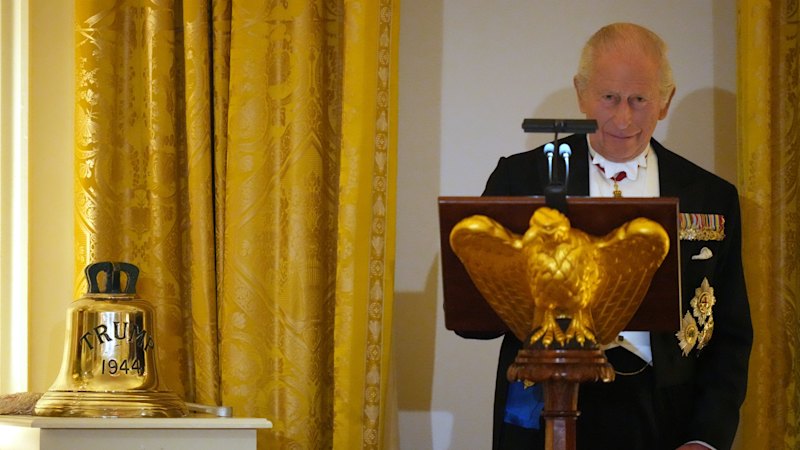
The real genius of the "Saved by the Bell" maneuver was the timing. By locking in the King’s visit now, Australia has established a baseline of "Royal Legitimacy" before the 2024 US election cycle hits its peak. They have created a series of images and narratives that will be played back in Mar-a-Lago and on Fox News for months to come.
They aren't just defending their current position; they are pre-emptively striking against future volatility. They are using the most stable institution in the world to hedge against the most unstable political climate in decades.
A New Breed of Diplomacy
This represents a shift in how middle powers operate. In the past, you hired lobbyists. Today, you deploy icons.
Australia is leading the way in "Iconic Diplomacy." They understand that in a world of 24-hour news cycles and social media dominance, a photo of the King at a surfboard factory is more effective than a 50-page trade brief. It creates a vibe of stability, a sense of "us vs. them," and a reminder of who belongs at the top table.
The King’s visit wasn't a distraction from the real work of government. It was the real work of government. It was a sophisticated, multi-layered operation designed to protect Australian interests in a world where the old rules no longer apply.
The message to Washington is clear: Australia is part of the inner circle. It is a member of the club. And it has the King to prove it.
The gamble is now in the hands of the American voter, but Canberra has already placed its bets. They’ve played the Royal card. Now they wait to see if the house wins.