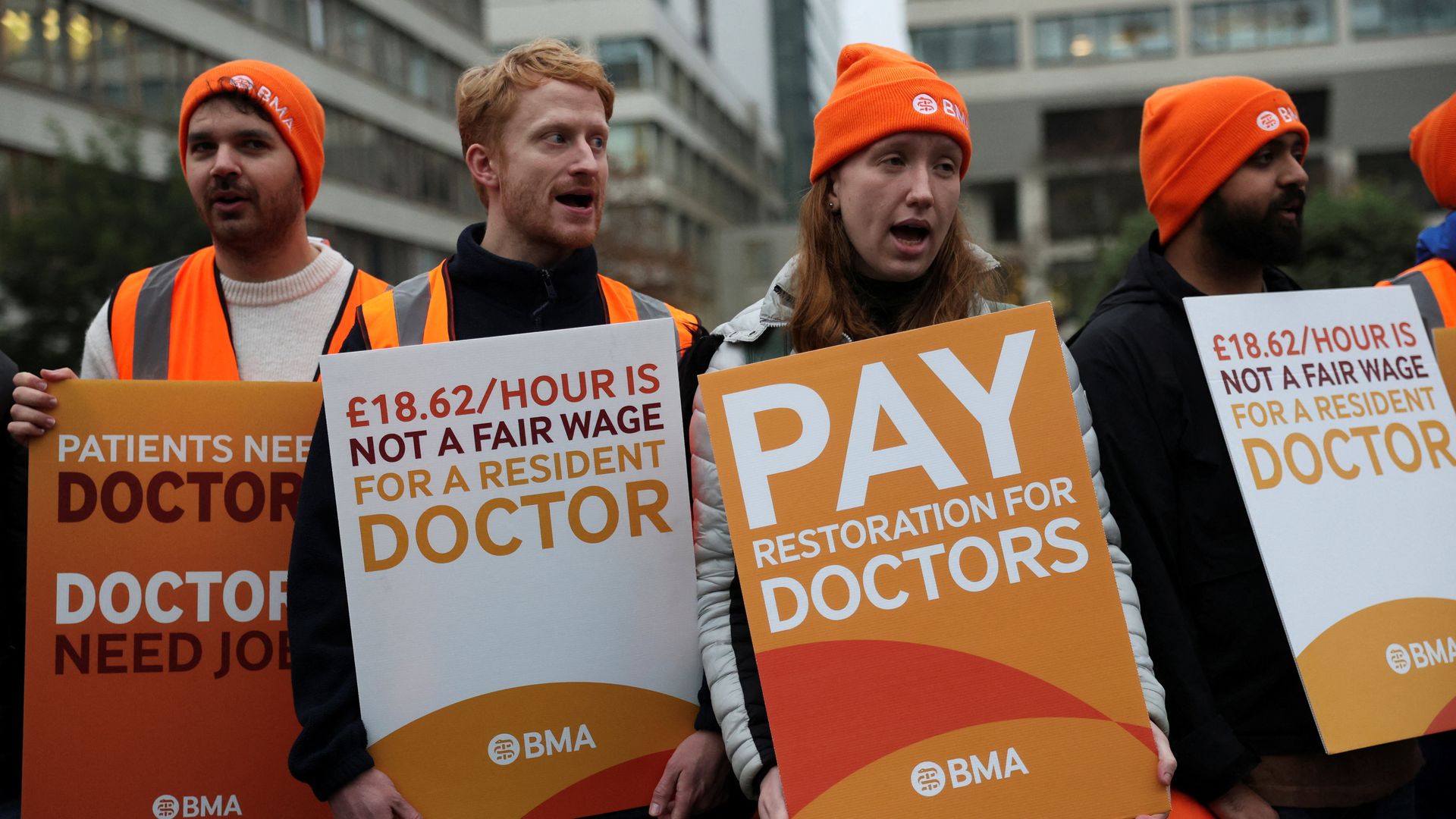
The British public is being fed a binary choice: you either support the "heroic" doctors or you support the "fiscally responsible" government. This is a false dichotomy designed to distract you from the structural rot of a single-buyer labor market.
Six days of strikes following an Easter bank holiday isn't just a scheduling conflict. It is the death rattle of a 20th-century employment model that treats high-skill medical professionals like interchangeable widgets in a factory line. The media treats this as a spat over a 35% pay restoration claim. It isn't. It is an existential crisis regarding the value of specialized human capital in an era of global mobility. Discover more on a similar subject: this related article.
If you think this is about "greed," you haven't looked at the flight paths to Brisbane.
The Pay Restoration Myth and the Real Math
The British Medical Association (BMA) argues for a 35% increase to reverse fifteen years of real-terms pay cuts. The government calls it "unaffordable." Both sides are arguing over the wrong variable. More reporting by CDC delves into comparable perspectives on the subject.
The issue isn't the percentage; it’s the monopsony.
In economics, a monopsony occurs when there is only one buyer for a service. In England, for the vast majority of resident doctors (formerly known as junior doctors), the NHS is the only game in town. When your employer also sets the regulations, controls the training tap, and holds the keys to your professional certification, "negotiation" is an illusion.
Let’s look at the numbers the standard news cycle ignores. A foundation year doctor starts on approximately £32,391. For a job that requires a five-year degree, six-figure student debt, and the literal power of life and death, that is an insult. But the "unaffordability" argument from the Treasury is equally shallow. They look at the immediate fiscal hit of a pay rise while ignoring the massive, hemorrhaging cost of:
- Locum Agency Fees: The NHS spends billions annually on temporary agency staff to plug gaps left by doctors who quit.
- Training Sunk Costs: It costs the UK taxpayer roughly £230,000 to train one doctor. When that doctor moves to Australia or enters management consulting because they can't afford a mortgage in London, that is a 100% loss on investment.
- The Waiting List Liability: A six-day strike adds hundreds of thousands to the elective backlog. The long-term economic cost of a sick workforce that cannot return to work because they are waiting for a hip replacement far exceeds the cost of a pay settlement.
The government isn't saving money. They are burning the furniture to keep the house warm.
Why "Patient Safety" is a Red Herring
The most tired trope in this entire saga is the "threat to patient safety" during strike action. It is the ultimate emotional cudgel used to silence dissent.
Here is the uncomfortable truth: patient safety is already compromised every single day of the year.
I have walked the wards at 3:00 AM where one resident doctor is covering 200 patients. That isn't a "strike day" anomaly; that is Tuesday. When you have a workforce that is burnt out, sleep-deprived, and morally injured by the inability to provide the care they were trained to give, "safety" is a PR term, not a clinical reality.
The strikes actually provide a weirdly controlled environment. Consultants—the most senior doctors—step down to cover the front lines. In some cases, the seniority of the staff on the floor during strike days actually improves immediate decision-making, though at the cost of cancelling elective surgeries.
The real danger isn't the six days of the strike. It’s the 359 days of "business as usual" in a collapsing system. If the public actually saw the spreadsheets for staffing ratios on a standard weekend in a provincial DGH (District General Hospital), they wouldn't be worried about the strike; they’d be barricading the doors in terror.
The Australia Problem: Exporting Our Best Assets
We are currently the world’s most expensive finishing school for the Australian healthcare system.
The "lazy consensus" suggests that doctors strike because they are "militant." The reality is they are mobile. For the first time in history, a 26-year-old doctor in Manchester isn't comparing their salary to the plumber down the road; they are comparing it to their classmate who moved to Perth, works 10 fewer hours a week, and earns double the salary in the sun.
The BMA isn't just fighting the government; they are fighting the global market for talent.
If the UK government refuses to pay the market rate for high-end labor, the labor will simply leave. This isn't a threat; it’s a demographic shift. We are seeing a "brain drain" that mirrors the collapse of industries in the 1970s. You cannot run a first-world health service on "claps" and "vocation." Vocation doesn't pay a 6% mortgage.
The Failure of the "Junior" Label
The very terminology used in the competitor’s article—"Junior Doctors"—is a linguistic trick used to diminish their status. Many of these "juniors" are 35-year-old registrars with a decade of experience, performing complex surgeries and leading cardiac arrest teams.
By labeling them as "juniors," the government and the media frame the dispute as a group of students complaining about their pocket money. It frames the strike as a tantrum rather than a professional withdrawal of labor.
The recent rebranding to "Resident Doctors" is a start, but the mindset remains. We treat our most vital intellectual assets like temporary interns. Imagine a law firm or an investment bank treating their ten-year associates with the same bureaucratic disdain the NHS treats its registrars. They would be out of business in a week. The only reason the NHS survives is because it is a state-enforced monopoly.
The Solution Nobody Wants to Hear
Everyone asks, "How do we stop the strikes?"
The wrong answer is a 5% pay rise and a pat on the head. The wrong answer is also a 35% pay rise without structural reform.
If you want to fix this, you have to break the monopsony.
- Portable Training Budgets: Stop tying training to specific NHS trusts. Give the doctor the funding and let them choose where to train. Competition for talent would force trusts to improve working conditions overnight.
- Student Debt Forgiveness: Instead of arguing over gross pay, tie debt jubilee to NHS service years. It’s a tax-efficient way to increase retention without the same inflationary pressures as a raw salary hike.
- Local Pay Weighting: The idea that a doctor in Sunderland should earn the same as a doctor in Zone 2 London is a relic of 1948. It is economically illiterate.
The Public’s Hypocrisy
The British public loves the NHS but treats its staff like public property. There is an implicit assumption that because your taxes pay their salary, you own their time, their mental health, and their future.
"I pay your wages" is the mantra of the entitled patient. But if you want a service that is free at the point of use, you have to ensure the people providing it aren't being used up until there’s nothing left.
The Easter bank holiday strike is a wake-up call. Not for the government, who are more concerned with the next election cycle than the next decade of healthcare, but for the citizens. You are losing your doctors. Not to the picket line, but to the exit door.
Stop asking when the strikes will end. Start asking why anyone is still staying.
The strike isn't the problem. The strike is the only honest signal left in a system built on lies.
Pay the market rate or watch the waiting list hit 10 million. There is no third option.
Go to the airport and see for yourself. The "junior" doctors are in the departures lounge.