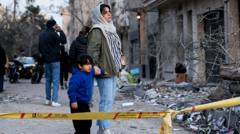
The stability of the current ceasefire between Israel and Hezbollah hinges not on diplomatic goodwill but on a precarious equilibrium of credible threats and the high marginal cost of renewed kinetic engagement. Iran’s recent warnings regarding ceasefire violations indicate a shift in its regional strategy, moving from passive observation to active enforcement of redlines that protect its primary strategic asset: the Lebanese theater. The viability of this truce depends on three specific variables: the enforcement mechanisms of UN Security Council Resolution 1701, the domestic political constraints within Lebanon, and the strategic depth required by the Iranian security apparatus to maintain its "Axis of Resistance."
The Calculus of Proportionality and the Violation Feedback Loop
Military escalations in the Levant rarely occur in isolation. They follow a logic of "tit-for-tat" calibrated to signal intent without triggering total war. Iran’s warning of a "strong response" serves as a psychological deterrent designed to raise the perceived risk for Israeli Defense Forces (IDF) intelligence and kinetic operations. When one party identifies a violation—such as unauthorized overflights or the movement of hardware into restricted zones—the response is calculated based on the internal political stability of the opponent. Building on this topic, you can also read: The Phonetic War for the Heart of a Meme.
The friction points currently endangering the truce are concentrated in the Litani River buffer zone. Under the framework of Resolution 1701, this area is intended to be devoid of non-state armed actors. However, the operational reality involves a complex overlap of civilian populations, subterranean infrastructure, and blurred lines between social services and paramilitary logistics.
The Triad of Enforcement Risks
- Verification Asymmetry: Monitoring bodies often lack the real-time technical intelligence necessary to adjudicate claims of violations. This creates a vacuum where "preemptive" strikes are justified as defensive measures, leading to a rapid degradation of trust.
- Sovereignty Constraints: The Lebanese Armed Forces (LAF) are theoretically tasked with being the sole security provider south of the Litani. In practice, the LAF lacks the budgetary resources and technical hardware to challenge entrenched local power structures, forcing a reliance on international peacekeepers who operate under restrictive rules of engagement.
- Proxy Decoupling: There is a persistent risk that local commanders may initiate contact without the explicit approval of central commands in Beirut or Tehran. These "bottom-up" escalations can force the hands of senior leadership, turning a localized skirmish into a theater-wide conflict through the necessity of maintaining face.
Lebanon as the Geopolitical Fulcrum
Lebanon is not merely a theater of war; it is the vital organ in Iran’s regional defense depth. For Tehran, the survival of Hezbollah’s political and military infrastructure is non-negotiable. This explains why Lebanon has emerged as the primary "sticking point" in broader regional negotiations. While other fronts—such as Yemen or Iraq—offer utility in harassing maritime trade or US interests, Lebanon provides a direct land-based deterrent against Israeli territory. Analysts at Reuters have shared their thoughts on this matter.
The Lebanese state’s near-total economic collapse adds a layer of volatility. The hyperinflation of the Lebanese Pound and the paralysis of the banking sector have eroded the state's ability to provide social safety nets. This vacuum is filled by non-state actors, which further complicates the "sovereignty" requirement of any lasting peace deal. If the central government cannot provide basic services, it cannot effectively assert a monopoly on the use of force in the south.
The Opportunity Cost of Re-escalation
For Israel, the objective is the permanent degradation of cross-border strike capabilities. However, the cost function of a prolonged campaign in Lebanon includes:
- Economic Attrition: The mobilization of reservists drains the high-tech workforce, impacting GDP growth.
- Infrastructure Exposure: Modern precision-guided munitions (PGMs) held by Hezbollah can target power grids, desalination plants, and offshore gas rigs, creating a domestic political crisis.
- International Diplomatic Isolation: Continued operations in civilian-dense areas increase the risk of sanctions or decreased military aid from Western allies.
Conversely, for Iran and its allies, the cost of a ceasefire violation that leads to full-scale war involves the potential loss of decades of investment in Lebanese infrastructure. They are operating on a principle of "strategic patience," attempting to bleed the opponent through low-intensity attrition rather than decisive, high-risk confrontations.
The Role of External Arbitrators and the Intelligence Gap
The United States and France have historically acted as the primary mediators in the Lebanese-Israeli conflict. Their influence, however, is waning as the conflict becomes more localized and decentralized. The "sticking points" in current negotiations often revolve around the specific technicalities of monitoring: who gets to fly drones over the border, who controls the sensors at the border crossings, and what constitutes a "clear and present danger" justifying a strike.
The intelligence gap is a primary driver of instability. When one side lacks visibility into the other’s intentions, it defaults to a "worst-case scenario" planning model. Iran’s rhetoric is a tool to fill this gap, signaling that the threshold for a "strong response" has been lowered. This is a classic signaling exercise in game theory: by appearing "irrational" or "aggressive," an actor can force a more cautious approach from a technologically superior adversary.
Structural Failures in Resolution 1701
The fundamental flaw in the existing diplomatic framework is its inability to account for the evolution of modern warfare.
- Cyber and Electronic Warfare: The 2006-era resolution does not address GPS jamming, signal interception, or cyber-attacks on civilian infrastructure, all of which are now standard components of modern skirmishes.
- Tunneling and Subsurface Assets: Traditional aerial and satellite surveillance cannot easily detect the subterranean logistical networks that have become central to modern asymmetric defense.
- The Drone Proliferation: The availability of low-cost, high-impact suicide drones has changed the "cost-per-kill" ratio, allowing non-state actors to maintain a persistent threat with minimal capital expenditure.
Assessing the Threshold for Strategic Re-entry
Whether this ceasefire holds depends on a specific set of indicators that signal a shift from "posturing" to "preparation." Analysts must monitor the following metrics to determine if a return to high-intensity conflict is imminent:
- Logistical Surge: The movement of heavy munitions, specifically long-range PGMs, from Syrian transit points into the Bekaa Valley.
- Rhetorical Escalation: A shift in Iranian state media from defending the ceasefire to delegitimizing the mediating parties.
- Civic Displacement: The mass movement of civilians away from the border area, indicating that both sides are preparing for high-intensity fire zones.
The current ceasefire is a "managed conflict," not a peace. Iran’s warning should be viewed as a tactical adjustment designed to preserve the status quo. The "sticking point" in Lebanon will remain until a broader regional agreement addresses the security concerns of both the Israeli state and the Iranian-aligned forces.
The strategic play for the coming months is one of calibrated attrition. Israel will continue to test the boundaries of the agreement through intelligence gathering and limited strikes on "high-value targets" (HVTs), while Iran and its proxies will use the threat of a "strong response" to delineate a new, more restrictive set of rules. The failure of this management will not result from a lack of diplomacy, but from a miscalculation of the opponent's "pain threshold."