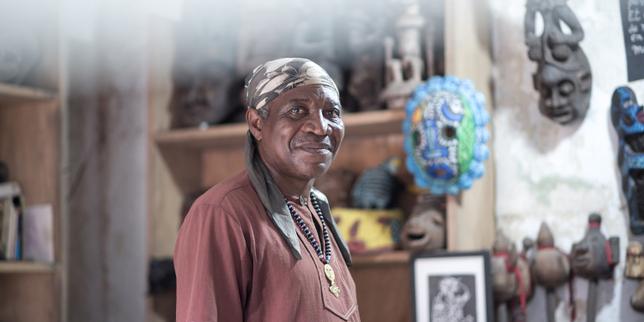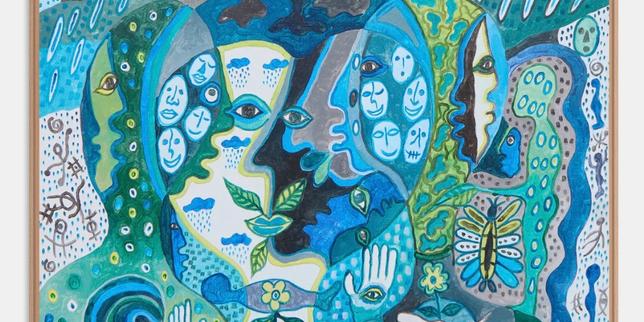
Most commentary surrounding contemporary Cameroonian artist Hervé Yamguen relies on a lazy, recycled script. Critics look at his paintings, bronze sculptures, and mixed-media installations born out of Douala's vibrant New Bell neighborhood and immediately default to tired tropes about animism, magical realism, and raw primitive instinct. They treat his transfigurations—where human faces morph into bird figures and botanical elements merge with bone—as quaint ethnic folklore rather than calculated, aggressive intellectual warfare against global art market categorization.
I have watched international curators approach Yamguen's body of work through a patronizing lens of geographical curiosity, treating his thirty-year trajectory as a localized anthropological artifact instead of a structural interrogation of modern urban existence. That perspective is entirely backward. Yamguen does not paint dreams because he is escaping reality; he paints them because reality in a hyper-industrialized, chaotic African metropolis like Douala demands a language sharper than straightforward documentary realism. For another look, consider: this related article.
To understand why standard art reviews miss the mark on Yamguen, we have to look past the superficial gloss of "spirituality" and examine the rigorous mechanics of his practice.
The Myth of the Untutored Vision
The standard biographical shorthand used by gallerists and journalists is that Yamguen is self-taught. In the ecosystem of contemporary art, labelling an African creator self-taught is often a coded marketing strategy designed to position their output as unpolluted, instinctual, and raw—the noble savage wielding a brush. Further analysis on the subject has been published by IGN.
This framing is insulting and factually bankrupt. Yamguen’s archive includes deep literary explorations, poetry, extensive theatrical set design, and foundational community art initiatives like the Marché des Arts Plastiques de Bali. His lines and bronze patinas are not accidental bursts of raw passion; they are the result of a deliberate intellectual cross-pollination between literature, public performance, and spatial architecture.
When Philippe Dagen or other European critics review his bronze sculptures, such as the Histoire de têtes series, they often emphasize the supposed ancient African ritualistic lineage. They ignore how these works dialogue directly with modern fragmentation. The faces are hollowed, distorted, and spliced with mechanical tension. This is not just old myth repackaged; it is a brutal dissection of how colonial history, urban decay, and contemporary commerce shred the human psyche.
Why Animism is a Lazy Label
Critics love to throw around the word "animism" when discussing the human-plant-animal hybrids in Yamguen's canvases. The lazy consensus assumes he is merely translating traditional Cameroonian cosmology onto canvas.
Imagine a scenario where a Western artist merges a human torso with industrial steel cables and organic circuitry; critics would instantly hail them as a brilliant visionary commenting on post-humanism and cybernetics. Yet when Yamguen merges a human profile with bird feathers and root systems, it gets filed under ancestral folklore.
This double standard strips contemporary African artists of their theoretical agency. Yamguen's ecological focus—seen clearly in bodies of work like Les Gardiens du vivant or his ongoing explorations of nature—is not a passive nod to village traditions. It is an active, aggressive critique of modern ecological devastation, urban sprawl, and the systematic commodification of the living world. The human-animal hybrid is a mirror reflecting our own predatory adaptation to a collapsing biosphere.
The Economics of Geographic Exoticism
International institutions love to feature artists from the African continent during moments of geographic trend-chasing, slotting them into group exhibitions themed around "the earth" or "inhabitation". Galleries like AFIKARIS have given Yamguen major European platforms, but the marketing machine always tries to pull him back toward the comfortable box of the mystic from Douala.
This geographic pigeonholing ignores the universal grammar of his mark-making. The chaotic energy in his strokes shares more DNA with the expressionism of the Cobra movement or the psychological excavation of Jean Dubuffet than with anonymous tribal craft. By reducing his work to a product of "New Bell poetry," the market attempts to neutralize its political bite.
Yamguen’s studio practice operates out of a specific urban crucible, yes, but his questions are global. What happens to individual identity when the state fails? How does memory survive concrete and asphalt? How do we maintain sanity inside a roaring metropolis?
Stop Collecting Labels, Start Looking at the Line
If you look at Yamguen's recent output, such as Nos géographies intimes, you notice an intentional stripping away of decorative excess. The drawings and paintings are starker, more urgent. The bronze work resists the polished sheen of trophy art; it retains the scars of the foundry, the rough textures of a maker who refuses to sand away the violence of creation.
Stop viewing artists like Yamguen as cultural ambassadors explaining their homeland to the West. Stop looking for primitive purity where you should be seeing sophisticated, multi-disciplinary rebellion.
Evaluate the line for its weight. Evaluate the bronze for its tension. Stop reading the artist's biography as a fairy tale, and start treating the work as the heavy, disruptive machinery it actually is.