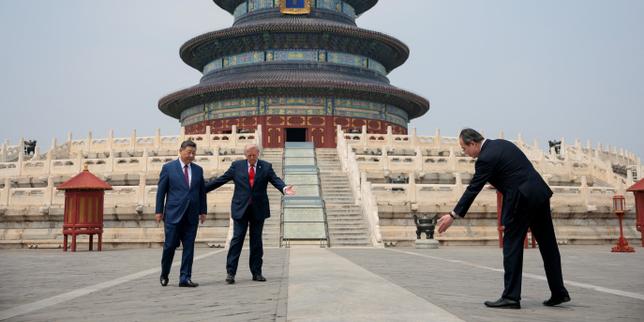
The air inside the Great Hall of the People in Beijing doesn’t circulate like the air in a normal room. It feels heavy, filtered by history and the immense weight of the decisions made beneath its cavernous ceilings. When Xi Jinping sat across from the American delegation, he wasn't just a head of state discussing trade tariffs or carbon emissions. He was a man drawing a line in the sand with a very sharp stick.
Across the Pacific, in a different kind of room—perhaps one filled with the hum of servers and the frantic clicking of keyboards in Washington—the message landed with the thud of a closing vault door. The subject was Taiwan. It always is. But this time, the tone had shifted from the usual diplomatic dance to something more primal. Xi’s warning to Donald Trump wasn't a suggestion. It was a description of a fuse that is already burning.
To understand why this matters, you have to stop looking at maps and start looking at the silicon in your pocket.
The Invisible Bridge
Imagine a bridge. It spans 160 kilometers of choppy, grey water. On one side, the massive, industrial engine of mainland China. On the other, a small, mountainous island that should, by all laws of geography, be a footnote. But this isn't a bridge made of steel or concrete. It is a bridge made of light, logic, and the very future of human capability.
Taiwan produces over 90% of the world’s most advanced semiconductors. These aren't just "chips." They are the nervous systems of every predator drone, every medical scanner, and every smartphone currently held in a trembling hand. If that bridge breaks, the modern world doesn't just slow down. It stops.
When Xi Jinping speaks of "conflict," he isn't just talking about ships in a strait. He is talking about the sudden, violent decoupling of the global brain. He is warning that the "red line" isn't a metaphor. It is a tripwire connected to a global blackout.
Two Men and a Mirror
Donald Trump views the world through the lens of the Deal. To him, everything is a commodity, a leverage point, or a trophy. He sees the island of Taiwan as a piece on a chessboard—a valuable piece, certainly, but one that can be traded, reinforced, or sacrificed depending on the strength of the hand he's playing.
Xi Jinping sees the world through the lens of the Century. To him, Taiwan is not a chip. It is a missing limb. It is the final, agonizing piece of a national identity that was shattered by colonial powers a hundred years ago. You cannot negotiate for your own arm. You can only demand its return.
When these two worldviews collide, the friction creates heat that can be felt in every boardroom from San Francisco to Shenzhen. The "risk of conflict" isn't a headline; it’s a tax on the future. Every time a threat is leveled, an engineer in a cleanroom in Hsinchu has to wonder if their laboratory will be a crater by Christmas. Every time a tariff is threatened, a family in Ohio pays five dollars more for a microwave they can barely afford.
The Human Cost of High Stakes
Consider a hypothetical woman named Lin. She works in a high-tech facility in Taipei. She spends her days dressed in a white "bunny suit," moving through air so pure that a single speck of dust is a catastrophe. She is an expert in photolithography, using extreme ultraviolet light to etch patterns onto silicon that are smaller than a virus.
Lin knows that her work is the reason her island is safe. This is the "Silicon Shield." The theory is simple: Taiwan is too important to be destroyed. If the factories stop, the world’s economy collapses, and therefore, no one will dare to pull the trigger.
But theories are cold. Humans are hot.
Lin watches the news. She sees the reports from Beijing. She sees the tweets from Florida. She feels the Shield getting thinner. The tragedy of the Taiwan Strait is that the people living on the front lines of the technological revolution are the ones most likely to be sent back to the stone age by a single miscalculation in a boardroom thousands of miles away.
The Language of the Ultimatum
The diplomacy of the past decade was built on "strategic ambiguity." It was a clever way of saying, "We won't tell you exactly what we'll do, so don't try anything." It worked. It kept the peace because it allowed everyone to save face while making money.
But the era of ambiguity is dying.
Xi’s warning to Trump signals a move toward strategic clarity. China is saying: "We are willing to break the world to fix our map." The "red line" has been painted in high-visibility neon.
Why now? Because technology has reached a tipping point. We are entering the age of Artificial Intelligence, where the country that controls the compute controls the century. If China loses access to the chips made in Taiwan, it loses the race. If the United States loses access, it loses its hegemony.
Suddenly, that 160-kilometer stretch of water isn't just a border. It’s the finish line of the only race that matters.
The Fragility of the Supply Chain
We like to think of our world as a robust, interconnected web. We use words like "globalization" to describe a system that feels permanent. But the truth is more fragile. Our modern life is a series of "just-in-time" miracles.
The laptop you use was designed in California, powered by chips from Taiwan, assembled in China, and shipped via a Greek-owned vessel through a canal in Egypt. If any one of those links snaps, the miracle ends.
Xi’s warning is a reminder that the most important link is the most volatile. He is telling the incoming American administration that the cost of "America First" might be "The World Last." If the trade war spills over into a sovereignty war, there are no winners. There are only people sitting in the dark, holding useless glass rectangles, wondering how a dispute over a map turned into the end of the internet.
The Sound of the Silence
There is a specific kind of silence that happens before a storm. It’s not the absence of sound, but the presence of pressure. You can feel it in the dip in the barometer and the way the birds stop singing.
The diplomatic world is in that silence right now.
The statements coming out of Beijing are designed to be heard by one man. They are an invitation to a high-stakes game of chicken where the vehicles are two of the most powerful militaries in history. The stakes aren't just "foreign policy." They are the prices of your groceries, the security of your bank account, and the physical safety of millions of people who just want to go to work in their bunny suits and etch light onto silicon.
We often talk about "geopolitics" as if it’s a weather pattern—something that happens to us, beyond our control. But these are choices. A choice to use a specific word. A choice to move a carrier strike group. A choice to ignore a warning.
Xi Jinping has made his choice clear. He has placed the burden of the next move squarely on the shoulders of a man who prides himself on never backing down.
The red telephone is sitting on the desk. It hasn't rung yet. But the line is open, and the person on the other end isn't interested in small talk. They are waiting to see if the world’s greatest deal-maker understands that some things are too expensive to buy, and far too dangerous to sell.
The 160 kilometers of water between the mainland and the island have never looked wider. The silence has never been louder. We are all living in the space between the warning and the response, hoping that the people in the rooms with the heavy air remember that the world they are gambling with is the only one we have.