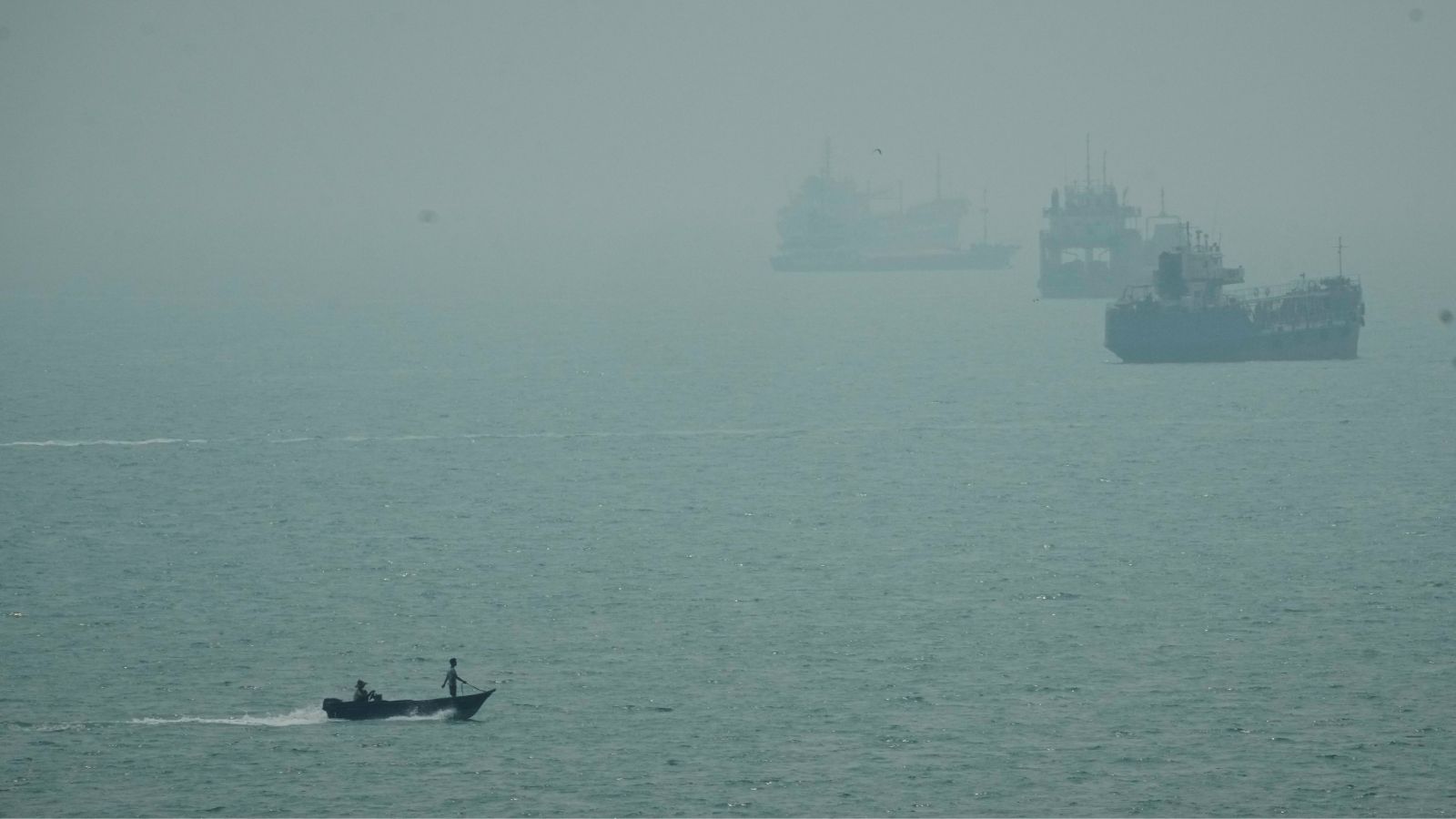
Salt crusts the windowpanes of the control room in Port Sudan. Outside, the waters of the Red Sea heave under a heavy, indifferent sun. Inside, the hum of ancient cooling fans fights a losing battle against the heat.
Meet Ibrahim. He is fictional, yet he stands for every engineer, harbor master, and customs official currently sweating through a shift on this crucial coast. Ibrahim has spent twenty-eight years watching tankers thread their way through the Bab el-Mandeb strait, slipping north toward the Suez Canal. He knows the tonnage. He knows the drafts. He knows the precise, fragile rhythm of global commerce that depends entirely on this narrow nautical corridor remaining open. If you liked this post, you should check out: this related article.
Lately, Ibrahim does not sleep well.
He looks out at the docks, where crude oil export infrastructure sits quiet, shadowed by the broader chaos consuming the Sudanese mainland. The world thinks of Sudan as a distant tragedy of displaced families and fractured politics. Wall Street thinks of it as a blip on a geopolitical risk matrix. But Ibrahim knows a different truth. He knows that beneath the surface of this broken country lies a dormant pulse of energy security that the rest of the world is ignoring at its extreme peril. For another look on this story, check out the recent update from Reuters.
We forget how thin the thread really is.
Global shipping lanes are not abstract blue lines on a digital map. They are physical bottlenecks. When the Houthi movement began launching drones and missiles across the southern mouth of the Red Sea, forcing major container lines to detour entirely around the Cape of Good Hope, the cost of moving goods spiked overnight. Ships burned thousands of extra tons of fuel. Supply chains groaned. Inflation crept back into grocery aisles thousands of miles away from the gunfire.
Now, layer Sudan into that exact equation.
Historically, Sudan was a modest but vital oil producer, pumping hundreds of thousands of barrels a day before the 2011 secession of South Sudan cleaved the nation in two. Overnight, Khartoum lost the majority of its oilfields. Yet, the geography remained absolute. The pipeline infrastructure—the structural veins carrying South Sudanese crude north to the Red Sea export terminal at Bashayer—did not vanish. It stayed right here. Pinned between a bitter civil war and one of the busiest maritime chokepoints on Earth.
To understand why this matters, imagine a garden hose carrying vital water to a thirsty neighborhood. Now imagine two neighbors fighting violently in the front yard, kicking dirt over the spigot, while someone else steps on the middle of the hose with heavy boots. The water stops. The neighbors keep fighting. And the people down the block wonder why their lawns are turning brown.
The civil war between the Sudanese Armed Forces and the Rapid Support Forces has turned oil infrastructure from a commercial asset into a high-stakes chess piece. Pumping stations have been contested. Pipelines have faced sabotage risks. When production ceases or export routes are choked off, the shockwaves ripple outward. South Sudan, landlocked and entirely dependent on those northern pipelines to sell its crude, watches its national budget evaporate. Refineries scramble. Global markets adjust to yet another phantom supply deficit.
Cruude oil prices do not care about politics. They care about fear.
When a commodity trader in London or New York looks at the Horn of Africa, they do not see human suffering first. They see risk. They see a Red Sea coastline transforming from a busy commercial highway into an armed camp. Navies from the United States, European Union, and regional powers now patrol these waters, launching defensive strikes, escorting container ships, and nervously tracking every radar blip.
Into this tense theater, Sudan sits like an unexploded ordnance.
Consider what happens next if the instability hardens into a permanent fragmentation of the state. It is not just about a few missing barrels of sweet crude. It is about strategic real estate. Global powers have eyed the Sudanese coastline for years, seeking naval outposts and deep-water ports. If the central government loses control entirely, the Red Sea ceases to be a shared commercial transit zone and hardens into a contested frontier of rival foreign ambitions. China, Russia, Gulf states, and Western nations all have vital economic interests tethered to these waters. When a failed state overlaps with a global energy throat, nobody walks away unaffected.
Ibrahim finishes his cup of lukewarm tea. He looks down at the harbor logbook. A tanker sits at anchor, half-loaded, waiting for clearances that take days instead of hours. The crew is exhausted. The captain is anxious.
The world economy runs on momentum. It is a bicycle that must keep moving forward or it falls over. We obsess over interest rates, central bank speeches, and tech valuations, assuming the physical bedrock of civilization—the fuel moving through pipes, the ships moving across water—will simply take care of itself.
It will not.
The red lights are blinking on the console in Port Sudan. The salt keeps piling up on the glass. And out on the water, the dark hulls keep moving, one nervous mile at a time, past a shore that holds far more power over our daily lives than any spreadsheet cares to admit.