The air at seven in the morning in Pamplona tastes of stale sangria, damp wool, and fear. It is a specific kind of cold that clings to the skin of your wrists, right where the red faja—the traditional sash worn during the San Fermin festival—is knotted tight. Thousands of people stand shoulder to shoulder in the narrow limestone corridor of Santo Domingo street, their white shirts stained with yesterday’s celebration, their breath rising in thin plumes toward balconies crowded with spectators who paid hundreds of euros just to watch from a safe distance.
You don't run to get away from the bulls. That is the first mistake foreigners make. If you run away, you die. You run to stay just inches ahead of them, to share their speed, to feel the specific, terrifying vacuum of displacement that occurs when half a ton of muscle and horn slices through a human crowd at twenty miles an hour.
Then the rocket fires. One sharp, echoing crack against the morning sky.
The gate is open.
Two Minutes and Thirty Seconds of Chaos
To understand what happened on this particular Saturday morning—the fifth encierro of the eight-day festival—you have to understand the math of a panic. Six fighting bulls from the Jose Escolar ranch, accompanied by six massive steers meant to keep them grouped together, are released into a human corridor that is exactly 875 meters long. That is 957 yards of ancient, wet cobblestone, walled in by timber barricades and stone storefronts. There is nowhere to go but forward.
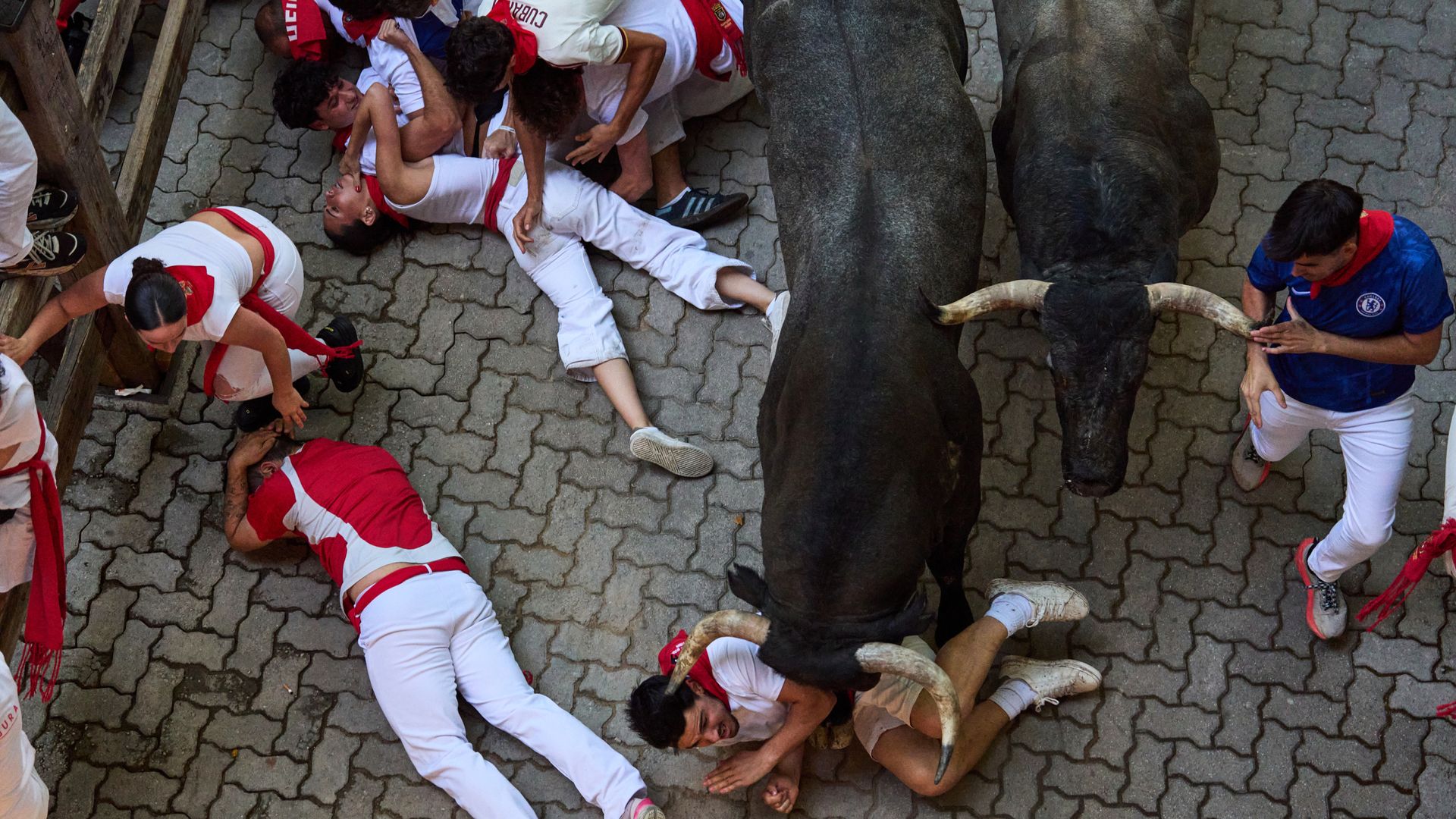
When the beasts hit the incline, the crowd doesn’t move like water; it moves like a pileup on a foggy highway. People trip over their own feet. They trip over each other.
Consider what happens next: a lone black bull breaks away from the pack. In the vernacular of the encierro, this is a suelto. A loose bull is a lethal bull because it has lost the safety of the herd and is now acting on pure, defensive instinct. It sees the crowd not as an obstacle, but as a threat.
The animal plows into a dense knot of runners. Human bodies are thrown like laundry. For most of the twelve people who would end up in the triage units of the University of Navarra Hospital that morning, the injuries were mechanical—the violent collision of flesh with stone, fractured clavicles, torn ligaments, and the deep, purple bruising caused by hundreds of stampeding feet trampling anyone who fell.
But for one runner, the physics of the morning turned visceral. A horn caught him full in the side of the face.
When a fighting bull's horn pierces human skin, it doesn’t just cut. The tip is jagged from scraping against concrete and dirt, and the animal’s neck muscles are designed to lift and toss. To survive a goring in the face is an exercise in millimeters. A fraction of an inch to the left, and the carotid artery tears; a fraction to the right, and the eye socket is crushed. The medical teams who lined the wooden fences moved before the bull had even cleared the section, pulling the bleeding man through the timber slats as the rest of the herd swept past.
The Century-Old Ghost in the Room
This year’s festival marks a quiet, heavy milestone. It is exactly one hundred years since a young journalist named Ernest Hemingway published The Sun Also Rises, the novel that took a localized, deeply religious Navarrese tradition and turned it into a bucket-list item for global thrill-seekers.
Before Hemingway, the run was an administrative necessity—a way for local herders to move the bulls from the city edge to the plaza where they would be fought later that afternoon. Today, it is an international economic engine. But that fame has fundamentally altered the ecology of the street.
The seasoned locals, the divinos, know how to read the animal's eyes. They know when to peel off to the side, when to drop to the ground and cover their heads, and when to let the bull’s momentum carry it past. But on any given Saturday in July, the track is choked with novices. Tourists from Chicago, Sydney, and London, fueled by sleepless nights and cheap wine, step onto the stones completely unaware that a bull's peripheral vision is sharpest when it is moving at a dead sprint.
During the chaotic two-and-a-half-minute run, many runners appeared completely oblivious to the fact that bulls were breathing down their necks. In several instances, men actually reached out to shove the massive animals out of the way, treating a five-hundred-kilogram wild beast like a crowded subway passenger. It is a miracle born of the animal's indifference, not the runner's skill, that more people weren't torn open.
The last person to die on these stones was Daniel Jimeno Romero in 2009, his neck pierced by a bull named Capuchino. Every year since, the local government has increased security, polished the anti-slip chemicals on the cobblestones, and issued fines for anyone filming with a smartphone while running. Yet the danger cannot be managed out of the equation. If you remove the risk of death, the ritual evaporates.
The Aftermath on the Sand
The run always ends in the Plaza de Toros. The bulls funnel through a narrow tunnel and burst into the sand-covered arena, where thousands of people in white and red cheer from the stands. The gates slam shut behind them. For the runners, there is a collective exhalation—a rush of endorphins so profound it makes the limbs shake. They hug strangers, wipe the mud from their clothes, and look for their friends in the crowd.
But for the six bulls from the Jose Escolar ranch, the journey isn't over. They are led into the dark, quiet pens beneath the grandstands. There, they will wait in the shadows until the afternoon heat softens, when the trumpets will sound again, and they will enter the ring one final time to face the matadors.
In the afternoon, the streets are hosed down. The blood, the spilled wine, and the sweat are washed into the drains, leaving the stones clean for the next morning's run. The festival doesn't pause for a goring; it incorporates it into the narrative. Tomorrow at eight o'clock, the rocket will fire again.
The adrenaline wears off long before the wounds heal, leaving nothing but the cold realization of how small a man looks when silhouetted against a horn.

.webp)