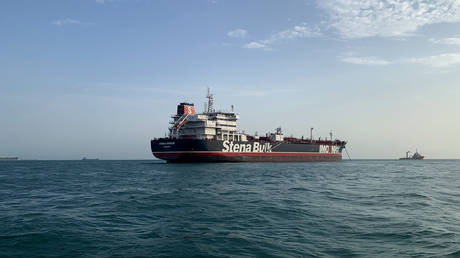
The fragile window for global energy stability slammed shut on Saturday morning. By 06:25 AM, the Islamic Revolutionary Guard Corps (IRGC) declared that the Strait of Hormuz had reverted to a state of "strict management," effectively ending a brief, 24-hour experiment in maritime de-escalation. While the surface-level narrative focuses on accusations of "piracy" and broken promises, the underlying reality is a calculated game of chicken between a newly emboldened Washington and an Iranian military establishment fighting for its institutional survival.
This is not just another diplomatic spat. This is the collapse of the Islamabad framework.
The immediate trigger for the reversal was a late-night post from President Trump, which clarified that while the United States would allow the strait to function for neutral commerce, the existing naval blockade targeting Iranian-linked hulls would remain in full effect. Tehran’s response was swift and predictable. If they cannot export their own crude, they will ensure that the 20 million barrels of oil and petroleum products typically flowing through that 21-mile-wide choke point remain largely stranded.
The Toll Road to Nowhere
Tehran’s short-lived offer to reopen the waterway on Friday came with a hidden price tag that many analysts overlooked. It wasn't just about freedom of navigation; it was about the establishment of a "new maritime regime." Under this proposal, the IRGC Navy intended to force all commercial traffic through Iranian territorial waters rather than the traditional international shipping lanes.
More importantly, they demanded tolls.
Estimates suggested a fee of over $1 million per vessel for safe passage. This was never a "reopening" in the traditional sense; it was an attempt to turn the world’s most vital energy artery into a private revenue stream for a cash-strapped paramilitary organization. When Washington made it clear that the U.S. Navy would continue to intercept any Iranian tankers attempting to bypass sanctions, the IRGC leadership decided that if they couldn't profit from the traffic, they would choke it entirely.
The Breakdown of Trust
The rhetoric coming out of the Khatam al-Anbiya Headquarters is centered on "treachery." Ibrahim Zolfaghari, the IRGC spokesperson, has framed the American refusal to lift the blockade as a violation of "good faith" negotiations. However, those on the ground in the Gulf of Oman saw a different story.
Throughout Friday, as the supposed "opening" was underway, U.S. Central Command (CENTCOM) reported that 19 vessels were turned back after attempting to comply with Iranian-mandated routes that would have placed them directly under IRGC guns. No Iranian-linked tankers even attempted to approach the blockade line. They knew the risk. The result was a maritime standoff where zero vessels successfully transited the strait under the "new regime."
A Market in Freefall
The economic consequences of this "open-shut" volatility are staggering. The global oil market, already reeling from the largest supply disruption in history, has no remaining buffer.
- Brent Crude: Prices had briefly dipped on news of the reopening but surged back toward $120 per barrel within hours of the Saturday closure.
- Regional Impact: For the Gulf Cooperation Council (GCC) states, the crisis is now existential. These nations rely on the strait for roughly 80% of their caloric intake.
- The Food Crisis: Major retailers in the region have already begun airlifting staples like rice and flour, leading to price spikes of up to 120% in some urban centers.
Saudi Arabia and the UAE have attempted to mitigate the fallout by utilizing bypass pipelines, but these routes can only handle about 4 to 7 million barrels per day. That leaves a structural deficit of nearly 10 to 15 million barrels per day that the world simply cannot replace.
The Power Vacuum in Tehran
Underpinning this chaos is a fundamental shift in the Iranian power structure. Following the assassination of Supreme Leader Ali Khamenei in late February, the IRGC has operated with unprecedented autonomy. Mojtaba Khamenei, who has issued statements via Telegram but has not appeared in public, seems unable or unwilling to rein in the more hawkish naval commanders.
These commanders view the Strait of Hormuz as their last remaining piece of leverage. To them, "piracy" is any action that prevents Iran from using the waterway as a geopolitical cudgel. By declaring the strait "closed" once more, they are signaling to the international community that they would rather see a global recession than accept a maritime status quo where they are the only ones unable to trade.
The U.S. has countered by accelerating mine-clearing operations and threatening direct strikes on Iranian energy infrastructure. But clearing a waterway as narrow and heavily defended as Hormuz is not a weekend project. It is a grueling, dangerous slog through waters likely seeded with advanced anti-ship mines.
The Strategy of Attrition
Washington’s "Maximum Pressure 2.0" is designed to starve the IRGC of resources until the cost of maintaining the blockade becomes unbearable. But Tehran is betting that the world’s appetite for $150 oil will run out long before their rockets do.
They are counting on the "grocery supply emergency" in the Gulf and the energy crisis in Europe to force a diplomatic retreat. This is why the Islamabad talks failed. Iran isn't looking for a compromise; they are looking for a total capitulation that grants them undisputed control over the Persian Gulf’s exit.
For the shipping industry, the message is clear: the Strait of Hormuz is now a combat zone, not a trade route. Insurance premiums for the few vessels still willing to risk the journey have become prohibitive, and most major carriers have redirected their fleets to anchorages off the coast of Oman or Fujairah, waiting for a clarity that isn't coming.
The reality on the water contradicts the diplomatic cables. Until the fundamental disagreement over who owns the right to the waves is settled—either through a definitive military victory or a total economic collapse—the gate to the Gulf will remain a revolving door that only swings at the IRGC’s whim.
Shipping companies should plan for a prolonged shutdown, as the current cycle of "opening" and "closing" is merely a tactical feint in a much larger war of attrition.