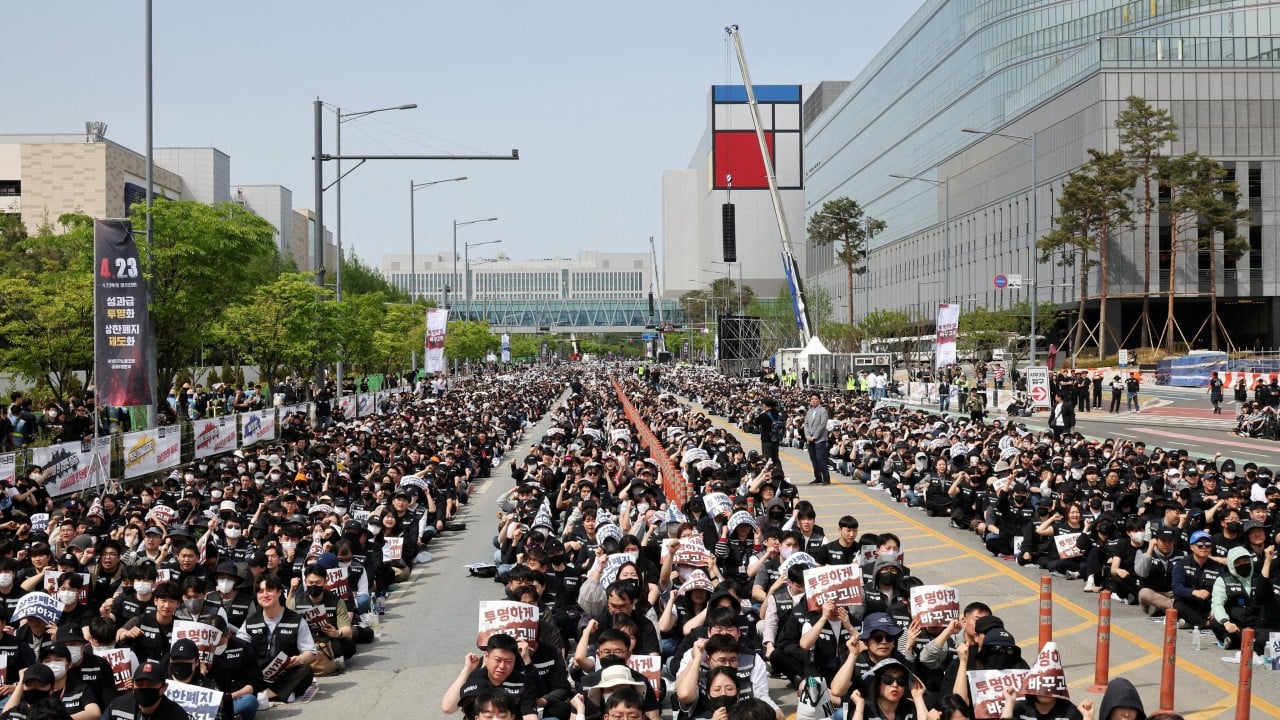
The collapse of last-minute, government-mediated bonus negotiations between Samsung Electronics management and its labor union has triggered an unprecedented 18-day full-scale strike involving up to 48,000 workers. This massive walkout, scheduled to begin on Thursday, directly threatens the global supply of semiconductors just as the artificial intelligence boom strains global data center capacity. Prime Minister Kim Min-seok warned that the industrial action could inflict up to 100 trillion won ($66 billion) in economic damage. With Samsung producing over a third of the global DRAM market and critical high-bandwidth memory (HBM) chips, the standoff exposes a deeper, structural crisis regarding how the massive wealth generated by generative AI is distributed between corporate leadership, shareholders, and the engineering workforce.
The Bonus Math Fueling the Standoff
At the core of the breakdown is a fundamental disagreement over performance-based compensation structures. The National Samsung Electronics Union, led by Choi Seung-ho, is demanding that the tech giant permanently abolish its current bonus cap, which limits annual performance payouts to 50 percent of an employee's base salary. Furthermore, the union insists that Samsung formalize a contract requiring 15 percent of the company's annual operating profit to be allocated directly to worker bonuses.
Management has dug in, labeling these demands excessive and unsustainable. Corporate leadership argues that the semiconductor industry is highly cyclical. They claim that locking in fixed profit-sharing percentages would undermine core management principles and jeopardize long-term capital expenditure needed for research and development.
The rancor peaks over how to compensate workers in underperforming segments. While Samsung’s chip division has engineered a massive financial turnaround—riding an eightfold jump in first-quarter operating profit to 57.2 trillion won—other domestic units have lagged. Management explicitly condemned the union's insistence on securing hefty bonus packages for loss-making divisions, stating that doing so violates basic corporate governance.
The SK Hynix Shadow
To truly understand the fury on the factory floor, one must look across town to Samsung's chief rival, SK Hynix. Workers are not striking in a vacuum. They are watching a widening wealth gap transform their industry.
Last year, SK Hynix dismantled its own decade-old bonus cap and committed 10 percent of its operating profit to performance bonuses. Because SK Hynix locked in critical early supply deals for Nvidia’s AI infrastructure, its workers are projected to take home astronomical average payouts approaching half a million dollars per employee this year.
Samsung engineers, by contrast, received zero performance bonuses in 2024 due to the preceding memory market downturn. The contrast has shattered morale. Samsung employees watched their cross-town rivals secure life-altering windfalls while they were told to tighten their belts, despite working identical shifts to keep up with the global AI hardware race.
Legal Shock Absorbers and the Silicon Catch-22
Recognizing the existential threat a prolonged shutdown poses to South Korea's trade-dependent economy—where Samsung accounts for nearly a quarter of all exports—the state is attempting to intervene. The Suwon District Court recently stepped in to blunt the strike's immediate operational impact.
The court granted Samsung a partial injunction against the union. Judge Shin Woo-jung ruled that the walkout cannot completely compromise factory safety, product quality, or risk structural damage to highly sensitive equipment. Staffing levels required to keep fabrication facilities running at baseline safety must remain normal.
This creates a highly technical friction point. Semiconductor manufacturing is a continuous, hyper-precise chemical process. You cannot simply flip a switch to turn a memory fab off and on.
A single day of complete suspension at a major semiconductor facility can incur immediate losses of 1 trillion won. More critically, restarting a halted manufacturing line takes months of calibration to achieve acceptable wafer yields.
🔗 Read more: The Glass Sky is Turning Opaque
By barring the union from physically occupying key facilities or blocking access roads under penalty of a 100-million-won daily fine, the court has effectively forced a "guerrilla" operational reality. Workers can legally strike, but they cannot sabotage the machinery.
The Threat of State Coercion
Should the 18-day strike trigger tangible shortages in global technology supply chains, the South Korean government has a nuclear option on the table. The labor ministry has threatened to invoke emergency arbitration powers.
This rare statutory mechanism strips the union of its legal right to strike, forcing a mandatory 30-day cooling-off period while a state-appointed panel dictates a compromise. While government officials publicly stated that invoking emergency powers is premature, the threat hangs heavily over the negotiations.
The union has responded with fierce rhetoric, accusing the administration of acting as a corporate mouthpiece rather than a neutral mediator. They argue that using national security logic to suppress manufacturing strikes sets a dangerous precedent for labor rights across the entire industrial sector.
The Structural Reality
The standoff at Samsung is a localized symptom of a global phenomenon. The AI boom is generating unprecedented, highly concentrated corporate revenues, but the technical labor required to build the physical foundation of this digital economy is demanding a structurally redefined share of the spoils.
A compromise will eventually be hammered out, likely involving one-off special compensation packages that protect management’s long-term flexibility while appeasing worker anxieties. Yet the illusion of absolute corporate control over tech manufacturing has been permanently broken. As long as the global tech sector relies on a handful of ultra-precise factories in East Asia, the engineers and technicians inside those cleanrooms hold a level of structural leverage that no corporate board or court injunction can fully erase.