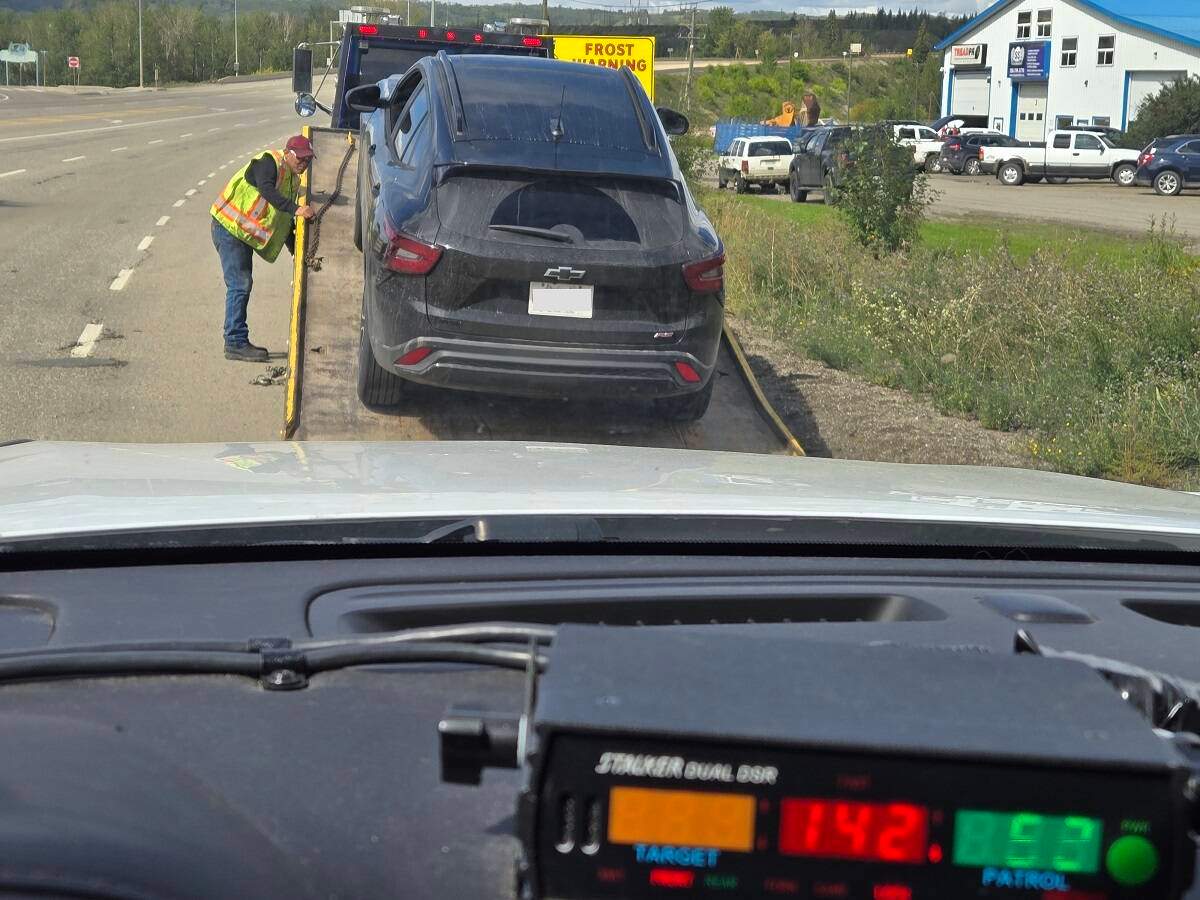
When a 21-year-old from Athabasca, Alberta, pointed her black Chevrolet Trax down Highway 97 south of Taylor, British Columbia, she likely assumed rural asphalt offered a quiet sanctuary from heavy policing. Radar proved otherwise. Clocked at 142 kilometers per hour in a 70 zone, her afternoon trip collided with the hard reality of British Columbia Highway Patrol enforcement. The immediate outcome was predictable enough: a $483 ticket for excessive speeding, a mandatory seven-day vehicle impoundment at her own expense, and towing fees. Yet, the true sting of provincial traffic enforcement extends far past the initial roadside encounter.
Interstate and interprovincial travelers frequently misunderstand how regional traffic laws cross provincial boundaries. Motorists from neighboring jurisdictions often treat vacation or transit routes as low-risk zones, failing to account for aggressive provincial targeting of excessive speed. When a driver crosses from the rolling prairies of Alberta into the dramatic topography of British Columbia, they are stepping into a vastly different regulatory framework. The financial penalty handed out on the side of the highway is merely the entry fee to a much larger administrative ordeal.
The Anatomy of an Excessive Speed Penalty
Under British Columbia's Motor Vehicle Act, excessive speed is defined as traveling more than 40 kilometers per hour over the posted limit. Crossing the threshold into speeds exceeding 60 kilometers per hour over the limit triggers the maximum tier of statutory fines and immediate vehicle seizures.
For the young Alberta motorist, that 142 km/h reading in a 70 km/h zone doubled the legal limit, transforming a routine traffic infraction into a severe public safety violation.
Consider the direct economic impact of such an stop:
- A base violation ticket totaling $483.
- Mandatory towing and seven days of commercial vehicle storage fees.
- Escalating ICBC risk premiums and cross-border administrative penalties totaling upwards of $2,000 over a three-year span.
The math reveals an unforgiving system. Police agencies do not simply collect the ticket and close the file. High-risk driver premiums attach to the individual rather than the vehicle, meaning the financial fallout follows the motorist back across the provincial border into Alberta. Provincial registries increasingly share data regarding moving violations, ensuring that major infractions committed in western mountain corridors impact insurance ratings nationwide.
The Geography of Rural Enforcement
A persistent myth among long-distance commuters is that provincial police resources concentrate solely on major urban corridors like the Lower Mainland or the Trans-Canada Highway near major cities. This misconception routinely catches drivers off guard on northern stretches and secondary interior routes.
British Columbia Highway Patrol units utilize stationary radar and unmarked cruisers specifically targeted at rural stretches where drivers feel emboldened to open up the throttle. Roads like Highway 97 or regional connectors through the Kootenays feature dramatic changes in topography, wildlife crossing zones, and sudden transitions from high-speed highway to tight municipal or industrial speed restrictions. A 70 km/h zone often marks an industrial transition or a transition near a residential hub, meaning speed differentials carry catastrophic kinetic energy risks.
When a vehicle travels at nearly double the limit, stopping distances increase exponentially. At 142 kilometers per hour, a driver covers nearly 40 meters every single second. Human reaction times simply cannot compensate for unexpected hazards, whether that hazard is a slow-moving commercial truck, a patch of gravel, or wildlife wandering onto the pavement.
The Cross-Border Regulatory Trap
Drivers shifting between provinces often assume home province leniency applies universally. Alberta and British Columbia maintain distinct administrative structures for penalizing bad driving behavior. While British Columbia imposes immediate roadside impoundments and high-risk premiums, these actions trigger reciprocal notifications to Alberta registries.
The driver from Athabasca or the 20-year-old from Grande Prairie caught screaming at 230 km/h in an 80 zone near Fairmont Hot Springs earlier that summer learn that local police agencies coordinate across provincial lines. BCPH units routinely coordinate with out-of-province licensing bodies to ensure that demerits and administrative sanctions follow the registered owner home.
This interprovincial coordination dismantles the old traveler's defense of treating a distant province as a temporary playground. Modern enforcement relies on digital integration. Once a ticket is issued under section 148(1) of the Motor Vehicle Act, the electronic paper trail travels faster than any vehicle on the highway. Insurance underwriters review these records upon policy renewal, turning a single heavy-footed mistake into a multi-year financial burden.
Beyond the Financial Ledger
Sgt. Michael McLaughlin of the British Columbia Highway Patrol noted that if the financial penalty fails to deter a motorist, the sheer operational hassle should. Standing on the shoulder of a northern highway waiting for a tow truck while a local impound yard prepares to lock away your primary form of transportation for a week alters a travel schedule permanently.
Vacations dissolve into logistics nightmares involving rental cars, alternative transit, and expensive recovery fees. The convenience of high-speed travel evaporates the moment police lights appear in the rearview mirror.
Enforcement agencies show zero appetite for leniency regarding extreme speed differentials. As automated data collection improves and patrol units maintain active presence across every rural artery, the margin for error narrows. The open road remains heavily watched, and the cost of ignoring provincial speed limits continues to climb.