Donald Trump finally revealed the nature of the mystery "present" he has been teasing from the Oval Office this week. It is not a diplomatic letter or a hidden cache of assets, but something far more tangible and flammable. Iran has authorized the safe passage of 10 massive oil tankers through the Strait of Hormuz.
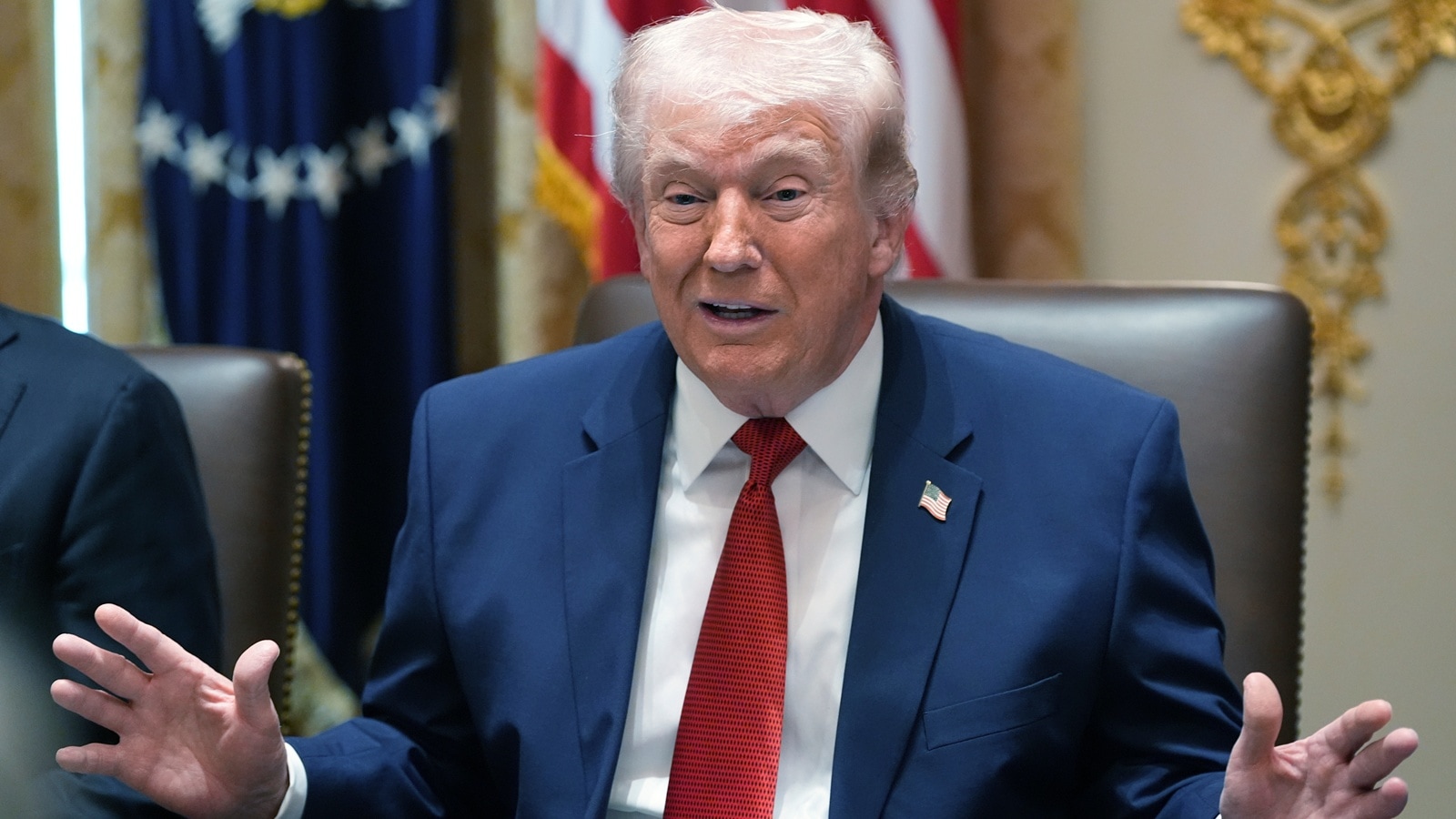
This move, confirmed by the President during a Cabinet meeting on Thursday, marks the first significant crack in the de facto blockade that has choked the world’s most vital energy artery for nearly a month. While the administration frames this as a "gift" and a sign that Tehran is "begging to make a deal," the reality on the water suggests a far more complex game of survival.
The ships, primarily Pakistani-flagged, represent roughly 20 million barrels of crude—a drop in the bucket compared to the 20 percent of global supply that usually flows through the Strait, but a massive psychological signal to a panicked market.
The Mechanics of a Forced Concession
To understand why Tehran would "give" the United States a prize worth hundreds of millions of dollars in transit value, you have to look at the state of the Iranian military. After 26 days of Operation Epic Fury, the Pentagon claims to be "extremely ahead of schedule." President Trump noted that the Iranian navy and air force have been effectively neutralized.
When your conventional ability to hold the Strait of Hormuz is being dismantled by joint U.S.-Israeli strikes, you stop calling it a blockade and start calling it a "negotiating gesture."
Tehran’s decision to let 10 tankers through wasn't just a random act of kindness. It was a calculated test of a 15-point action list recently hand-delivered to the Iranian leadership via Pakistani mediators. By selecting Pakistani-flagged vessels for this "present," Iran is signaling to its neighbors and the U.S. that it can still control the faucet, even if it can no longer hold the hose.
The Hidden Price Tag
While the President celebrates the "free" passage of these ships, reports from the ground suggest a darker economic reality. Iranian state-affiliated outlets have been floatng a plan to charge a $2 million "transit fee" per tanker.
- The Claim: Iran is providing "security" in a war zone.
- The Reality: This is a maritime shakedown.
- The Complication: U.S. sanctions make international banking with Iran nearly impossible.
How these fees are being paid—and in what currency—remains the biggest unanswered question of the week. If these 10 tankers paid a toll to pass, the "present" isn't a gift to Washington; it's a lifeline for a regime whose traditional revenue streams have been turned into craters.
Why the Market Isn't Buying the Peace Just Yet
If 10 tankers moving through the Strait is such good news, why did Brent crude once again break the $100 per barrel mark today?
The math is simple and brutal. Before the conflict, roughly 138 vessels transited the Strait of Hormuz every day. Ten ships over the course of three days is a statistical rounding error. For global energy markets, this "present" is less like a reopening of the gates and more like a peep-hole in a reinforced door.
Major energy players like Shell and Qatar Energy have already invoked force majeure. They aren't going to risk a billion-dollar hull and a crew of twenty because eight or ten ships made it through with a wink and a nod from Tehran. They need the "15-point plan" to turn into a signed treaty.
The Power Vacuum in Tehran
There is a reason the President is dealing with "unidentified officials" and "unspecified negotiators." The leadership structure in Iran is currently a black box. With the death of the previous Supreme Leader early in the strikes and the tactical silence of his successor, Mojtaba Khamenei, the U.S. is essentially negotiating with a fragmented Revolutionary Guard.
The "present" of 10 tankers may actually be a sign of internal desperation. Different factions within the IRGC are likely competing to show they can still deliver results to avoid further bombardment of their domestic power plants. Trump himself alluded to this, stating that the number of tankers increased from eight to ten as an "apology" for a previous remark made by Iranian negotiators.
The Shadow of the Venezuelan Model
Perhaps the most telling moment of Thursday's Cabinet meeting wasn't about the tankers at all. It was Trump’s admission that taking control of Iran’s oil remains a very real "option."
He explicitly compared the current situation to the U.S. strategy in Venezuela, suggesting that if the negotiations don't yield a total surrender on the nuclear front, the U.S. may move from protecting the Strait to physically managing the wells.
This isn't just about 10 boats. It is about who owns the 1.5 million barrels per day Iran was producing before the first bombs fell. The "present" was a gesture intended to keep the U.S. away from the refineries. Whether it bought Tehran enough time to survive the week is a question that will be answered by the movement of the next 100 ships, not the first 10.
Watch the transponder data over the next 48 hours. If the number of AIS-active vessels doesn't double, the "present" was nothing more than a temporary ceasefire in a war that hasn't yet found its ending.