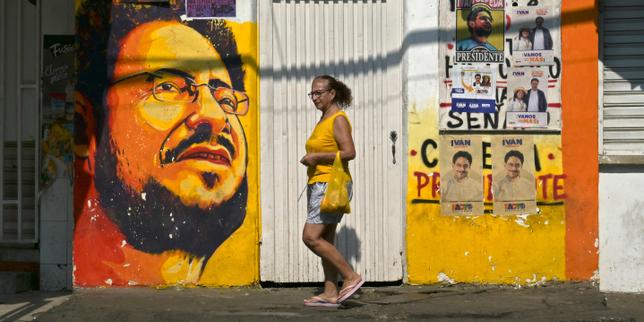
Colombia stands on a knife-edge hours before voters head to the polls for a defining presidential runoff. The race pits Iván Cepeda, a veteran left-wing senator representing the ruling Pacto Histórico, against Abelardo de la Espriella, a brash, right-wing millionaire lawyer who has modeled his campaign on the populist tactics of Donald Trump and Javier Milei. While international observers frame this as a simple ideological contest, the reality on the ground points to a much deeper crisis of institutional trust, rising security failures, and a systematic breakdown of faith in the democratic process itself.
The political atmosphere is thick with anxiety. Outgoing President Gustavo Petro has openly attacked the validity of the preliminary vote-counting systems managed by private contractors, claiming that software glitches and registration anomalies have artificially padded voter rolls. These accusations have turned what should be a routine democratic exercise into a dangerous referendum on the state's very capability to run a clean election. For the average citizen in cities like Bogotá or rural enclaves in Catatumbo, the choice on Sunday is not just between different economic paths, but between two wildly divergent definitions of public safety and national order.
The Mirage of Total Peace
The central failure driving voters into opposite ideological camps is the deterioration of internal security. The current administration staked its legacy on a policy of negotiation with various regional armed groups, an ambitious strategy designed to dismantle decades of cartel and guerrilla violence through dialogue. It has not worked as promised. Instead of stability, rural communities have seen a fragmentation of criminal groups competing fiercely for territory and drug trafficking routes.
Consider the dynamic in the country's border regions. When one dominant insurgent group agrees to a localized ceasefire, rival factions frequently move in to fill the vacuum, escalating targeted killings of community leaders and forcing mass displacements. This security vacuum has allowed the political right to rearm itself ideologically.
Abelardo de la Espriella has capitalized perfectly on this collective exhaustion. Using aggressive rhetoric, he has promised a return to heavy-handed military intervention and an outright end to negotiations with criminal syndicates. His supporters do not view his lack of prior governance experience as a drawback. They see it as a qualification, believing his career as a high-profile corporate defense attorney is exactly the kind of external force needed to break a stagnant bureaucracy.
The Machinery of Institutional Distrust
The friction surrounding this runoff extends far beyond the campaign trail and directly into the logistics of how ballots are tallied. Colombia utilizes a multi-step counting system where initial results are gathered by a private contractor and telephoned into a centralized registry. It is a system vulnerable to public skepticism, particularly after glaring discrepancies during previous legislative cycles required massive post-election audits to recover missing votes.
Parties across the spectrum are deploying hundreds of thousands of official witnesses to manually monitor individual polling tables. The financial disparity between the campaigns dictates how effectively they can cover the national territory. A well-funded political machine can station observers at almost every urban table, while marginalized rural zones, where intimidation by armed groups is highest, are left vulnerable to minimal oversight.
Colombia First Round Voting Shares (May 31, 2026)
-----------------------------------------------
Abelardo de la Espriella (Far-Right):  43.7%
Iván Cepeda (Left-Wing):                40.9%
Abstention Rate:                        42.0%
The high abstention rate from the first round reveals a quiet majority that feels entirely unrepresented by either faction. More than forty percent of eligible voters chose to stay home, signaling that polarization is not just an active clash between two loud movements, but a force that is actively alienating large swaths of the population from the democratic system.
Competing Economic Destinies
The economic anxieties of everyday citizens are driving the intense polarization seen across the country. Iván Cepeda has promised to defend and expand state-driven social programs, pointing to structural inequality as the root cause of the country's generational instability. His platform emphasizes agricultural reform and shifting the national economy away from a heavy reliance on oil and coal extraction toward sustainable domestic production.
Opposing this vision is an aggressive push for sweeping deregulation and privatization. De la Espriella argues that state intervention has stifled economic growth, pointing to his own business success as proof that market-driven policies can generate widespread wealth. This message resonates strongly with urban middle-class business owners who feel buried under tax burdens and inflation.
The ultimate tragedy of this election cycle is that neither candidate offers a realistic plan to bridge the deep divisions within the country. The winner will inherit a nation where half the population views their leadership as fundamentally illegitimate. If the underlying issues of rural insecurity, institutional distrust, and economic despair are not addressed, the cycle of polarization will only deepen, leaving the country's democratic future increasingly fragile.